
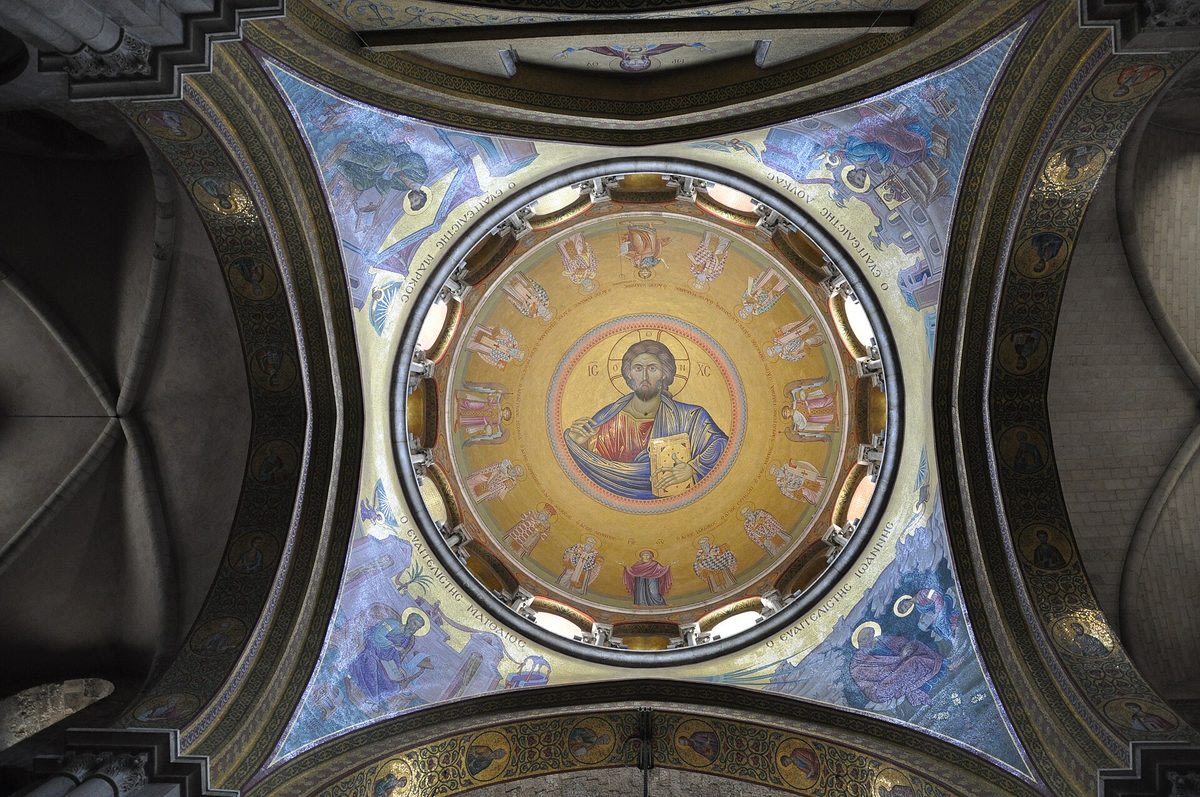
The Aedicule (Tomb of Christ)
The Aedicule — Tomb of Christ, Church of the Holy Sepulchre
Public domain, via Wikimedia Commons
The Aedicule (from Latin: 'little house') is the shrine built over the traditional site of the tomb of Jesus Christ in the Church of the Holy Sepulchre in Jerusalem — the most sacred site in Christianity. The current structure was built after a fire in 1808 and restored most recently in 2016-2017 in a major conservation project by Greek Orthodox, Roman Catholic, and Armenian Apostolic authorities working jointly.
The Aedicule consists of two chambers: the Chapel of the Angel (where the angel appeared to the women on Easter morning) and the inner Tomb Chamber (the actual burial place), which contains a marble slab placed over the original rock of the tomb. The Aedicule stands within the rotunda of the Church of the Holy Sepulchre — the great circular space built by Constantine's architects in the 4th century and rebuilt multiple times since. The church itself is shared by six Christian communities: Greek Orthodox, Roman Catholic, Armenian Apostolic, Coptic Orthodox, Ethiopian Orthodox, and Syriac Orthodox.
The site of the Tomb was identified by Helena, mother of the Emperor Constantine, in her 326 AD pilgrimage to Jerusalem. Constantine built the original Church of the Holy Sepulchre over the site, consecrated in 335 AD.
The church was destroyed by the Caliph al-Hakim in 1009 and rebuilt by the Byzantines; the Crusaders built the medieval church that forms the basis of the current structure. The 2016-2017 restoration was the first scientifically rigorous conservation of the Aedicule, including removal of layers of plaster, reinforcement of the marble slabs, and installation of support structures. Scientific examination during the restoration confirmed the antiquity of the underlying rock surface.
The experience of visiting the Aedicule is unlike any other site in Christianity — the site's authenticity and significance are such that pilgrims from every Christian tradition come to pray here. Queue at the entrance to the Aedicule (queues can be very long — arrive at opening time or late in the evening for shorter waits).
The Chapel of the Angel contains a section of the rolling stone that once sealed the tomb. In the inner chamber, the marble slab is lit by oil lamps; there is room for only two or three people at a time. The sense of proximity to the historical event is overwhelming even for non-believers.
When standing before this work, look carefully: The Aedicule — Tomb of Christ, Church of the Holy Sepulchre. Give it time — what seems decorative often carries the central meaning.
When standing before this work, look carefully: The Tomb Chamber interior — marble slab over the rock. Give it time — what seems decorative often carries the central meaning.
When standing before this work, look carefully: The rotunda — Constantine's circular space. Give it time — what seems decorative often carries the central meaning.
When standing before this work, look carefully: Church of the Holy Sepulchre exterior, Jerusalem. Give it time — what seems decorative often carries the central meaning.
Church of the Holy Sepulchre, Christian Quarter, Old City, Jerusalem. Open daily from early morning (hours vary by season).
No admission fee. The Aedicule is accessible to all visitors; respectful dress required.