
The Alba Madonna
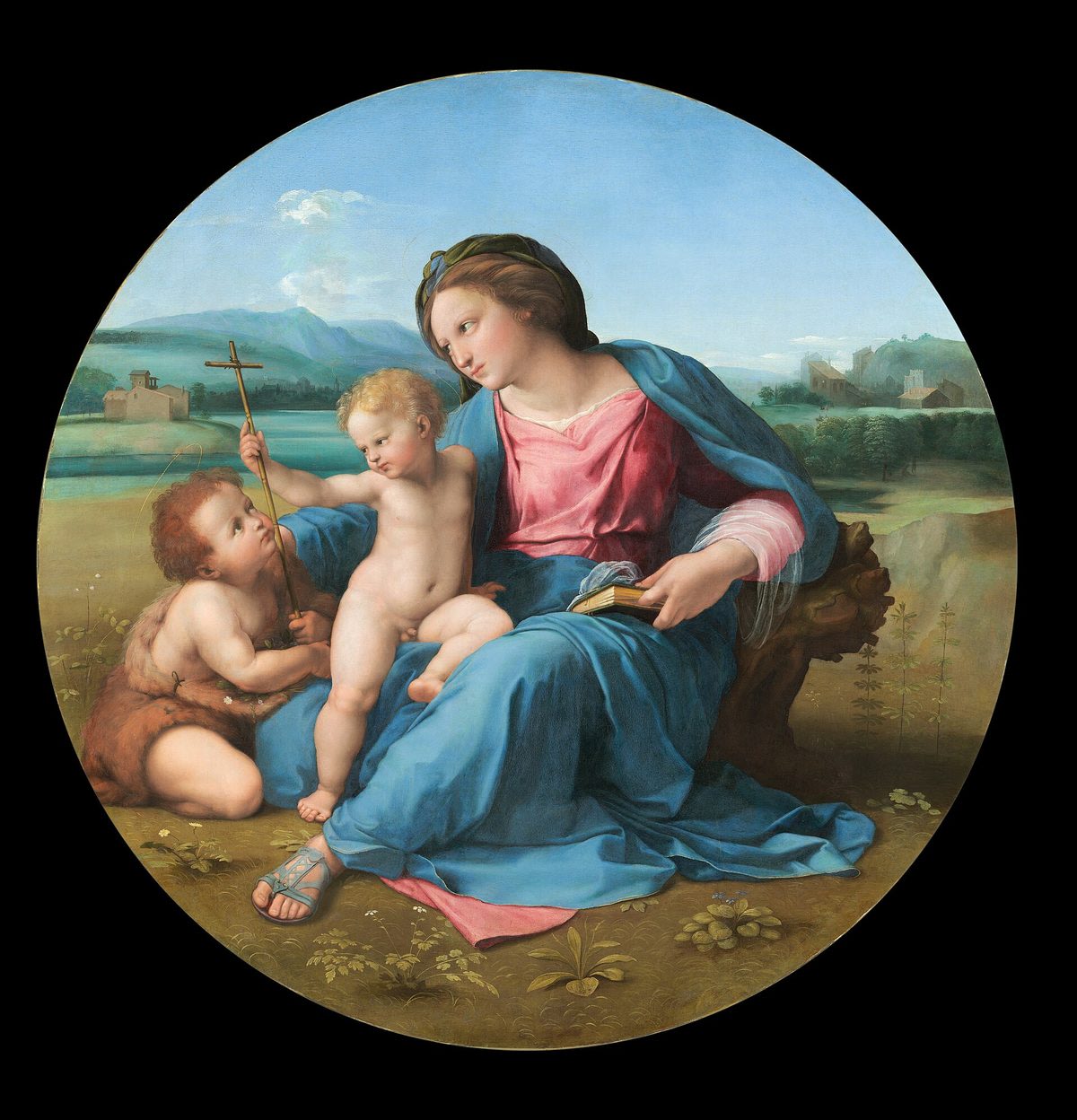
The Alba Madonna — Raphael, c.1510
Raphael, Public domain, via Wikimedia Commons
The Alba Madonna is Raphael's greatest circular composition (tondo, 94.5 cm diameter) — painted in Rome around 1510 and among the most harmoniously composed works of the High Renaissance. The Virgin sits on the ground in a landscape, holding the Christ Child who has reached across to take the cross (a reed cross, the future instrument of his Passion) from the infant St John the Baptist.
The composition is structured in a series of interlocking circles and triangles: the tondo's circular frame, the circular arc of the Virgin's blue mantle, the triangular arrangement of the three figures, and the circular horizon of the Roman campagna in the background. The Virgin's face — calm, slightly melancholy, aware of the Passion the cross portends — is among Raphael's finest portrayals of the Madonna.
The Alba Madonna was probably made for the church of Monte Oliveto in Nocera de' Pagani and later passed through the collections of the Spanish Royal Family and the Hermitage in St Petersburg (sold by the Soviet government in 1931) before entering the National Gallery of Art. The transfer from panel to canvas (done in the 19th century) has slightly altered the paint surface, but the quality of the drawing and compositional structure are fully preserved. The composition shows Raphael at his most geometrically sophisticated: the placement of the three figures in the tondo, the use of the curving mantle to echo the circular frame, and the balance of the figures against the landscape demonstrate his mastery of monumental composition at small scale.
The tondo format requires the composition to resolve within a circle — a much more demanding frame than the rectangle. Raphael's solution is to build the composition on a series of arcs: the Virgin's mantle curves from lower right to upper left, the group of figures creates a left-leaning triangle, and the horizon of the landscape passes through the composition at the equator.
Notice how every element — the Virgin's gaze, the Child's gesture, St John's forward lean — creates movement within the circle. The Christ Child's acceptance of the cross, combined with the Virgin's knowing expression, makes this one of the most poignant anticipations of the Passion in Renaissance art.
When standing before this work, look carefully: The Alba Madonna — Raphael, c.1510. Give it time — what seems decorative often carries the central meaning.
When standing before this work, look carefully: The tondo composition — circles within circles. Give it time — what seems decorative often carries the central meaning.
When standing before this work, look carefully: The Virgin's face — calm awareness of the Passion. Give it time — what seems decorative often carries the central meaning.
When standing before this work, look carefully: Christ Child receiving the cross from St John. Give it time — what seems decorative often carries the central meaning.
National Gallery of Art, West Building, National Mall, Washington DC. The NGA is free admission. The Alba Madonna is in the Italian Renaissance galleries.