
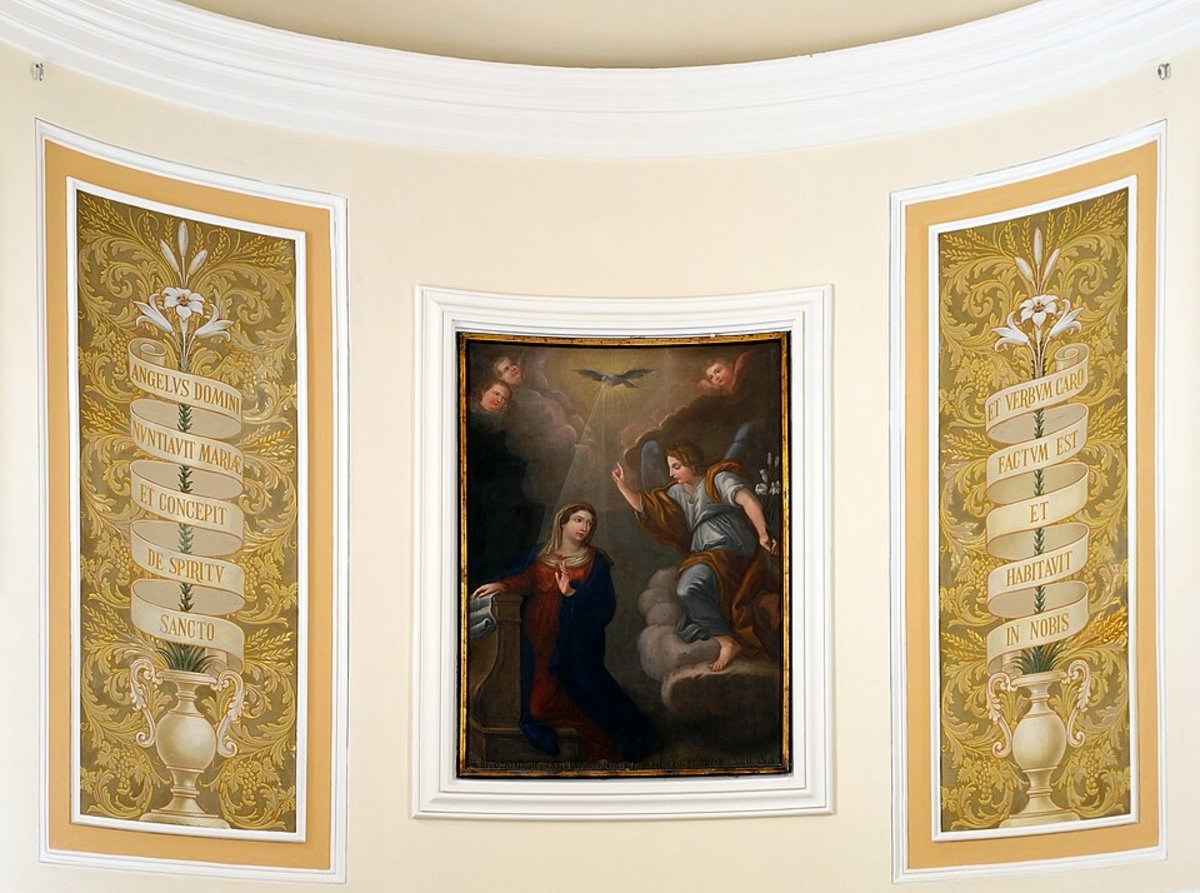
The Annunciation (Santissima Annunziata)
Santissima Annunziata interior — miraculous tabernacle
Public domain, via Wikimedia Commons
The Santissima Annunziata in Florence houses one of the most venerated miraculous images in Italy — an Annunciation fresco traditionally said to have been completed by an angel after the artist fell asleep (or despaired) while attempting to paint the face of the Virgin. The original image dates from c.1252; it has been housed in an elaborate tabernacle (designed by Michelozzo, 1448-1452) in the church's left aisle, surrounded by hundreds of ex-votos.
The church and its miraculous image are the centre of one of Florence's most important religious traditions: a visit to the 'Nunziata' for the blessing of students before exams, and a procession on the feast of the Annunciation (March 25, Florentine New Year). The image is also a crucial site for pregnant women seeking the Virgin's protection.
The Santissima Annunziata was the principal Florentine Servite church — the Servants of Mary (Servi di Maria), a mendicant order founded in Florence in 1233. The church was rebuilt in the 15th century by the Medici, and the tabernacle enclosing the miraculous Annunciation image was commissioned by Piero de' Medici. The ex-votos that once covered the walls and ceiling were, until the 18th century, an extraordinary collection of wax figures, portraits, and votive objects — the whole church as a visual record of miraculous intercessions.
The miraculous Annunciation image is partially visible through the elaborate gilded tabernacle. The tradition of visiting the Nunziata before important events (exams, journeys, marriages) is still active in Florence. The church's atrium (the Chiostrino dei Voti) contains early 16th-century frescoes by Andrea del Sarto, Pontormo, and Rosso Fiorentino — among the finest paintings of the Florentine Renaissance.
When standing before this work, look carefully: Santissima Annunziata interior — miraculous tabernacle. Give it time — what seems decorative often carries the central meaning.
When standing before this work, look carefully: Michelozzo's tabernacle — housing the miraculous image. Give it time — what seems decorative often carries the central meaning.
When standing before this work, look carefully: The miraculous Annunciation image — c.1252. Give it time — what seems decorative often carries the central meaning.
When standing before this work, look carefully: Chiostrino dei Voti — Andrea del Sarto frescoes. Give it time — what seems decorative often carries the central meaning.
Basilica della Santissima Annunziata, Piazza della Santissima Annunziata, Florence. Open daily 7:30-12:30, 16:00-18:30. Free admission.