
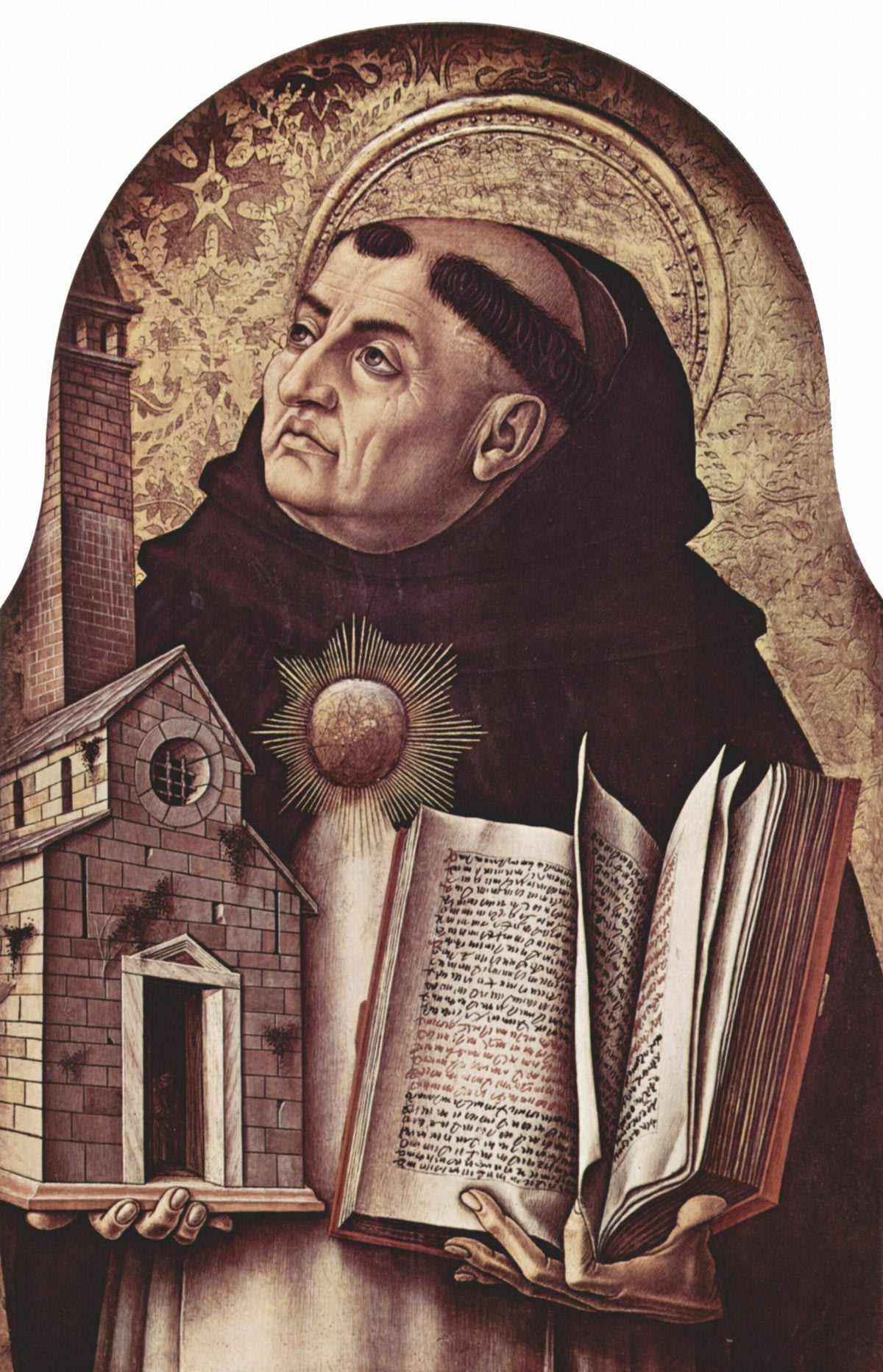
The Annunciation with St Emidius
Annunciation with St Emidius — Crivelli, 1486
Carlo Crivelli, Public domain, via Wikimedia Commons
Carlo Crivelli's Annunciation with St Emidius is one of the strangest and most elaborate paintings of the Italian Renaissance — a monumental altarpiece (approximately 2.07 by 1.46 metres) that combines the theological subject of the Annunciation with the civic occasion of a political grant of autonomy to the town of Ascoli Piceno, depicted in a meticulously rendered Italian street scene. The archangel Gabriel arrives from the left with St Emidius (patron saint of Ascoli) carrying a model of the city; from the upper left, the dove of the Holy Spirit descends on a golden beam through the architecture to reach the Virgin in her room at the upper right; the urban street below is filled with figures going about their business, including a peacock (symbol of immortality and paradise), a young man who stares at the viewer from a ledge, and a gherkin (a vegetable Crivelli favoured as a decorative motif). The painting was made to celebrate the grant of partial self-governance (Libertas Ecclesiastica) given to Ascoli Piceno by Pope Sixtus IV on 25 March 1482 — the feast of the Annunciation.
Carlo Crivelli (c.1430/35-c.1495) was a Venetian painter who worked principally in the Marche region of central Italy — he was expelled from Venice in 1457 (for adultery with a sailor's wife) and never returned. His style is one of the most singular in Italian painting: intensely decorative, late Gothic in its love of surface detail and gold, deeply influenced by Paduan Squarcionesque sculpture in its sense of three-dimensional sculptural relief, and personal to an extreme in its use of specific objects (gherkins, cucumbers, apples, flies) as decorative and symbolic elements. The Annunciation is his most elaborate work and the fullest demonstration of his eccentric genius.
The painting demands extremely slow, detailed viewing. Start at the lower left: the street is a three-dimensional architectural setting with arched passages, a rug hanging from a window, a peacock on a ledge, and figures including St Emidius with the city model and the archangel in elaborate robes. Then trace the golden beam from upper left to the Virgin's room: it passes through holes in the architecture (the city's buildings are pierced to let the divine messenger through) and reaches the kneeling Virgin with a precise diagonal.
The Virgin's room is depicted through the wall as a cut-away section — her books, her furnishings, her absorbed posture all visible. Look also at the elaborate decorative elements: Crivelli's gherkins, his apple, his flies are all present. The young man on the right who looks directly at the viewer has been identified as a self-portrait.
When standing before this work, look carefully: Annunciation with St Emidius — Crivelli, 1486. Give it time — what seems decorative often carries the central meaning.
When standing before this work, look carefully: The golden beam of the Holy Spirit through the city. Give it time — what seems decorative often carries the central meaning.
When standing before this work, look carefully: The Virgin's room — seen through the wall. Give it time — what seems decorative often carries the central meaning.
When standing before this work, look carefully: The street scene below — civic life and sacred event. Give it time — what seems decorative often carries the central meaning.
National Gallery, Room 55, London.