
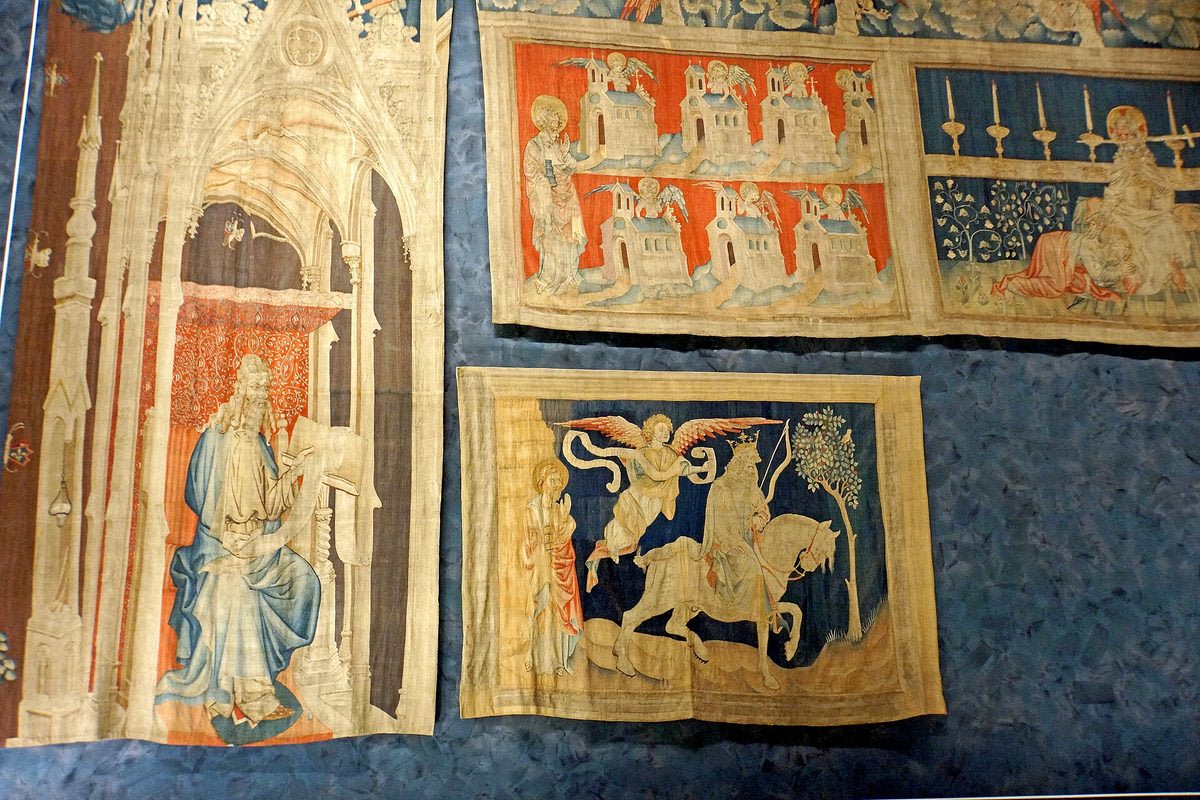
The Apocalypse Tapestry
The Apocalypse Tapestry — Angers, c.1377-1382
Public domain, via Wikimedia Commons
The Apocalypse Tapestry at Angers is the largest surviving medieval tapestry in the world — originally approximately 144 metres long and 5 metres high, now approximately 103 metres (surviving from the original), and divided into 76 individual scenes from the Book of Revelation. Commissioned by Louis I, Duke of Anjou, from the Parisian workshop of Nicolas Bataille around 1377-1382 (based on cartoons attributed to Hennequin de Bruges, painter to the French court), it was designed to hang in the nave of Angers Cathedral during special occasions.
The scenes depict the full sequence of the Apocalypse as narrated in Revelation: the opening of the seven seals, the seven trumpets, the woman clothed with the sun, the beasts, the Whore of Babylon, the Last Judgment, and the New Jerusalem. The colour scheme (red and blue alternating as backgrounds) and the formal vocabulary of the figures combine the International Gothic style of the Paris court with the monumental ambitions of the subject.
The tapestry was made in approximately five years — an extraordinary pace for a work of this scale. The cartoon designer Hennequin de Bruges had access to an illuminated manuscript of the Apocalypse belonging to King Charles V (now identified as probably the Angers Apocalypse manuscript in the Bibliothèque nationale de France), which served as the compositional source for the scenes.
The tapestry was donated to Angers Cathedral by René of Anjou in 1480; it suffered centuries of neglect (used as horse blankets during the Revolution, cut into pieces, sold) before being reassembled in the 19th century. The surviving 103 metres represent approximately 70% of the original length.
The tapestry is displayed in a purpose-built gallery within the Château d'Angers. The gallery is dimmed and temperature-controlled for conservation. Walking the length of the tapestry (103 metres) takes approximately 30 minutes of sustained attention.
The individual scenes are large (approximately 2 by 2 metres each) and legible from the viewing distance. Look for the Woman Clothed with the Sun (Revelation 12:1) — one of the most elaborate compositions in the tapestry, with the red dragon below and the twelve-star crown above. The New Jerusalem panel at the end, with its gold-and-jewel city descending from heaven, is the programme's conclusion and its most visually elaborate single scene.
When standing before this work, look carefully: The Apocalypse Tapestry — Angers, c.1377-1382. Give it time — what seems decorative often carries the central meaning.
When standing before this work, look carefully: The Woman Clothed with the Sun — Revelation 12. Give it time — what seems decorative often carries the central meaning.
When standing before this work, look carefully: The New Jerusalem — the final scene. Give it time — what seems decorative often carries the central meaning.
When standing before this work, look carefully: The gallery at Château d'Angers. Give it time — what seems decorative often carries the central meaning.
Château d'Angers, 2 Promenade du Bout du Monde, Angers. Open daily.
The Apocalypse Tapestry gallery requires a separate ticket to the Château. Angers is approximately 2 hours from Paris by TGV.