
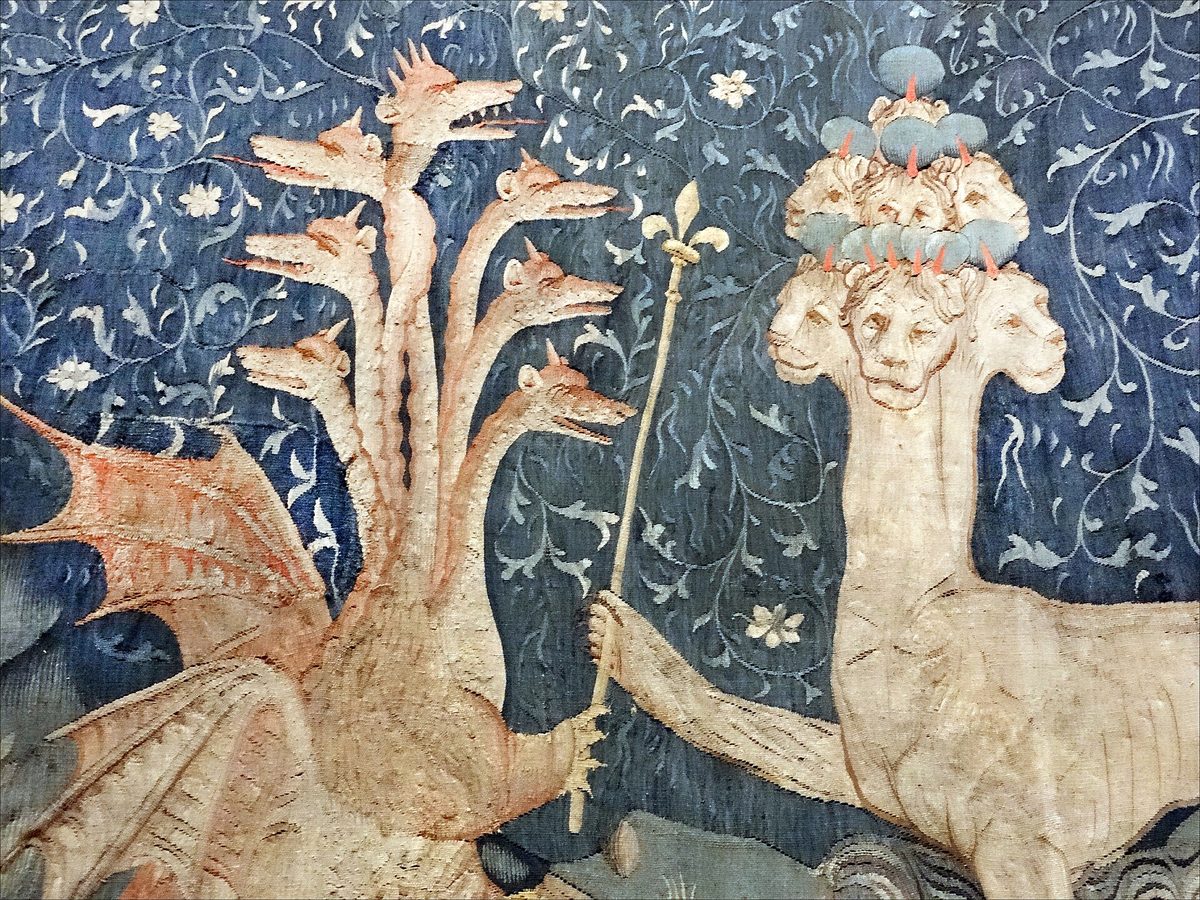
The Apocalypse Tapestry (Tenture de l'Apocalypse)
Apocalypse Tapestry — Angers, c.1377-1382
Public domain, via Wikimedia Commons
The Apocalypse Tapestry of Angers is the largest surviving medieval tapestry in the world and the most complete visual programme from the Book of Revelation ever made — originally 144 metres long (approximately 90 metres survive), woven in six panels of seven scenes each, commissioned by Louis I, Duke of Anjou, and woven by Nicolas Bataille's Paris workshop between approximately 1377 and 1382. Each scene depicts an episode from the Book of Revelation in a scale and visual programme without precedent: the figures (angels, the Whore of Babylon, the four riders of the Apocalypse, the woman clothed with the sun, the seven-headed Beast, the New Jerusalem) are approximately 2-3 metres tall, woven in two tones alternating between red and blue grounds.
The visual quality of the individual scenes — the specificity of the animals and figures, the horror and wonder of the apocalyptic narrative — is extraordinary. The cartoons for the tapestry were probably drawn by Hennequin of Bruges (Jan de Bondol), the Flemish painter who served as court painter to Charles V of France.
The tapestry was made for Louis I of Anjou and was given to Angers Cathedral in 1400 by his son Louis II. It was damaged during the Revolution (used as a blanket, as insulation in greenhouses, and for other utilitarian purposes) and partially recovered in the 19th century.
The surviving portion (approximately 103 metres in six sections) is displayed in a purpose-built gallery in the Château d'Angers. The tapestry is the primary visual document for understanding the Apocalyptic imagination of late medieval France and the most important tapestry cycle in existence.
The gallery at Angers is arranged to allow walking the length of the tapestry — a 10-15 minute walk past 76 surviving scenes. Begin with the figure of St John receiving the Revelation (the first scene) and follow the narrative through the seven seals, seven trumpets, the Beast, the Whore, and the New Jerusalem. The scale of the individual figures — 2-3 metres tall, filling the width of each panel — creates a physically overwhelming visual experience.
When standing before this work, look carefully: Apocalypse Tapestry — Angers, c.1377-1382. Give it time — what seems decorative often carries the central meaning.
When standing before this work, look carefully: The seven-headed Beast — Revelation narrative. Give it time — what seems decorative often carries the central meaning.
When standing before this work, look carefully: The New Jerusalem — final panels. Give it time — what seems decorative often carries the central meaning.
When standing before this work, look carefully: The tapestry gallery in the Château d'Angers. Give it time — what seems decorative often carries the central meaning.
Château d'Angers, 2 Promenade du Bout du Monde, Angers, France. Open daily (hours vary by season); admission fee (includes both the castle and the tapestry gallery). Angers is approximately 2.5 hours from Paris by TGV.