
The Baptism of Christ
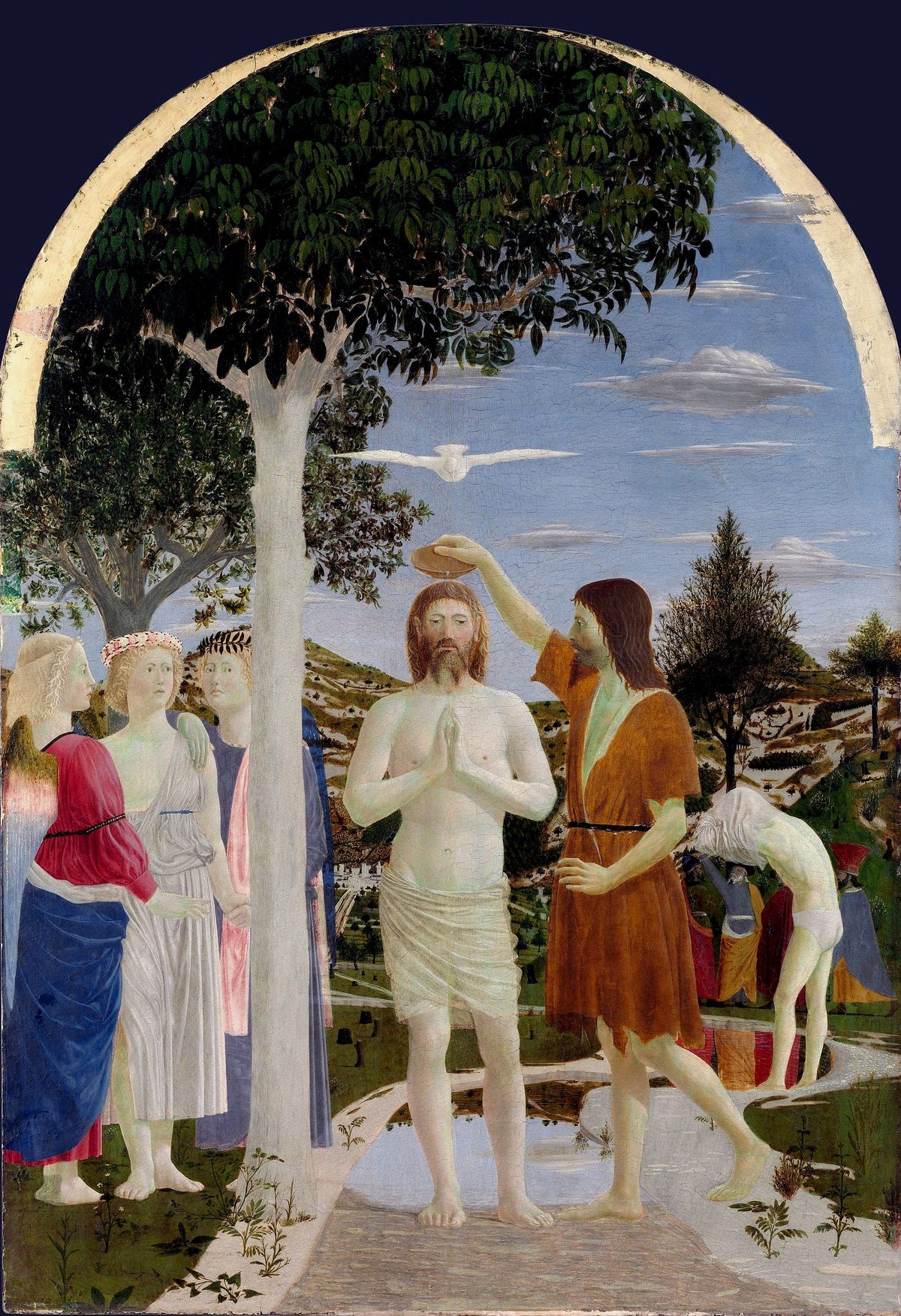
Baptism of Christ — Piero della Francesca, c.1437-1445
Piero della Francesca, Public domain, via Wikimedia Commons
Piero della Francesca's Baptism of Christ is among the most serene and geometrically perfect paintings of the Italian Renaissance — the central panel of a polyptych altarpiece made for the Priory of St John the Baptist in Borgo Sansepolcro (Piero's hometown). The composition is organised around a series of precise geometric relationships: Christ stands at the exact vertical and horizontal centre of the panel; the dove of the Holy Spirit is directly above him at the golden mean of the height; the tree at the left and the river bend at the right frame the figure symmetrically.
John the Baptist pouring water over Christ's head is slightly off the central axis; three angels (their hands clasped, looking at the Baptism) stand at the left. Behind the central figures, in the middle distance, another man removes his robe — possibly a catechumen preparing for his own baptism, or Jesus himself before the event.
The Baptism was probably Piero's first independent work — painted before his trip to Florence and his encounter with the work of Masaccio, Donatello, and the Florentines. The geometric programme is characteristically Piero: the circle (John's basin), the rectangle (the panel), and the vertical (Christ's axis) are in precise mathematical relationship.
The pale Umbrian landscape behind the figures — the Val di Noce near Sansepolcro, which Piero knew intimately — dissolves into a haze of hills and sky. The pale, still quality of the light — cool, even, without shadows — is Piero's signature atmospheric effect: neither morning nor afternoon but the absolute light of divine revelation.
Stand in front of the painting and notice the geometric structure: a white dove directly above Christ's head is at the vanishing point of the implied perspective; the tree at the left and John at the right balance the composition around Christ's axis. The angel on the far left holds a garment (possibly the garment of Christ, to be returned after the Baptism) in a pose that mirrors the tree; the centre angel's face is one of the most beautiful in early Renaissance painting — serene, absorbed, specific. The water being poured from the basin over Christ's hair catches the light in a passage of optical observation unprecedented in Italian painting.
When standing before this work, look carefully: Baptism of Christ — Piero della Francesca, c.1437-1445. Give it time — what seems decorative often carries the central meaning.
When standing before this work, look carefully: The dove above Christ — precise geometric placement. Give it time — what seems decorative often carries the central meaning.
When standing before this work, look carefully: The three angels — serenity and specific observation. Give it time — what seems decorative often carries the central meaning.
When standing before this work, look carefully: The Val di Noce landscape — Piero's pale Umbrian light. Give it time — what seems decorative often carries the central meaning.
National Gallery, Room 61, London. The National Gallery's collection of Italian Early Renaissance paintings includes Piero's Baptism alongside several of his other works. Free admission.