
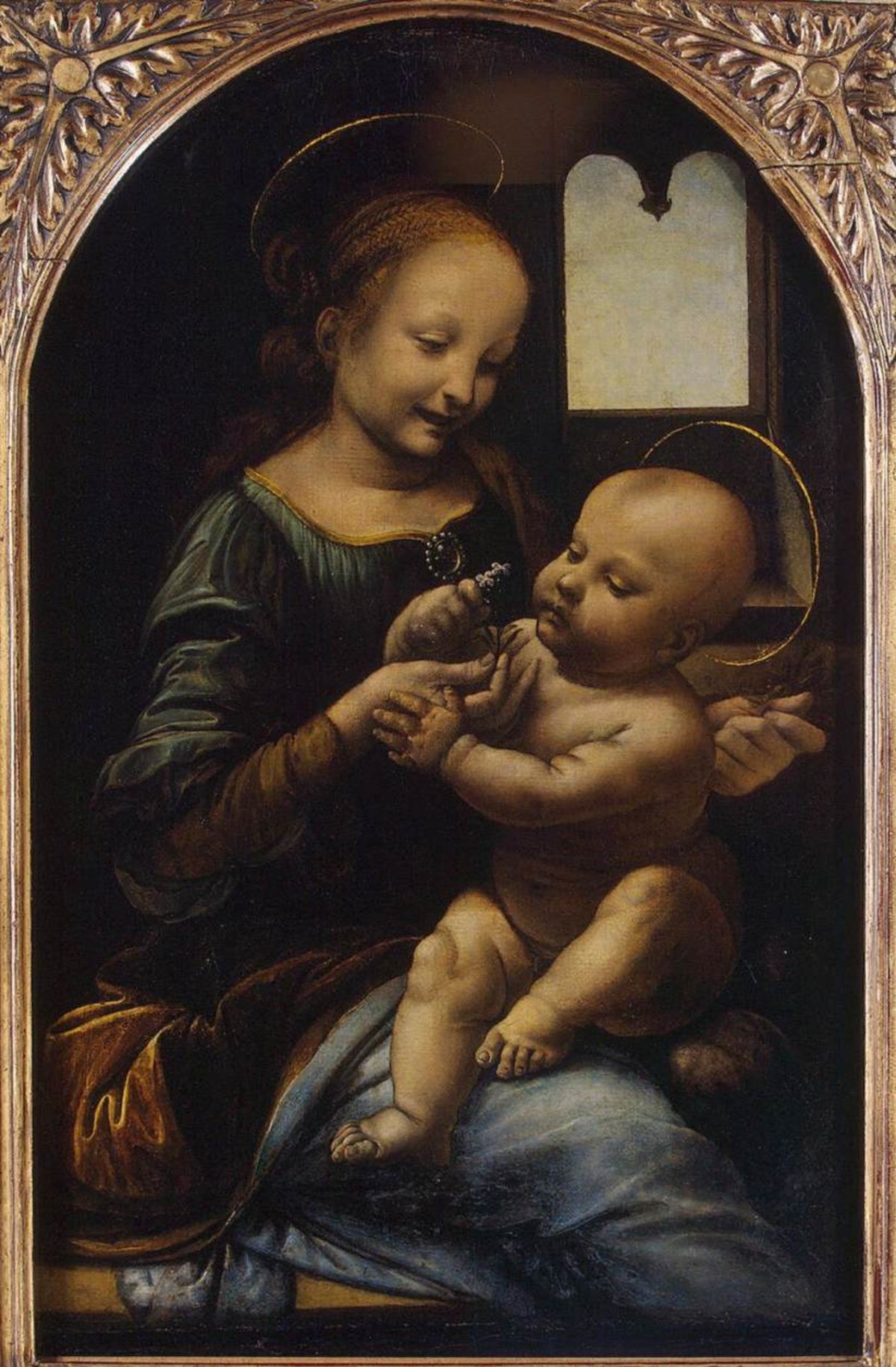
The Benois Madonna
Benois Madonna — Leonardo da Vinci, c.1478-1482
Leonardo da Vinci, Public domain, via Wikimedia Commons
The Benois Madonna is one of Leonardo's earliest surviving paintings — a small panel (approximately 49.5 by 33 cm) depicting the Virgin and Child in a domestic interior with a window, painted in approximately 1478-1482. The Virgin, shown as a young Florentine woman (specifically young, not the idealized mature Virgin of convention), holds the Christ Child who reaches across her to grasp a flower with four petals — a cruciform flower (symbolising the Cross).
Both figures look down at the flower with absorbed attention. The composition is completely naturalistic — no gold ground, no hierarchic scale, no formal setting — but the domestic intimacy of the subject and the quality of the light (from the window on the right) are fully in the Leonardo tradition of observation and psychological subtlety. The painting was purchased by Czar Nicholas II in 1914 from the Benois family and entered the Hermitage collection.
The Benois Madonna is generally accepted as one of Leonardo's earliest surviving works — the earliest securely attributed painting by the artist, preceding the Annunciation (Uffizi, entry 26) and the Ginevra de' Benci (Washington). The specific quality of the light (the window light creating soft shadows on the Virgin's face and the Child's body), the naturalistic setting, and the psychological focus on the interaction between mother and child all presage the fully developed Leonardo style of the Milanese period. The painting was in Russian private collections for over a century before its purchase by Nicholas II.
The four-petaled flower the Child reaches for is a cruciform flower — its shape anticipates the cross of the Passion. The Leonardo tradition of placing Passion symbols in the hands of the Christ Child (as in the Carnegie Annunciation and the London Virgin of the Rocks) is already present in this very early work. The Virgin's face is specifically youthful — she is depicted as a girl, not a woman, responding to her child with wonder rather than devotional gravity.
When standing before this work, look carefully: Benois Madonna — Leonardo da Vinci, c.1478-1482. Give it time — what seems decorative often carries the central meaning.
When standing before this work, look carefully: The young Virgin — naturalistic observation. Give it time — what seems decorative often carries the central meaning.
When standing before this work, look carefully: The Christ Child reaching for the cruciform flower. Give it time — what seems decorative often carries the central meaning.
When standing before this work, look carefully: Window light — soft shadows on the figures. Give it time — what seems decorative often carries the central meaning.
State Hermitage Museum, Palace Square 2, St Petersburg. Open Tuesday-Sunday; admission fee. One of the largest and most visited art museums in the world.