
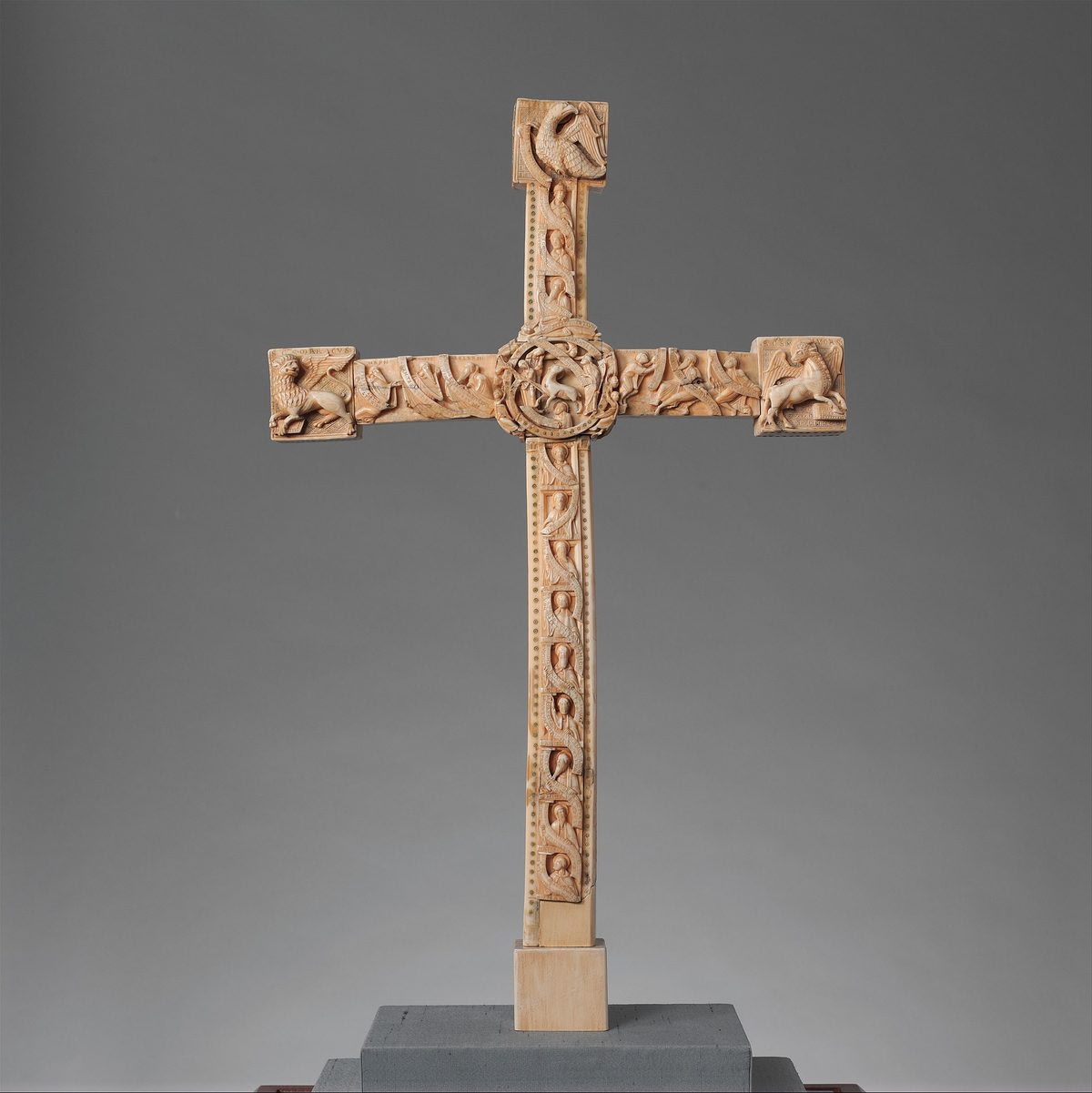
The Cloisters Cross (Bury St Edmunds Cross)
The Cloisters Cross — front face, c.1150-1190
Public domain, via Wikimedia Commons
The Cloisters Cross is the most complex and ambitious work of Romanesque carved ivory in existence — a processional cross carved from a single piece of walrus ivory (approximately 57.5 cm high), densely covered on both its front and back faces with over 100 tiny figures and inscriptions. The carvings include scenes from the Old Testament typologically prefiguring the Crucifixion, a serpent on the foot (the Brazen Serpent of Numbers, a type of Christ's Crucifixion), and on the back a Triumph of the Cross composition with Christ as both victim and victor.
The inscriptions include commentary in Latin and a reference to Moses, Isaias, and John (linking Old Testament prophecy to the Crucifixion). The cross was probably made for the Abbey of Bury St Edmunds in Suffolk — one of the greatest English Benedictine abbeys, dissolved in 1539 — and entered the Cloisters collection in 1963 from the collection of the Yugoslav dealer Topic Mimara.
The attribution to Bury St Edmunds is based on stylistic comparison with other works connected to the abbey's scriptorium and on the presence of the figure of Moses with the inscription 'MOYSES' in a form characteristic of Bury manuscripts. The cross was probably made by a master carver working within the abbey's artistic programme around 1150-1190 — the period of the abbey's greatest cultural output. The complexity of the iconographic programme (over 100 figures, arranged in a typological system cross-referencing Old and New Testament scenes) suggests an elaborate theological programme devised by a learned monk.
The cross is displayed in a specially lit case that allows viewing of both the front and back faces. Use the Cloisters' magnifying glass (provided at the desk) to read the tiny inscriptions and identify individual figures.
The front face is centred on the Crucifixion: note the small figure of Synagoga (blindfolded, the personification of the Old Covenant) at the foot of the cross, and Ecclesia (the Church) at the right. The back face shows Christ in Majesty surrounded by symbols of the Evangelists. The technical quality of the carving is extraordinary: individual facial expressions are visible on figures smaller than a centimetre.
When standing before this work, look carefully: The Cloisters Cross — front face, c.1150-1190. Give it time — what seems decorative often carries the central meaning.
When standing before this work, look carefully: The Cloisters Cross — back face with Christ in Majesty. Give it time — what seems decorative often carries the central meaning.
When standing before this work, look carefully: Detail of tiny carved figures — over 100 on the cross. Give it time — what seems decorative often carries the central meaning.
When standing before this work, look carefully: The Brazen Serpent at the foot of the cross. Give it time — what seems decorative often carries the central meaning.
The Met Cloisters, Fort Tryon Park, New York. The Cloisters Cross is in the Treasury room alongside other medieval ivories, reliquaries, and metalwork.