
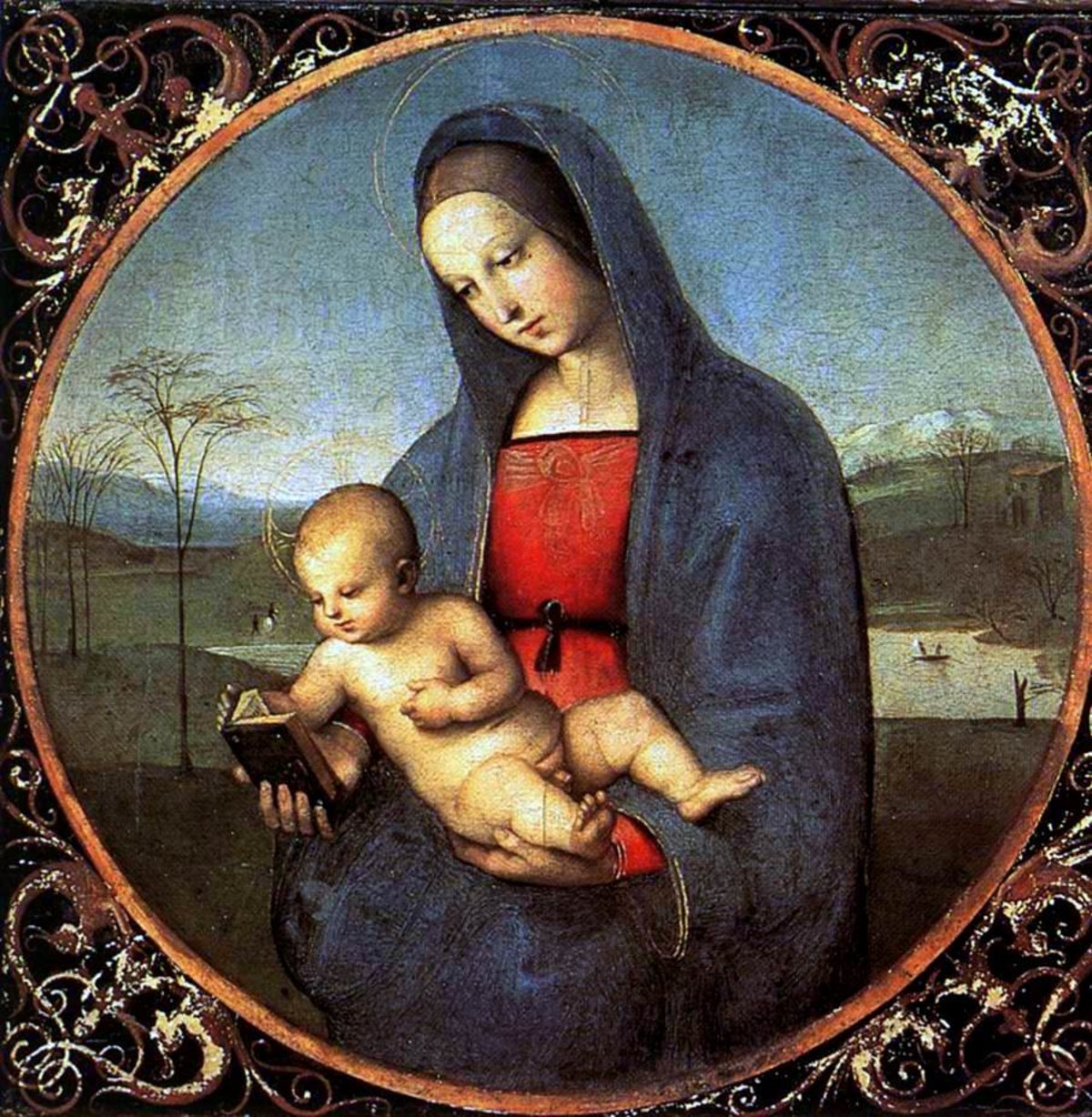
The Conestabile Madonna
Conestabile Madonna — Raphael, c.1502-1504
Raphael, Public domain, via Wikimedia Commons
The Conestabile Madonna is one of Raphael's earliest surviving panel paintings — a tiny tondo (approximately 17.9 by 17.9 cm including its original gilt frame) depicting the Virgin holding the Christ Child while reading from a book, set in a winter Umbrian landscape with bare trees and a pale lake. The work was painted when Raphael was approximately 18-20 years old, still in Perugia under the influence of Perugino, and demonstrates his early mastery of small-format composition and the Umbrian landscape tradition.
The painting is set in an identical format to Perugino's own small tondi but already shows Raphael's characteristic refinement of surface and psychological intimacy. It was purchased by Czar Alexander II from the Conestabile della Staffa family in Perugia in 1871 and transferred from panel to canvas at the Hermitage in the 1880s.
For Raphael's biographical context, see entry 140 (Alba Madonna). The Conestabile Madonna is the earliest securely attributed panel by Raphael — it precedes his Florentine period (1504-1508) and shows him working entirely within the Umbrian tradition of Perugino. Compare the Conestabile's Umbrian winter landscape with the Florentine spring landscapes of the Small Cowper Madonna (entry 167) — the two works are separated by approximately five years and represent entirely different artistic environments.
The winter landscape is highly unusual for an early Raphael Madonna — the bare trees and snow-dusted hills create a specific atmospheric effect of cold clarity. The Virgin's reading of the book and the Christ Child's interaction with the text suggest the devotional context of lectio divina (meditative reading of scripture). The tiny scale of the work (barely larger than an adult hand) makes it an object for intimate private devotion.
When standing before this work, look carefully: Conestabile Madonna — Raphael, c.1502-1504. Give it time — what seems decorative often carries the central meaning.
When standing before this work, look carefully: The winter Umbrian landscape — bare trees and pale lake. Give it time — what seems decorative often carries the central meaning.
When standing before this work, look carefully: The original gilt frame — tiny tondo format. Give it time — what seems decorative often carries the central meaning.
When standing before this work, look carefully: The Virgin reading with the Christ Child. Give it time — what seems decorative often carries the central meaning.
State Hermitage Museum, St Petersburg. See entry 222 for visiting details.