
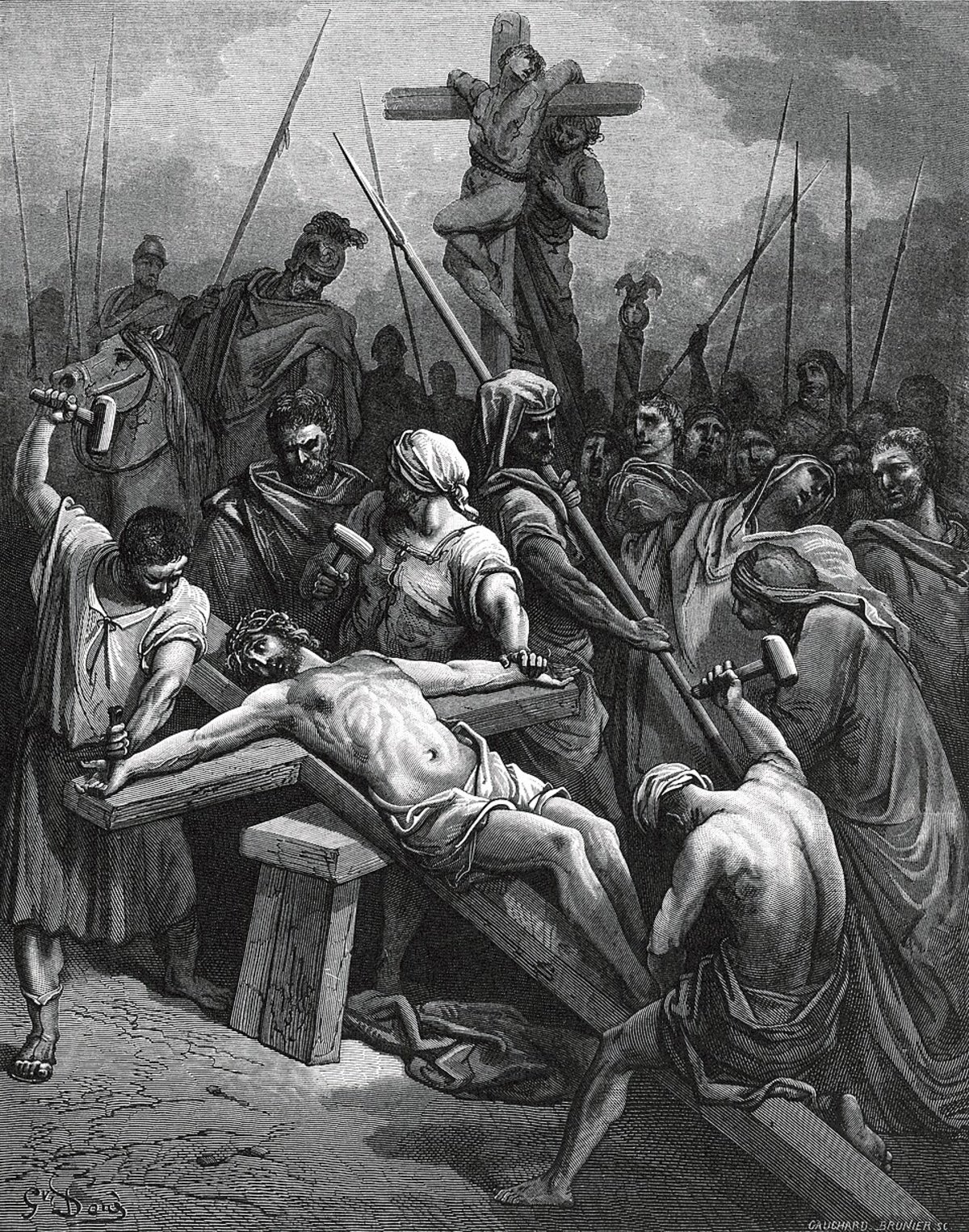
Jacopo Tintoretto, Public domain, via Wikimedia Commons
Tintoretto's Crucifixion in the Sala dell'Albergo of the Scuola Grande di San Rocco is the largest and most complex single painting of the Italian Renaissance — a canvas approximately 5.38 by 12.24 metres covering the entire east wall of the room, painted in 1565. The composition shows the Crucifixion not as a static hieratic image but as a seething crowd scene: hundreds of figures in a continuous panoramic space, the three crosses at the centre surrounded by soldiers, onlookers, mourners, workers raising the crosses of the two thieves, horsemen, and in the foreground a group of disciples and holy women lamenting. John Ruskin — who spent weeks drawing every detail of the Scuola cycle — wrote that it was 'beyond all analysis and above all praise.' Henry James called it 'the greatest picture in the world.' The work's power derives from the simultaneous experience of intimate human detail (the Magdalene at the foot of the cross, the disciples in grief) and cosmic scale (the crosses rising into a dark sky, the crowd extending to the horizon).
Jacopo Tintoretto (Jacopo Robusti, 1518-1594) was the last of the great Venetian painters of the 16th century — working in the tradition of Titian but with a dynamism, a theatrical use of light, and a compositional boldness that goes beyond his predecessor. His programme for the Scuola Grande di San Rocco (three rooms of the Albergo, the upper hall, and the ground floor hall) is the most ambitious decorative programme completed by a single artist in Venice — it occupied approximately thirty years of his career (1564-1588). The cycle's scale and ambition can only be compared to the Sistine Chapel in Rome.
The Scuola di San Rocco experience is overwhelming: enter the Sala dell'Albergo (the first room you enter from the staircase) and turn right to face the Crucifixion. The scale of the canvas fills your entire field of vision; the complexity of the composition reveals new details with every minute of looking.
A mirror on wheels (provided by the Scuola) allows you to look upward at the ceiling paintings without neck strain. Bring binoculars for the Crucifixion's upper zones and distant figures.
When standing before this work, look carefully: The Crucifixion — Tintoretto, 1565. Give it time — what seems decorative often carries the central meaning.
When standing before this work, look carefully: The full 12.24-metre canvas — east wall of the Albergo. Give it time — what seems decorative often carries the central meaning.
When standing before this work, look carefully: Mary Magdalene at the cross — intimate detail. Give it time — what seems decorative often carries the central meaning.
When standing before this work, look carefully: Workers raising the thieves' crosses — crowd complexity. Give it time — what seems decorative often carries the central meaning.
Scuola Grande di San Rocco, Campo San Rocco 3052, San Polo, Venice. Open daily; admission fee. The Scuola is approximately 5 minutes' walk from the Frari Church (entry 55).