
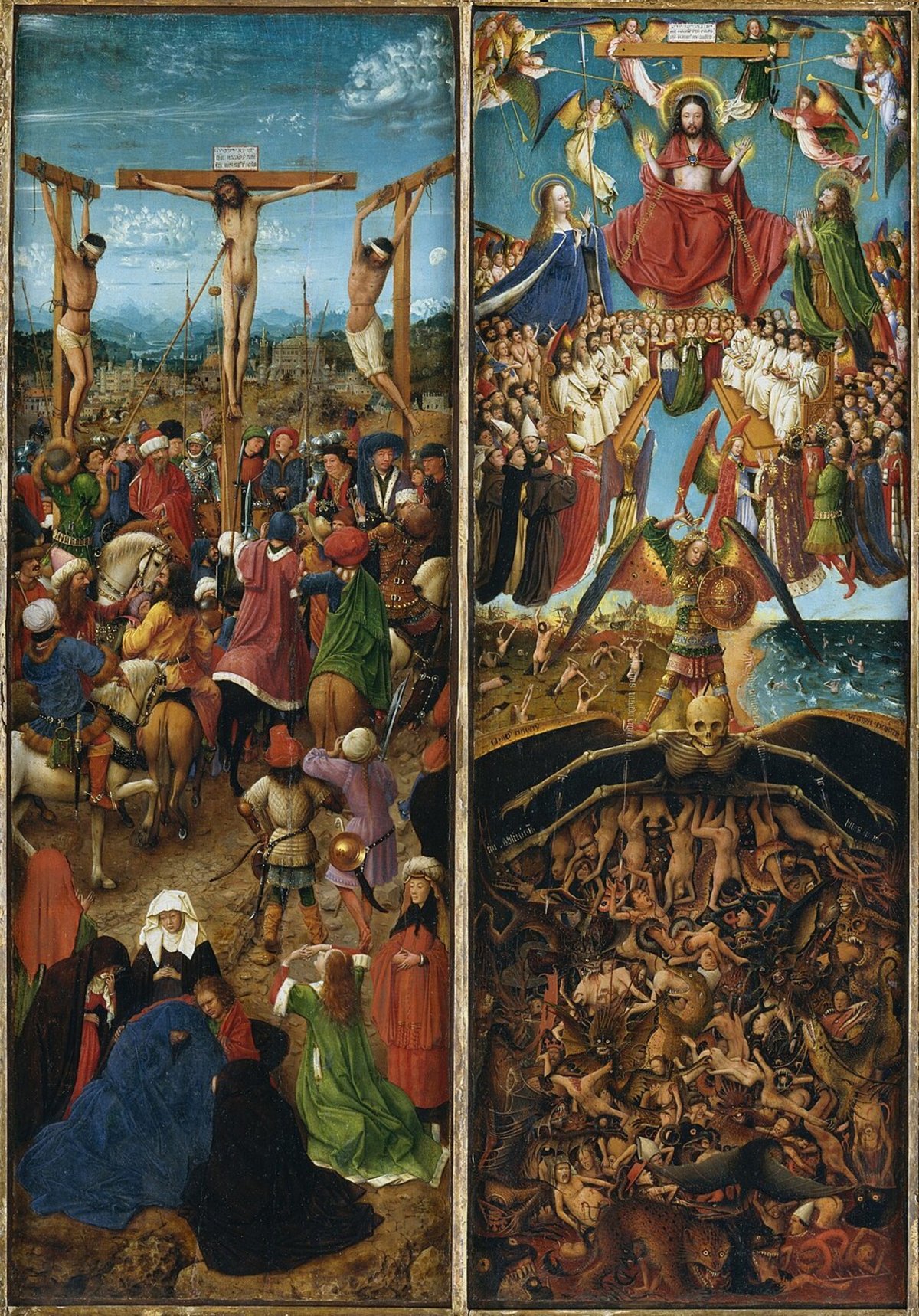
The Crucifixion and Last Judgment Diptych
Crucifixion and Last Judgment Diptych — van Eyck, c.1425-1430
Jan van Eyck, Public domain, via Wikimedia Commons
Jan van Eyck's Crucifixion and Last Judgment Diptych at the Metropolitan Museum of Art is one of the most astonishing small-scale paintings in the history of Western art — two panels each approximately 56.5 by 19.7 cm, packed with hundreds of figures rendered in oil paint with a density and precision that requires magnification to fully appreciate. The left panel shows the Crucifixion: Christ on the cross between the two thieves, a crowd of mourners below (including the Virgin, St John, the Magdalene), and behind them the city of Jerusalem and a vast landscape of rocky hills dissolving into a pale sky. The right panel shows the Last Judgment: the dead rising from the earth and the sea, the good ascending to heaven, the damned falling into Hell — the Hell scene a spectacle of anatomical horror rendered in extraordinary detail, with skeletal Death at the top and the writhing damned below.
The Diptych was probably made in the late 1420s as a private devotional object — its small scale and hinged format (it folds together for protection and transportation) suggest personal use rather than a public altarpiece. The work was acquired by William II of the Netherlands in 1838 and subsequently purchased by the Metropolitan Museum in 1933. The quality of the painting is fully characteristic of van Eyck's mature style: every figure in the crowd at the Crucifixion has an individual face and expression visible to the naked eye; the Hell scene contains dozens of specific figures in postures of torment rendered with an anatomical precision comparable to medical illustration.
The Hell scene in the right panel is the most disturbing image in van Eyck's surviving work: the skeletal figure of Death at the top of the Hell zone, the falling damned entangled in serpents and dragged by demons, the physical detail of each body — these are rendered with the same precise observation van Eyck brings to the surfaces of cloth and jewels in his other paintings. The contrast between the orderly ascending saved (upper zone) and the chaotic falling damned (lower zone) is a visual exposition of the entire medieval theology of salvation and damnation.
When standing before this work, look carefully: Crucifixion and Last Judgment Diptych — van Eyck, c.1425-1430. Give it time — what seems decorative often carries the central meaning.
When standing before this work, look carefully: The Crucifixion crowd — hundreds of individual faces. Give it time — what seems decorative often carries the central meaning.
When standing before this work, look carefully: The Hell scene — skeletal Death and the damned. Give it time — what seems decorative often carries the central meaning.
When standing before this work, look carefully: The ascending saved — orderly versus chaotic zones. Give it time — what seems decorative often carries the central meaning.
Metropolitan Museum of Art, Gallery 611, Fifth Avenue and 82nd Street, New York. The Diptych requires viewing at close range — use the museum's magnifying glass if available.