
The Descent from the Cross
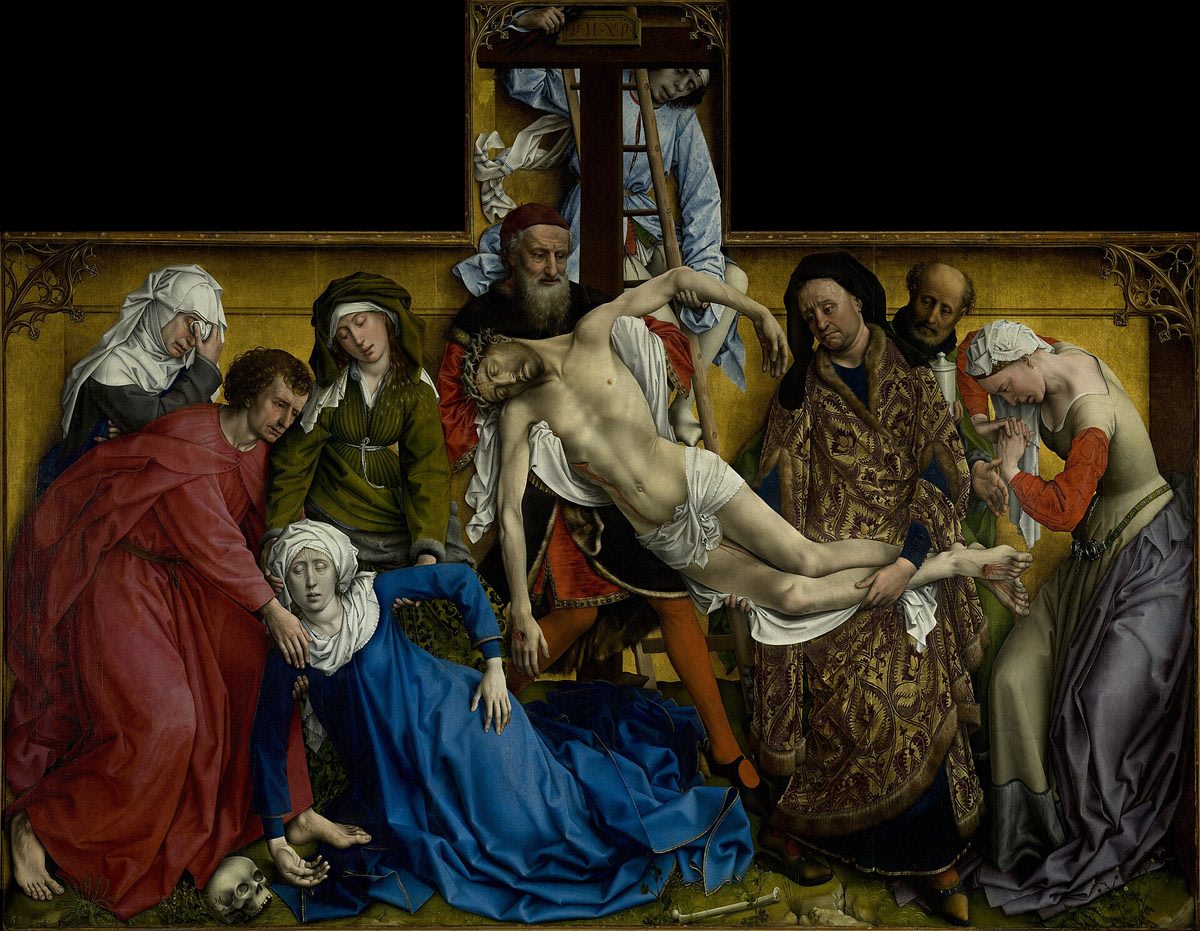
Descent from the Cross — Rogier van der Weyden, c.1435
Rogier van der Weyden, Public domain, via Wikimedia Commons
Rogier van der Weyden's Descent from the Cross is universally considered the masterpiece of Flemish 15th-century painting and one of the greatest paintings in existence. Originally the central panel of a triptych commissioned by the Confraternity of the Crossbowmen of Leuven for their chapel in the Church of Our Lady (Notre-Dame) in Leuven, Belgium, it was purchased by Mary of Hungary (regent of the Netherlands) in 1549 and eventually entered the Prado's collection.
The painting shows ten figures lowering Christ's body from the cross in an enclosed golden space — a triptych-shaped niche that compresses the figures into a shallow, stage-like depth. The Virgin, mirroring Christ's posture in a swoon of grief, is the compositional and theological centre: mother and son are in exactly parallel diagonal postures, sharing the same arc of suffering across the space between them.
Rogier van der Weyden (c.1399/1400-1464) was the most influential Flemish painter after Jan van Eyck and the principal transmitter of Flemish painting's emotional and compositional achievements to the rest of Europe. His innovation was to take the objective, documentary naturalism of van Eyck and charge it with an emotional intensity derived from medieval devotional tradition — the Andacht (devotional meditation) tradition of Northern European piety.
In the Descent, the emotions of each of the ten figures are precisely characterised: Mary Magdalene's wringing hands and hiked skirt (she is balanced on her toes, suspended in grief), Nicodemus's concentrated effort, St John's pale anxiety, the holy women's tears. The quality of Rogier's observation of emotional expression has never been surpassed.
Count the emotional registers in the ten figures: each is in a different stage of grief — from the concentrated effort of the bearers (Nicodemus and Joseph of Arimathea, supporting the body) to the abandoned despair of the swooning Virgin, the controlled sorrow of the women at the right, and the fixed gaze of St John at the left. Mary Magdalene, at the far right, is the most dynamically grief-stricken: her body is twisted with the effort of containing emotion, her skirt gathers around her feet, her hands wring involuntarily.
Look also at the paint quality: the fabrics are depicted with a precision of weave and texture that has never been equalled; the Magdalene's orange skirt is a passage of almost supernatural observation. The skull and bones at the lower left identify Golgotha (the Place of the Skull).
When standing before this work, look carefully: Descent from the Cross — Rogier van der Weyden, c.1435. Give it time — what seems decorative often carries the central meaning.
When standing before this work, look carefully: The Virgin's swoon — mirroring Christ's posture. Give it time — what seems decorative often carries the central meaning.
When standing before this work, look carefully: Mary Magdalene — the most dynamic expression of grief. Give it time — what seems decorative often carries the central meaning.
When standing before this work, look carefully: Christ's body — Flemish precision of observation. Give it time — what seems decorative often carries the central meaning.
Museo Nacional del Prado, Paseo del Prado, Madrid. Room 58 (Flemish Primitives).
The painting has been cleaned and studied in recent decades; the current state shows the exceptional quality of Rogier's brushwork. The Prado is open Tuesday to Sunday; timed entry tickets recommended.