
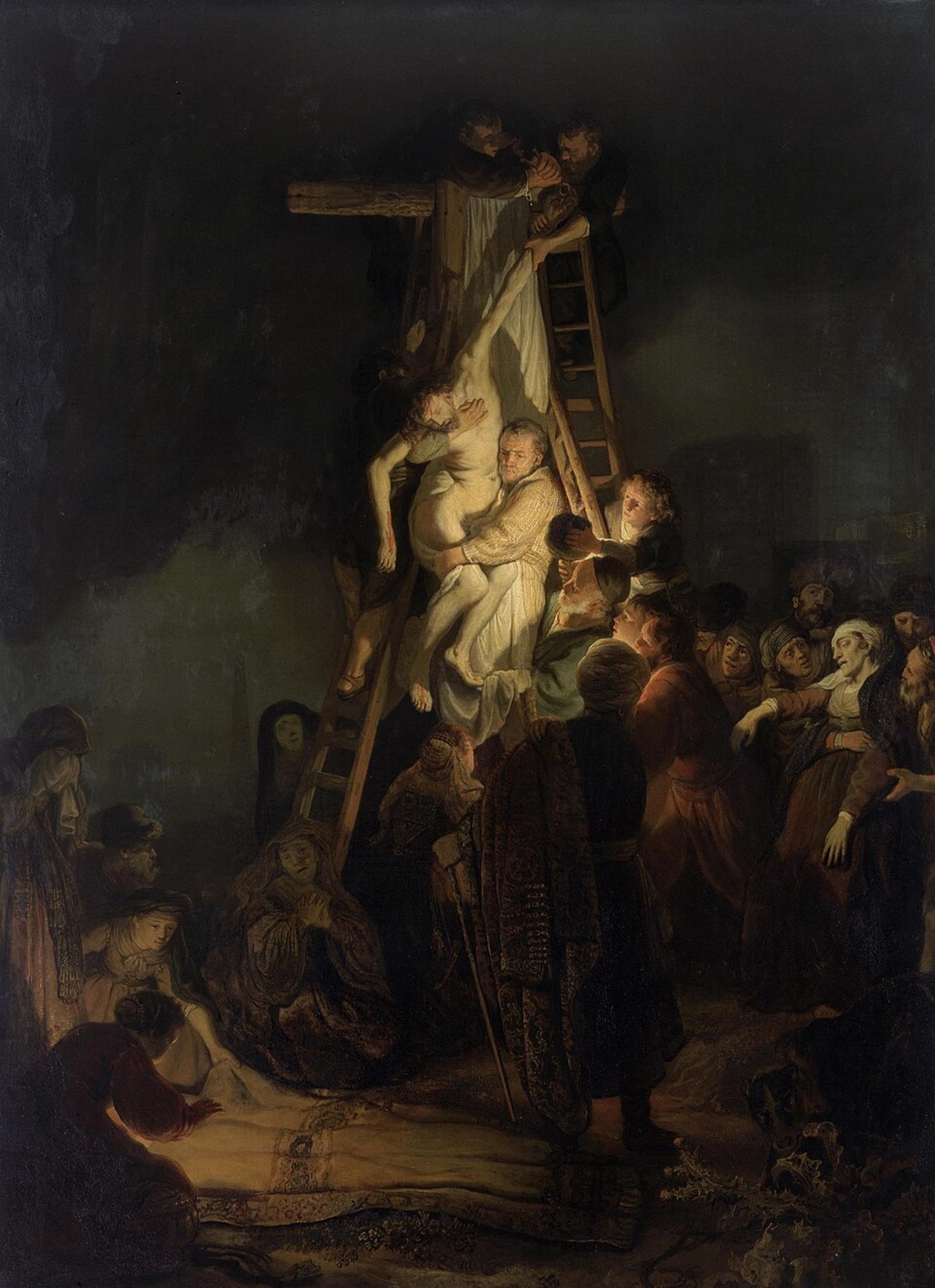
The Descent from the Cross
Descent from the Cross — Rembrandt, c.1634
Rembrandt van Rijn, Public domain, via Wikimedia Commons
Rembrandt's Descent from the Cross in the Hermitage is one of his three paintings of this subject (the others are the Alte Pinakothek version, c.1633, and a nighttime version) — a large dramatic composition (approximately 158 by 117 cm) showing the body of Christ being lowered from the cross in the darkness of Good Friday. The composition is strongly influenced by Rubens's famous Descent (Antwerp Cathedral, entry 79) and shows Rembrandt in his early Amsterdam period, working within the Flemish Baroque tradition of large-scale religious narrative. The specific Rembrandt contribution is the quality of the light: where Rubens floods the composition with warm radiance, Rembrandt uses a single torch to create a dramatic chiaroscuro — the light catches the white of Christ's shroud and the faces of the mourners while the rest of the composition dissolves into darkness.
Rembrandt van Rijn (1606-1669) is the greatest Dutch painter and one of the supreme religious artists in the history of Western painting — his biblical scenes characterised by a psychological depth, a quality of light, and a social observation that transform the sacred narrative into human experience. The Hermitage Descent was probably made as a pendant to the Hermitage Raising of the Cross (also in the Hermitage), both of which were given to Czar Nicholas I as diplomatic gifts. For Rembrandt's biographical context, see entry 88 (Blinding of Samson, Frankfurt).
Compare the Hermitage Descent with the Alte Pinakothek version (which was painted for Prince Frederick Henry of Orange as part of a Passion series): the two paintings are close in composition but different in scale and atmosphere. In the Hermitage version, the torchlight creates a more dramatic contrast between the lit and unlit areas; the figure of Nicodemus holding Christ by the torso is more central and more heroic in scale.
When standing before this work, look carefully: Descent from the Cross — Rembrandt, c.1634. Give it time — what seems decorative often carries the central meaning.
When standing before this work, look carefully: The torchlight — dramatic chiaroscuro. Give it time — what seems decorative often carries the central meaning.
When standing before this work, look carefully: The white shroud — light catching the linen. Give it time — what seems decorative often carries the central meaning.
When standing before this work, look carefully: The mourners — psychological depth in grief. Give it time — what seems decorative often carries the central meaning.
State Hermitage Museum, St Petersburg. See entry 222 for visiting details.