
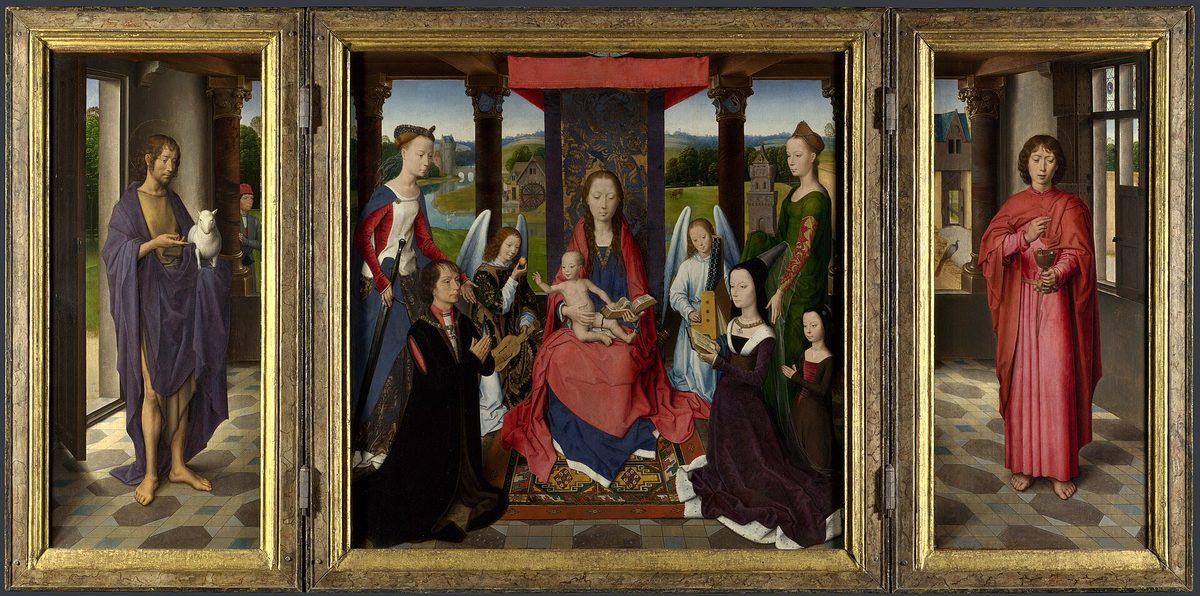
The Donne Triptych
The Donne Triptych — Memling, c.1478
Hans Memling, Public domain, via Wikimedia Commons
The Donne Triptych is Hans Memling's finest portable altarpiece in Britain — a small but exquisitely detailed triptych (central panel 70.7 by 70.5 cm) made around 1478 for the English knight Sir John Donne of Kidwelly, who appears with his wife Lady Elizabeth Donne and their daughter as donor portraits in the side panels. The central panel shows the Virgin enthroned with the Christ Child in a loggia open to a Flemish landscape, attended by St John the Evangelist (who holds a chalice with a serpent, his attribute) and St John the Baptist; at the sides, angels play musical instruments.
The side panels show Sir John and his wife kneeling in prayer, attended by their patron saints (St Catherine of Alexandria and St Barbara). The quality of the painting — the landscape, the textile surfaces, the portraits of the donors — represents Memling at his most refined and intimate.
Hans Memling (c.1430/40-1494) was the dominant painter in Bruges in the generation after Jan van Eyck and Roger van der Weyden — he synthesised their innovations into a style of supreme refinement and commercial success. The Donne Triptych was commissioned during Donne's period as an English royal envoy in Flanders (he was at the court of Charles the Bold of Burgundy) and demonstrates the appetite of the English aristocracy for high-quality Flemish panel painting in the late 15th century. The triptych was subsequently at Chatsworth House before entering the National Gallery in 1957.
The landscape visible through the loggia in the central panel is one of Memling's finest — a Flemish riverside landscape with a distant town, specific trees, and a sky with layered cloud formations. The triptych rewards comparison of the central panel's landscape with those visible in the donor portrait wings: slight variations in the weather and light of the three panels create a continuous atmospheric space that unifies the triptych across its hinges. The donors' faces are specific portrait studies: Sir John Donne's face has the directness of a Flemish commercial portrait.
When standing before this work, look carefully: The Donne Triptych — Memling, c.1478. Give it time — what seems decorative often carries the central meaning.
When standing before this work, look carefully: The Virgin and Child — central panel. Give it time — what seems decorative often carries the central meaning.
When standing before this work, look carefully: Sir John and Lady Donne — donor portraits. Give it time — what seems decorative often carries the central meaning.
When standing before this work, look carefully: The Flemish landscape through the loggia. Give it time — what seems decorative often carries the central meaning.
National Gallery, Room 63 (Early Netherlandish painting), London.