
The Elevation of the Cross
Elevation of the Cross — Rubens, 1610-1611
Peter Paul Rubens, Public domain, via Wikimedia Commons
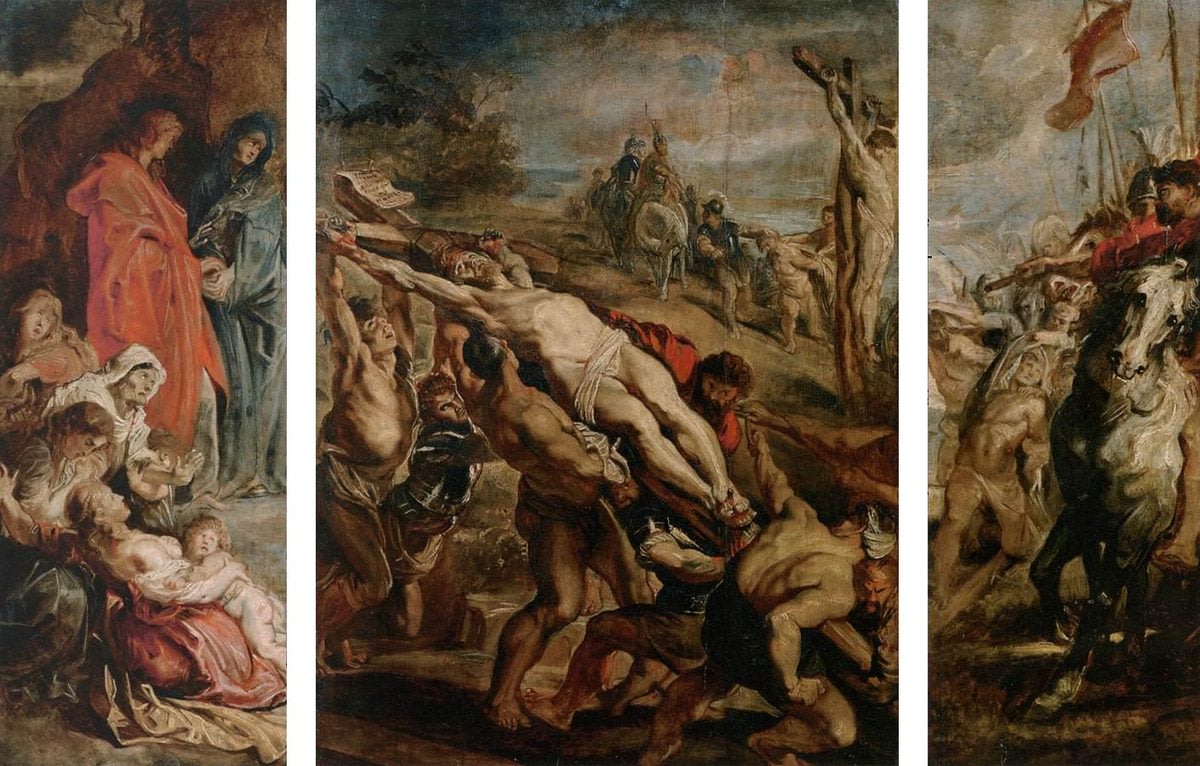
Rubens's Elevation of the Cross is the left triptych of the first of his two enormous altarpieces in Antwerp Cathedral — the other being the Descent from the Cross (entry 95). The central panel, approximately 6.2 metres tall, shows the moment of the cross being raised upright: Christ already nailed to the cross grips the wood in agony as soldiers and workers strain with ropes and poles to raise the cross to vertical.
The composition is an immense diagonal from lower right to upper left — the cross angle creating a sweeping dynamic force that carries the whole panel's energy upward and to the left. The physical effort of the soldiers is depicted with total anatomical precision; Christ's body is the ideal classical torso of Rubens's Flemish-Italianate synthesis. The scale is overwhelming: the painting fills a triptych space that, when open, measures approximately 6 by 15 metres.
Peter Paul Rubens (1577-1640) had returned from Italy to Antwerp in 1608 and had absorbed the entire Italian tradition — Roman classical sculpture, Michelangelo, Titian, Tintoretto, and Caravaggio. The Elevation of the Cross was his first major Antwerp commission and the demonstration of that synthesis at public scale.
The central panel's diagonal composition, the muscular baroque dynamism of the worker figures, and the precise tenebristic light (Caravaggesque in direction, Titian-like in warmth) created an immediate sensation and established Rubens's reputation as the greatest painter in Northern Europe. The Elevation and Descent from the Cross face each other in the transepts of Antwerp Cathedral — the two altarpieces together constituting the most important single ensemble of Baroque religious painting north of the Alps.
The central panel is the key: the diagonal of the cross occupies the full height and creates a powerful asymmetric force that is balanced by the mass of figures in the lower right. Christ's body — white, still, controlled — is at the composition's upper apex, the Christ of classical beauty contrasted with the straining brown bodies of the workers below.
The flanking wings show (left) the holy women and Joseph of Arimathea watching with grief, and (right) the Roman officers overseeing the execution. The side panels' quieter quality (narrative witnesses) frames the dramatic centre (the physical event). The same combination of scale, quality, and setting makes the Antwerp triptychs mandatory viewing for anyone interested in Baroque religious painting.
When standing before this work, look carefully: Elevation of the Cross — Rubens, 1610-1611. Give it time — what seems decorative often carries the central meaning.
When standing before this work, look carefully: The central panel — the cross being raised. Give it time — what seems decorative often carries the central meaning.
When standing before this work, look carefully: Christ gripping the cross — white against dark. Give it time — what seems decorative often carries the central meaning.
When standing before this work, look carefully: The north transept of Antwerp Cathedral. Give it time — what seems decorative often carries the central meaning.
Cathedral of Our Lady (Onze-Lieve-Vrouwekathedraal), Handschoenmarkt, Antwerp. The Elevation of the Cross is in the north transept; the Descent from the Cross is in the south transept. Entry requires a ticket to the cathedral.