
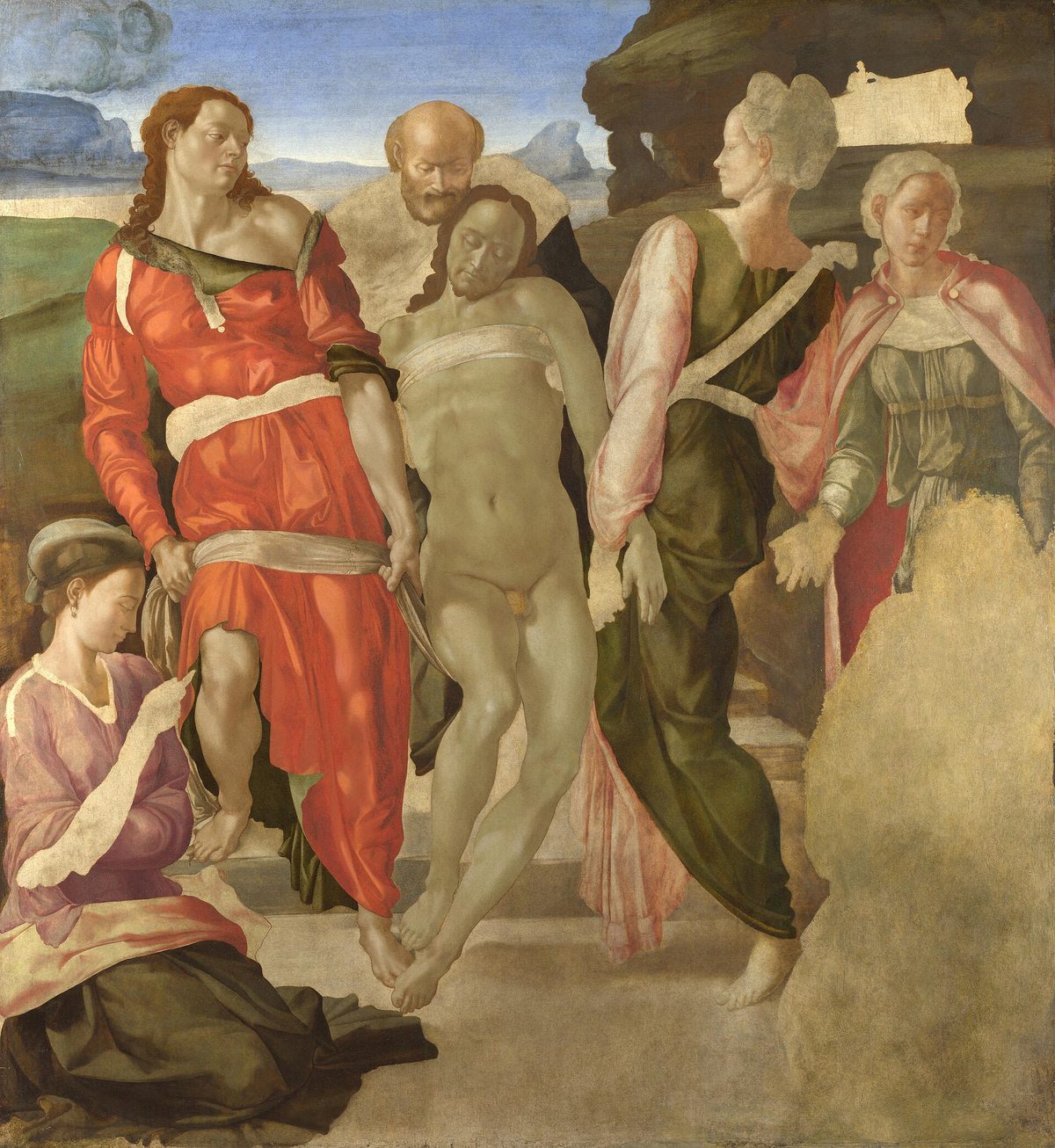
The Entombment of Christ
The Entombment — Michelangelo (unfinished), c.1500-1501
Michelangelo (unfinished), Public domain, via Wikimedia Commons
Michelangelo's Entombment in the National Gallery is one of only two surviving panel paintings attributed to him (the other is the Doni Tondo in the Uffizi) and the only unfinished painting by a major Renaissance master in a public collection. It shows four or five figures carrying Christ's body toward an unidentified destination (the Holy Sepulchre or, in the iconographic type it follows, the Lamentation).
The composition is incomplete: several figures are unpainted (including the kneeling Virgin at the lower left, who is entirely unpainted and visible only as underdrawing), and the background is blocked out in grisaille but not developed. What is complete — the central figure of Christ and the bearer at the upper right — demonstrates the sculptural power of Michelangelo's early figure painting: the bodies have the quality of his marble sculptures translated into paint.
The Entombment was probably made in Rome around 1500-1501, shortly before or during the period of the Vatican Pietà. The attribution to Michelangelo was accepted in the 20th century based on style and early sources; the work was apparently never finished (possibly because the patron failed to pay, or because Michelangelo was called to Florence for the David commission).
The technical examination has revealed that Michelangelo began with a detailed underdrawing and then proceeded to paint the central figures first, working outward — leaving the unpainted Virgin as evidence of the process. The quality of the painted areas is unmistakably Michelangelesque: the anatomical precision, the sculptural solidity, and the emotional force of the bearer's face are all consistent with the period of the Pietà and early Sistine Chapel studies.
The incomplete state is itself informative. Look at the unpainted Virgin at the lower left — she is visible in the underdrawing, her position clear, but the paint was never applied.
This allows a rare view into Michelangelo's working process. The completed figures — Christ's body at the centre, the bearer from behind at the right, the red-cloaked figure at the left — demonstrate his approach: the bodies are built from the inside out, the musculature establishing the figure before the surface detail. The Christ body has the same quality of idealised anatomical observation as the Vatican Pietà, but in paint rather than marble.
When standing before this work, look carefully: The Entombment — Michelangelo (unfinished), c.1500-1501. Give it time — what seems decorative often carries the central meaning.
When standing before this work, look carefully: Christ's body — sculptural quality in paint. Give it time — what seems decorative often carries the central meaning.
When standing before this work, look carefully: The unpainted Virgin — underdrawing visible. Give it time — what seems decorative often carries the central meaning.
When standing before this work, look carefully: The bearer from behind — anatomical force. Give it time — what seems decorative often carries the central meaning.
National Gallery, Room 8, London.