
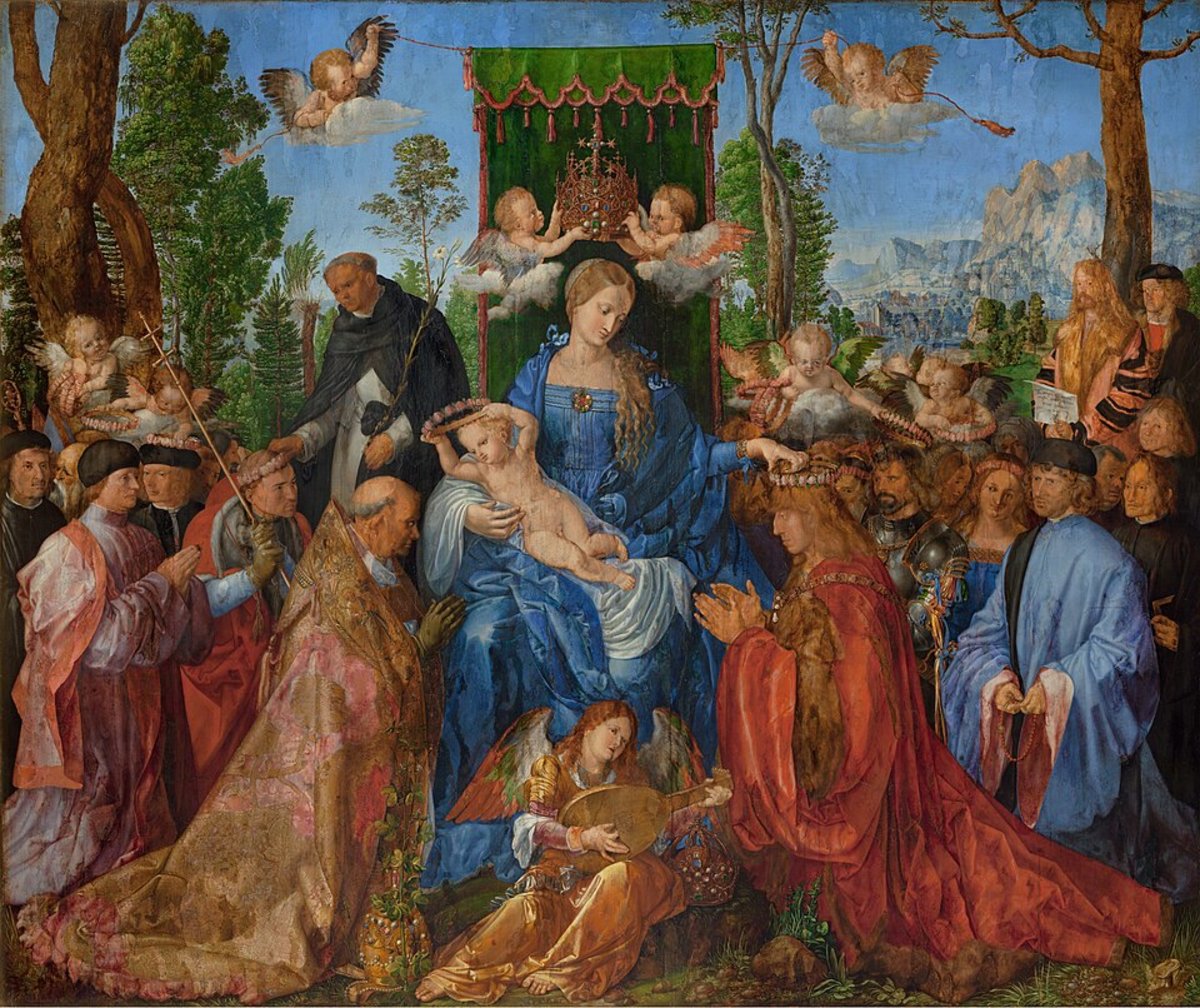
The Feast of the Rosary
Feast of the Rosary — Dürer, 1506
Albrecht Dürer, Public domain, via Wikimedia Commons
Dürer's Feast of the Rosary (also known as the Rosenkranzfest or Madonna of the Rosary) is the most ambitious German altarpiece of the northern Renaissance — a large panel (approximately 162 by 194.5 cm) painted by Dürer in Venice in 1506 for the German merchant community's church of San Bartolomeo. The composition shows the Virgin and Child enthroned in an elaborate rose bower, distributing garlands of roses to a crowd of worshippers including (on the left) Pope Julius II and (on the right) Emperor Maximilian I — figures representing the spiritual and temporal powers of Christendom — while angels, saints, and humble worshippers also receive garlands.
Dürer himself appears in the right edge of the composition, holding a piece of paper with a Latin inscription identifying himself. The painting demonstrates Dürer's absorption of the Venetian colour and atmospheric painting traditions (acquired during his two Venetian visits) into his characteristically German precision and detailed surface description.
Dürer painted the Rosenkranzfest in Venice, working with Venetian techniques he had observed in Bellini and Giorgione, and was justifiably proud of it: he wrote to his friend Willibald Pirckheimer that 'I have silenced all the painters who said that I was good at engraving but that in painting I did not know how to handle colours; now they all say that they have never seen colours so beautiful.' The painting was acquired by Emperor Rudolf II in 1606 and moved to Prague, where it remains (now in the National Gallery). It suffered damage in transit and during storage over the centuries; a significant restoration was completed in 2009.
Dürer's self-portrait in the right edge of the composition deserves attention: he holds a slip of paper with the inscription 'Albertus Durer Germanus faciebat anno a Virginis partu 1506' (Albert Dürer the German made this in the year 1506 from the Virgin's birth). The inscription is a pride marker — Dürer signs himself not humbly but with the assertion of a national identity and artistic achievement. The composition itself is structured around two horizontal axes: the Virgin enthroned at the centre, distributing garlands to the left (Pope) and right (Emperor) at the top of their respective groups; the crowd of worshippers below.
When standing before this work, look carefully: Feast of the Rosary — Dürer, 1506. Give it time — what seems decorative often carries the central meaning.
When standing before this work, look carefully: Pope and Emperor receiving garlands. Give it time — what seems decorative often carries the central meaning.
When standing before this work, look carefully: Dürer's self-portrait in the right edge. Give it time — what seems decorative often carries the central meaning.
When standing before this work, look carefully: The Virgin and Child enthroned in the rose bower. Give it time — what seems decorative often carries the central meaning.
National Gallery (Šternberský palác / Sternberg Palace), Prague. The painting is currently held in Prague. Confirm current exhibition location before visiting.