
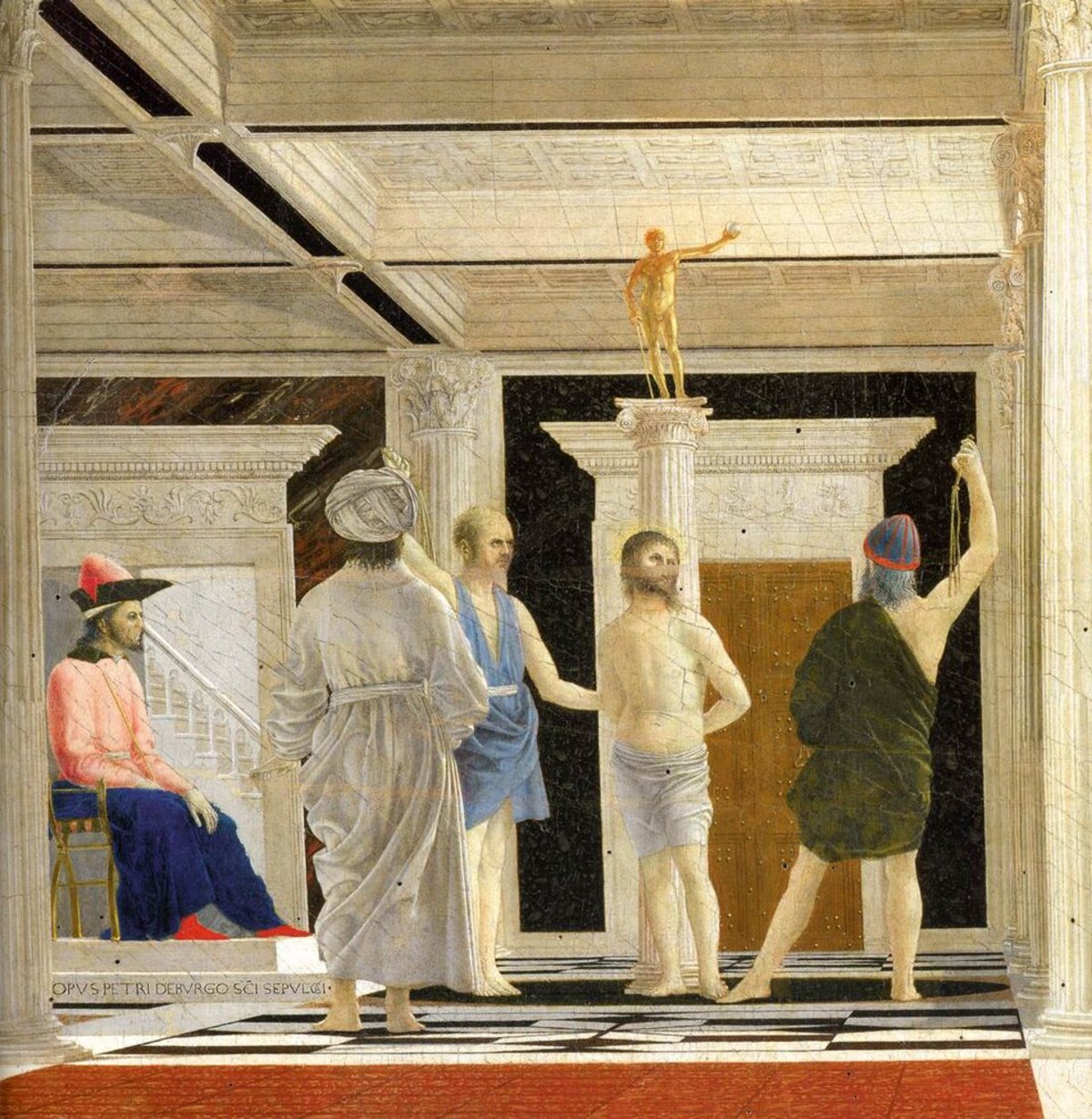
The Flagellation of Christ
Flagellation of Christ — Piero della Francesca, c.1455-1460
Piero della Francesca, Public domain, via Wikimedia Commons
Piero della Francesca's Flagellation of Christ is the most debated small panel painting of the Italian Renaissance — a small but precisely constructed painting (approximately 58.4 by 81.5 cm) that divides into two zones: on the left (in the background), Christ is bound to a column in Pilate's palace and being flagellated; on the right (in the foreground, at larger scale), three unidentified contemporary figures stand in conversation. The relationship between the sacred event in the background and the contemporary figures in the foreground has been interpreted in dozens of ways — as a commission for a specific family (the Montefeltro of Urbino), as a political allegory, as a theological programme. The precision of the perspective construction (the floor tiles, the architecture, the coffers of the ceiling — all in exact mathematical perspective) and the quality of the paint surface are both extraordinary for a painting of this size.
Piero della Francesca painted the Flagellation probably for the court of Federico da Montefeltro in Urbino, where it has remained (with a brief period as a diplomatic gift to the Duke of Milan in the 15th century). The painting has been in the Palazzo Ducale since the late 15th century and entered the Galleria Nazionale delle Marche when the palace became a museum.
The attribution to Piero is secure; the date and iconographic programme remain disputed. The Flagellation's fame derives both from the quality of the painting and from the enigma of its subject: the three unidentified foreground figures have been identified as Girolamo and Ludovico, the brothers of Oddantonio da Montefeltro (who was murdered); as theological figures (Plato, Aristotle, and Piero himself); and as contemporary political allegory.
The painting must be studied both as a formal composition and as an iconographic puzzle. The formal: the division into two spatial zones (background sacred, foreground secular), both in exact perspective, creates a paradox — the flagellation of Christ is visible but distant, while the contemporary figures are immediate and large. The iconographic: who are the three men?
What is the building? Why is the flagellation visible in the background while they talk in the foreground? These questions have generated a scholarly literature of extraordinary volume; visiting the painting with a good catalogue is essential.
When standing before this work, look carefully: Flagellation of Christ — Piero della Francesca, c.1455-1460. Give it time — what seems decorative often carries the central meaning.
When standing before this work, look carefully: The three unidentified foreground figures. Give it time — what seems decorative often carries the central meaning.
When standing before this work, look carefully: Christ bound to the column — background scene. Give it time — what seems decorative often carries the central meaning.
When standing before this work, look carefully: Perspective construction — floor tiles and coffered ceiling. Give it time — what seems decorative often carries the central meaning.
Galleria Nazionale delle Marche, Palazzo Ducale, Piazza Duca Federico 107, Urbino. Open Tuesday-Sunday; admission fee. Urbino is approximately 3 hours from Florence by road.