
Albrecht Dürer, Public domain, via Wikimedia Commons
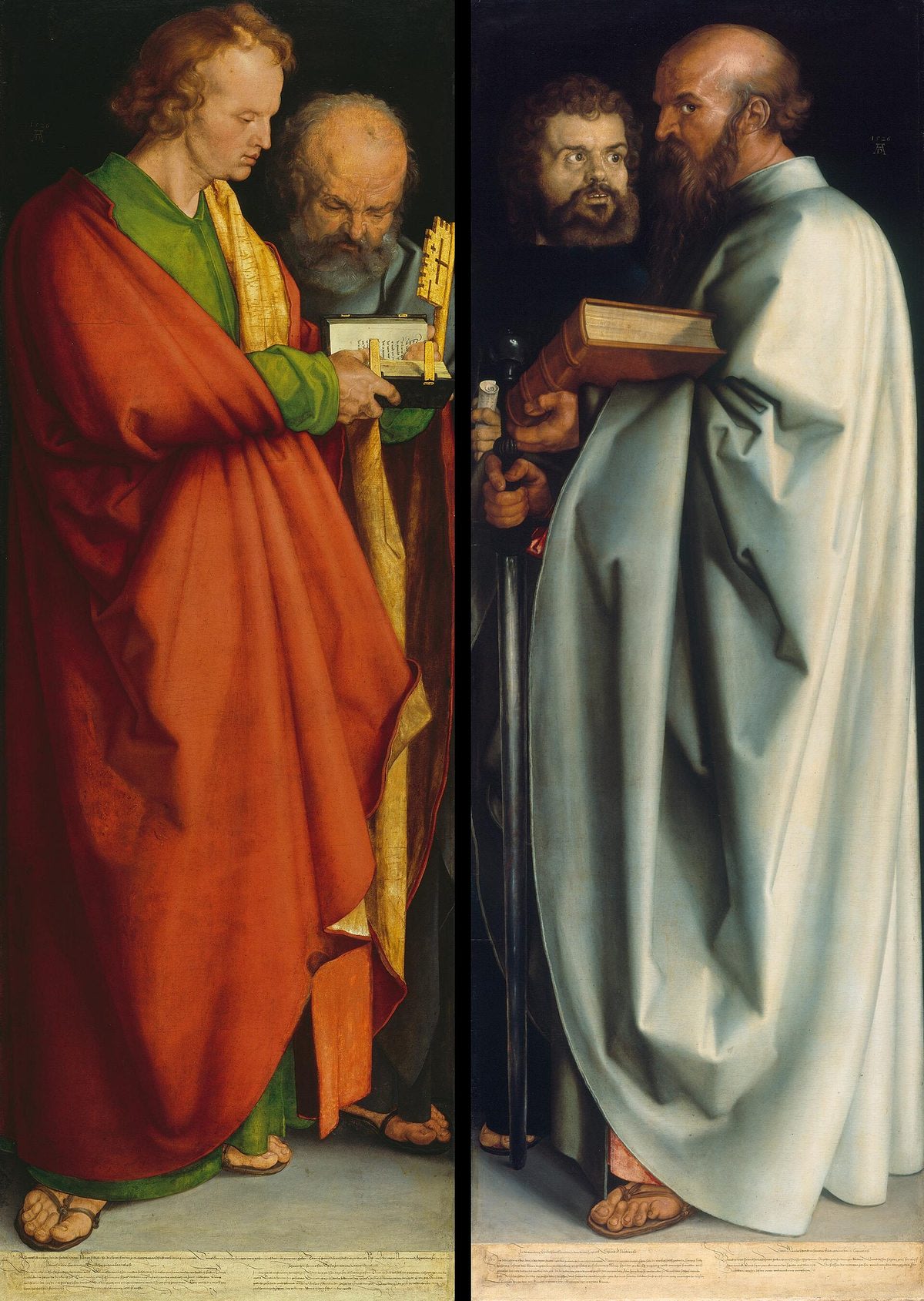
Dürer's Four Apostles is his greatest painting and his bequest to the city of Nuremberg — two large panel paintings (each approximately 204 by 74 cm) depicting John, Peter, Mark, and Paul. Dürer gave them to the Nuremberg city council in 1526, two years before his death, as a statement of his Protestant convictions: the inscriptions at the base of the panels quote Luther's translation of the New Testament, warning against those who 'come to you in sheep's clothing but are ravening wolves within' — understood as a warning against the radical Reformation movements (Anabaptism, antinomianism) that Dürer saw as threatening both Church and civil order.
John (the contemplative Evangelist) stands prominently in the left panel; Peter (the institutional Church), Mark (the active Evangelist), and Paul (the theological authority) are in the two panels. The figures are monumental, the painting technically the most accomplished of Dürer's career.
Albrecht Dürer (1471-1528) was the greatest German artist of the Renaissance — engraver, painter, printmaker, and theorist, who made two journeys to Italy (1494-95 and 1505-07) and absorbed the Italian Renaissance tradition while remaining distinctly Northern in his approach. The Four Apostles were made in the final years of his life, during the high moment of the Reformation in Germany.
Dürer was a supporter of Luther but was troubled by the radical directions the Reformation was taking in the mid-1520s (the Peasants' War of 1525, the Anabaptist movements). The Four Apostles is both a theological statement (the authority of Scripture as interpreted by these four) and a political statement (against extremism of any kind).
The figures fill the panel height — monumental, close to the viewer, each face specifically characterised. John (the young Evangelist) opens his Gospel and reads; the light falls on the open text. Peter (old, the institutional Church, holding the keys) looks outward with a quality of steady authority.
Mark (the active Evangelist) holds his quill; Paul (the theological Reformer) holds his sword and looks with intensity toward the viewer. The quality of Dürer's painting here — the fabrics, the hands, the skin — is among his finest. The inscribed warning at the base of the panels makes the political context explicit: 'In these dangerous times all secular rulers should take heed not to accept human delusion as divine truth.'
When standing before this work, look carefully: The Four Apostles — Dürer, 1526. Give it time — what seems decorative often carries the central meaning.
When standing before this work, look carefully: John and Peter — the left panel. Give it time — what seems decorative often carries the central meaning.
When standing before this work, look carefully: Mark and Paul — the right panel. Give it time — what seems decorative often carries the central meaning.
When standing before this work, look carefully: Paul's face — theological intensity. Give it time — what seems decorative often carries the central meaning.
Alte Pinakothek, Barer Strasse 27, Munich. Room III.
The Alte Pinakothek holds the most important collection of German Renaissance painting in the world. The Four Apostles are the centrepiece of the Dürer holdings.