
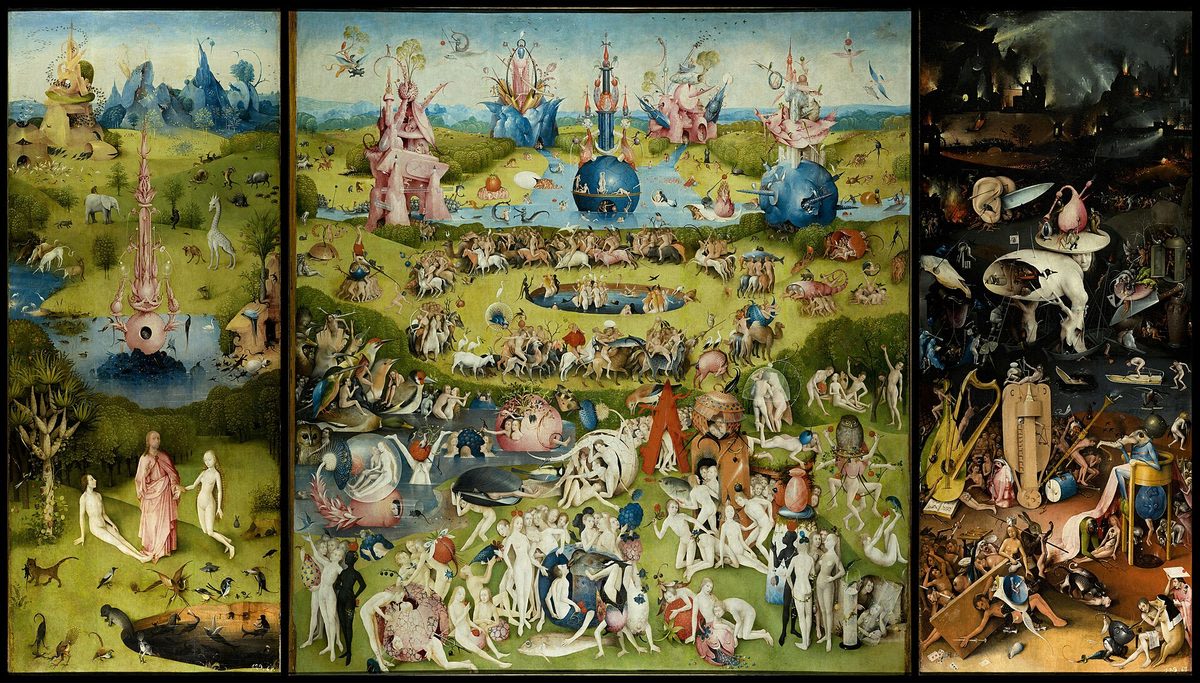
The Garden of Earthly Delights
Garden of Earthly Delights — full triptych, open
Hieronymus Bosch, Public domain, via Wikimedia Commons
Hieronymus Bosch's Garden of Earthly Delights is the most enigmatic and most visually overwhelming painting of the Northern European Renaissance — a triptych whose programme has generated more scholarly disagreement than any other single work. The left wing shows the Garden of Eden (God presenting Eve to Adam, the landscape populated with fantastical animals); the central panel shows an enormous pleasure garden crowded with thousands of nude figures engaged in activities of ambiguous moral character (erotic, playful, fantastical); the right wing shows Hell — a landscape of darkness and burning cities in which humans are tortured by monstrous hybrid creatures in punishment for earthly sins.
The closed triptych (grisaille) shows the third day of Creation — the earth in a glass sphere, still waterlogged, emerging from darkness. The entire programme may be a meditation on the fate of humanity between Eden and Hell, with the central panel representing either the sinfulness of earthly pleasure or a utopian vision of prelapsarian innocence — the debate is unresolved.
Hieronymus Bosch (c.1450-1516) worked in 's-Hertogenbosch in the northern Netherlands and was among the most original minds in the history of European painting. His iconography is famously resistant to systematic interpretation: the creatures, symbols, and narrative episodes in his paintings draw on medieval moralising traditions, alchemical symbolism, Flemish proverbs, and his own apparently inexhaustible visual invention.
The Garden of Earthly Delights was probably commissioned by Engelbrecht II of Nassau around 1490-1510 and has been in Spanish collections since the 16th century. Philip II of Spain kept it at El Escorial; it entered the Prado in 1939.
Stand before the open triptych and read it from left to right. The left wing (Eden) is serene and orderly: God is small, the animals exotic but specific, the landscape luminous.
The central panel is overwhelming in its density: the giant fruit, the birds, the transparent spheres, the figures — hundreds of nude humans in every conceivable combination of activity — fill every centimetre of the pictorial space. The right wing (Hell) is darker and more obviously nightmarish: look for the figure of the 'Tree-Man' (a hollow man whose trunk rests on two boats, his head carrying a flat plate with bagpipers and naked figures), and for the ear-bodies, knife-blade, and instrument-torture devices. Bosch's Hell is simultaneously horrifying and satirically inventive.
When standing before this work, look carefully: Garden of Earthly Delights — full triptych, open. Give it time — what seems decorative often carries the central meaning.
When standing before this work, look carefully: The left wing — Garden of Eden. Give it time — what seems decorative often carries the central meaning.
When standing before this work, look carefully: The right wing — Hell. Give it time — what seems decorative often carries the central meaning.
When standing before this work, look carefully: Central panel detail — the pleasure garden. Give it time — what seems decorative often carries the central meaning.
Museo Nacional del Prado, Madrid. Room 56A. The painting is displayed on a freestanding display structure that allows viewing of the closed grisaille wings as well as the open triptych.