
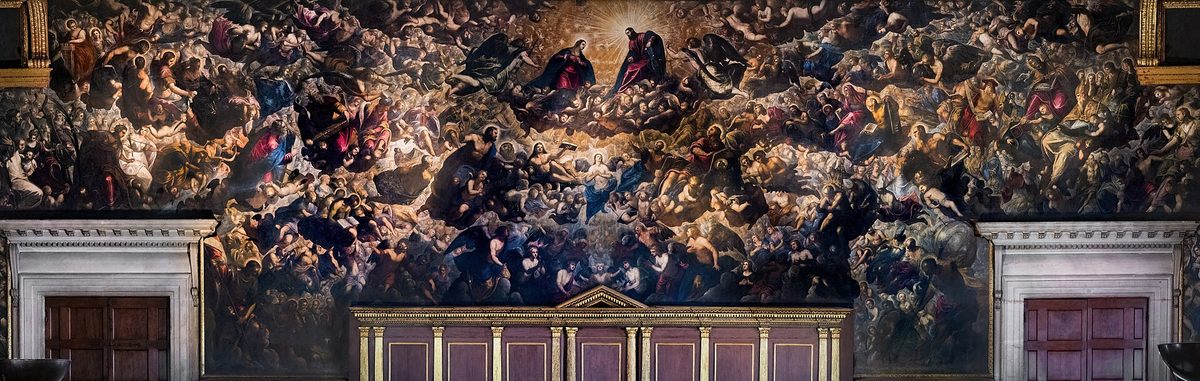
The Glory of Paradise
Paradise — Tintoretto, 1588-1594
Jacopo Tintoretto, Public domain, via Wikimedia Commons
Tintoretto's Paradise (The Glory of Paradise) in the Sala del Maggior Consiglio of the Palazzo Ducale is the largest oil painting on canvas in the world — approximately 7.45 by 24.65 metres, covering the entire east wall of the Great Council Chamber. The composition shows the celestial court of the Blessed arranged in an oval composition around the central figures of Christ, the Virgin, and the heavenly angels, with concentric rings of saints, patriarchs, prophets, martyrs, and the entire company of heaven arranged in a spiral pattern ascending toward the divine light at the centre.
Tintoretto painted the composition with the assistance of his son Domenico between approximately 1588 and 1594 — it was his final major work and was completed in the last year of his life. The earlier version of the composition (by Guariento, 1365) had been destroyed in the fire of 1577; Tintoretto's canvas is the replacement.
The Palazzo Ducale was the centre of Venetian government — the Sala del Maggior Consiglio (the Great Council Chamber) was the largest room in Venice, used for the assembly of the Republic's governing council of approximately 1,000 noble citizens. The scale of the chamber (54 by 25 metres) required a painting of corresponding ambition; Tintoretto and his son provided the largest canvas programme ever conceived. The painting demonstrates the Mannerist tradition of the 'gloria' (glory) composition — the heavenly court arranged in concentric rings around the divine centre — at its most extreme scale.
The painting is best seen with binoculars — the upper zones (the innermost circles around Christ and the Virgin) are approximately 7 metres above eye level and contain hundreds of individual figures rendered at a scale of 10-20 cm per face. The outer zones (the lower portions of the composition) are at eye level and show the figures of the blessed at larger scale. The entire composition has the quality of an aerial view of heaven — as if you are looking up from below at the celestial dome.
When standing before this work, look carefully: Paradise — Tintoretto, 1588-1594. Give it time — what seems decorative often carries the central meaning.
When standing before this work, look carefully: Christ and the Virgin at the centre — the divine core. Give it time — what seems decorative often carries the central meaning.
When standing before this work, look carefully: The outer rings — saints and the blessed. Give it time — what seems decorative often carries the central meaning.
When standing before this work, look carefully: The Sala del Maggior Consiglio — the full wall. Give it time — what seems decorative often carries the central meaning.
Palazzo Ducale, Piazza San Marco, Venice. Open daily; admission fee. The Sala del Maggior Consiglio is the largest room in the palace; the Tintoretto Paradise is impossible to miss.