
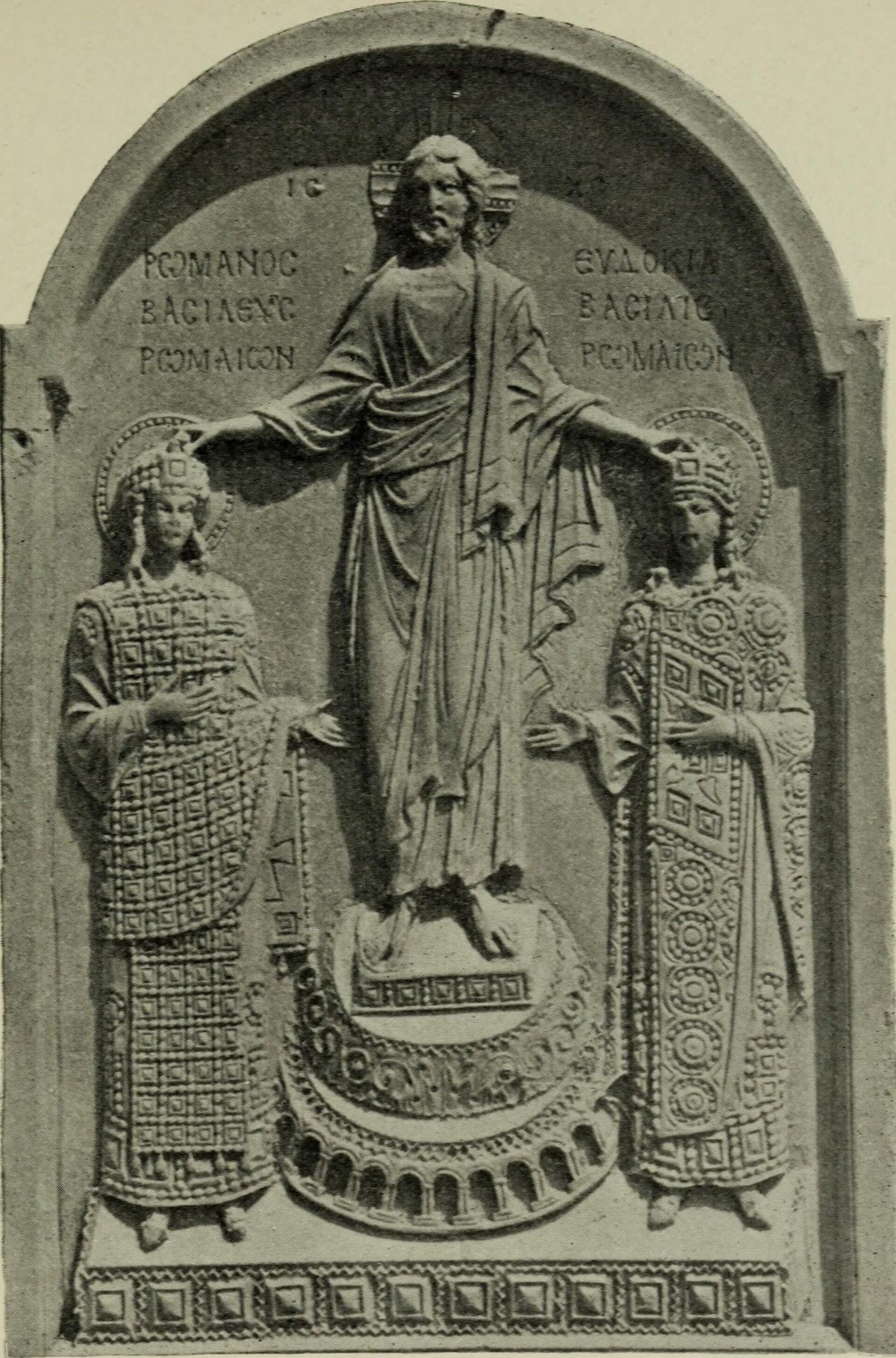
The Harbaville Triptych
The Harbaville Triptych — Byzantine ivory, c.950-975
Byzantine, Public domain, via Wikimedia Commons
The Harbaville Triptych is the finest portable Byzantine ivory triptych in existence — a small devotional object (central panel 24.2 by 14.2 cm when open) carved in Constantinople around 950-975 in the 'court style' of the middle Byzantine Macedonian Renaissance. The central panel shows Christ enthroned flanked by the Virgin Mary and St John the Baptist (the Deesis — the standard Byzantine intercession composition); below Christ's feet, five apostles are depicted in smaller scale.
The inner faces of the two outer wings are carved with ten standing saints in pairs; the outer faces of the wings bear a cross-within-cross pattern. The quality of the carving — the deep undercutting of the drapery folds, the delicacy of the facial modelling, the precision of the inscriptions — is extraordinary, representing the apex of Byzantine ivory carving.
The Harbaville Triptych takes its name from its last private owner, Harbaville, from whom it was acquired by the Louvre in 1891. The Macedonian Renaissance (c.867-1056) was the great period of Byzantine art under the Macedonian dynasty — a period of cultural renewal, systematic revival of classical forms, and sophisticated court patronage. The 'court style' of this period is characterised by extreme refinement of surface, classical proportions in the figure, and a combination of hieratic frontality (inherited from the icon tradition) with naturalistic classical surface modelling (derived from late antique ivory carving).
The triptych is small — approximately the size of an open book — and must be studied at close range. The Louvre's display allows viewing from both front and back.
The central Deesis is the theological heart: Christ in the centre blesses the viewer; the Virgin and John lean slightly toward him in the gesture of intercession; below them, the apostles stand in smaller panels. The drapery of the central figures is carved in deep relief, the folds catching the light like the fluting of a column. The inscriptions (in Greek) identify each figure.
When standing before this work, look carefully: The Harbaville Triptych — Byzantine ivory, c.950-975. Give it time — what seems decorative often carries the central meaning.
When standing before this work, look carefully: The central Deesis — Christ with Virgin and John. Give it time — what seems decorative often carries the central meaning.
When standing before this work, look carefully: The wing saints — ten standing figures. Give it time — what seems decorative often carries the central meaning.
When standing before this work, look carefully: Drapery detail — deep undercutting. Give it time — what seems decorative often carries the central meaning.
Musée du Louvre, Sully Wing, Room 2 (Byzantine collection), Paris.