
The Haywain Triptych
The Haywain Triptych — Bosch, c.1516, Prado
Hieronymus Bosch, Public domain, via Wikimedia Commons
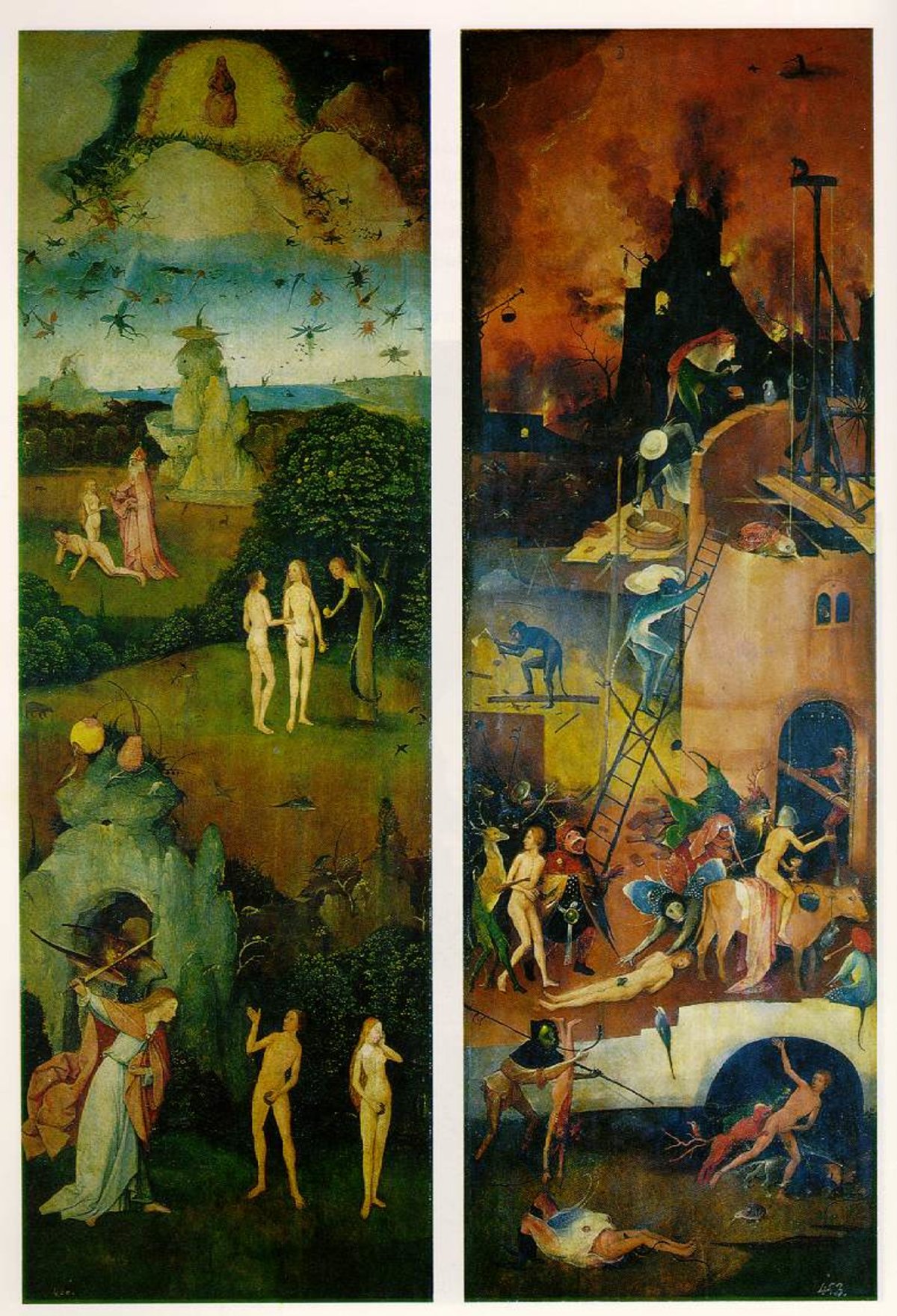
The Haywain Triptych is one of the largest and most complex of Bosch's surviving works (approximately 135 by 200 cm open), a tripartite altarpiece that reads as an allegory of human greed. The left panel shows the Garden of Eden and the Fall; the central panel shows a vast hay cart being pulled toward Hell, with all levels of society — popes, emperors, merchants, monks, peasants, lovers — climbing and fighting over it, as angels and demons watch; the right panel shows Hell as an already-begun nightmare construction. The central image is Bosch's most striking allegory: the hay cart (with its load of worthless hay representing worldly goods and wealth) is pulled by demons, and every human being is fighting for a share of what is worth nothing.
The Haywain Triptych belongs to the same family of works as The Garden of Earthly Delights — a panoramic moral allegory set across three panels. Where The Garden is primarily erotic in its imagery of sin, The Haywain is primarily economic: greed, the desire for worldly goods, the folly of fighting over what is valueless.
Philip II of Spain, who owned the Haywain as he owned The Garden of Earthly Delights, displayed both in the Escorial monastery. The Prado inherited both works from the Royal Collection.
The central panel rewards slow, systematic looking: at the top of the hay cart, a group of angels plays music and Christ watches from a cloud above — no-one on the cart looks up. The lovers sitting on top of the hay are oblivious to their destination.
In the procession following the cart, popes and emperors and bishops are shown not as sinners condemned from outside but as participants — they too follow the cart toward Hell. The right panel of Hell is an early version of the Hell imagery that Bosch developed most fully in The Garden of Earthly Delights.
When standing before this work, look carefully: The Haywain Triptych — Bosch, c.1516, Prado. Give it time — what seems decorative often carries the central meaning.
When standing before this work, look carefully: Central panel — the hay cart procession. Give it time — what seems decorative often carries the central meaning.
When standing before this work, look carefully: Left panel — Garden of Eden and the Fall. Give it time — what seems decorative often carries the central meaning.
When standing before this work, look carefully: Right panel — Hell construction. Give it time — what seems decorative often carries the central meaning.
Museo del Prado, Paseo del Prado s/n, Madrid 28014. Open Tuesday-Sunday 10:00-20:00. Displayed in the Bosch gallery alongside the Garden of Earthly Delights.