
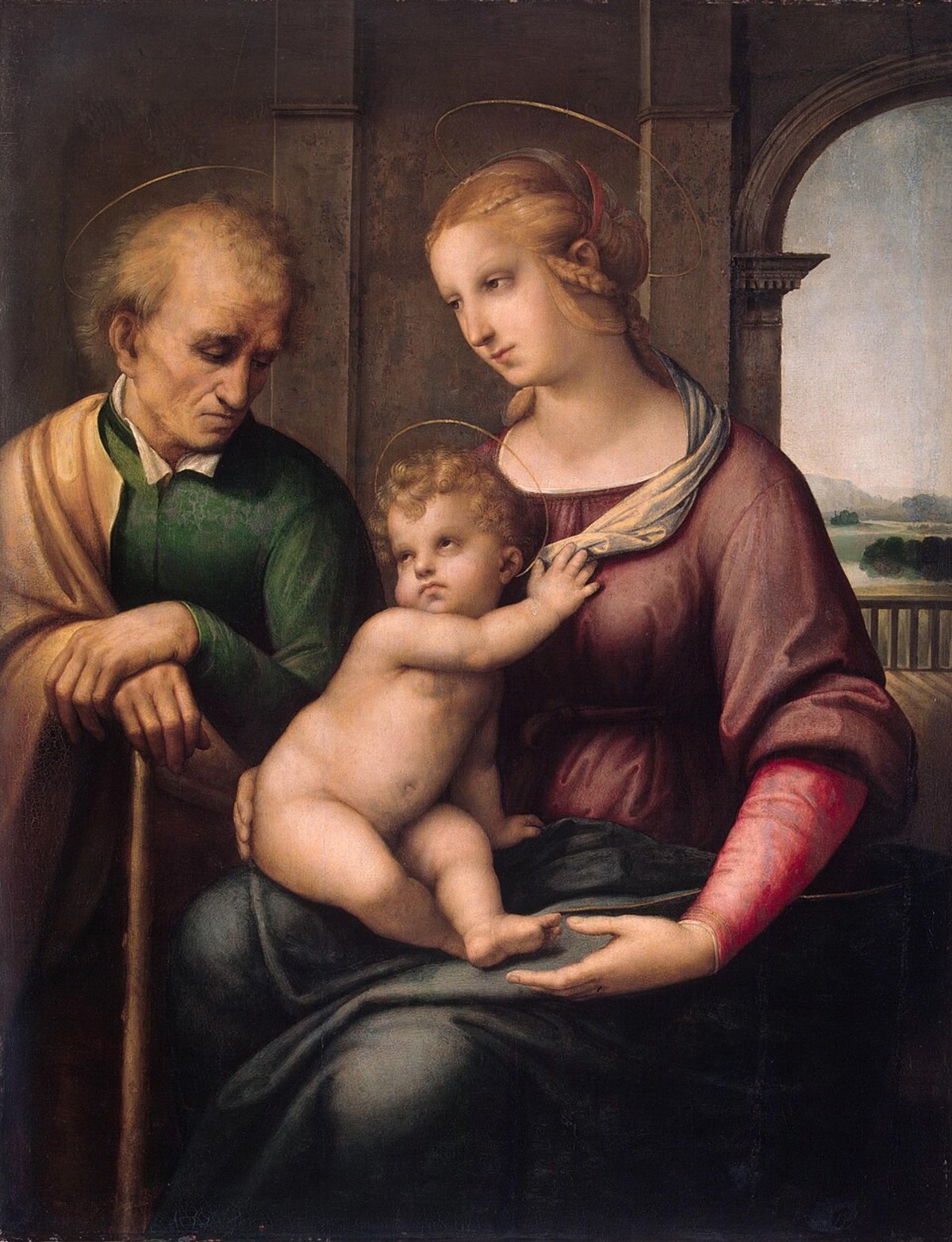
The Holy Family (Madonna with Beardless Joseph)
Holy Family with Beardless Joseph — Raphael, c.1506
Raphael, Public domain, via Wikimedia Commons
Raphael's Holy Family with Beardless Joseph in the Hermitage is a significant early Florentine period work (approximately 72.8 by 56.7 cm) — one of several Holy Family compositions from his 1504-1508 Florence years that show his assimilation of Leonardo's approach to group composition and psychological interaction. The Virgin, Joseph, and the Christ Child form a compact triangular group; the sleeping Christ Child is held by the Virgin while Joseph bends forward to look at him.
The specific detail that gives the painting its common name — Joseph without a beard (extremely unusual in Italian painting, where Joseph is conventionally depicted as an old man with a long beard) — reflects a naturalistic approach to the Holy Family as a young nuclear family. The work was in the French Royal Collection before entering the Hermitage and demonstrates the range of Raphael's Holy Family compositions in his Florentine period.
For Raphael's biographical context, see entry 140. The Hermitage holds three Raphael Madonnas (entries 223, 224, and this entry), making it one of the most important single collections of Raphael's early work outside Italy. The Madonna with Beardless Joseph is the most intimate and psychologically complex of the three — the sleeping child, the attentive parents, and the specific naturalism of the group create a devotional image grounded in domestic observation.
The sleeping Christ Child is a specific devotional type (anticipating the Pietà — the sleeping child will die and be laid in the Virgin's arms again) combined with pure domestic naturalism (all parents know the absorbed attention of watching a sleeping child). The beardless Joseph is young, attentive, present — a very different figure from the old, passive Joseph of the Byzantine tradition.
When standing before this work, look carefully: Holy Family with Beardless Joseph — Raphael, c.1506. Give it time — what seems decorative often carries the central meaning.
When standing before this work, look carefully: The young beardless Joseph — unusual in Italian painting. Give it time — what seems decorative often carries the central meaning.
When standing before this work, look carefully: The sleeping Christ Child. Give it time — what seems decorative often carries the central meaning.
When standing before this work, look carefully: The triangular group — Leonardo's compositional influence. Give it time — what seems decorative often carries the central meaning.
State Hermitage Museum, St Petersburg. See entry 222 for visiting details.