
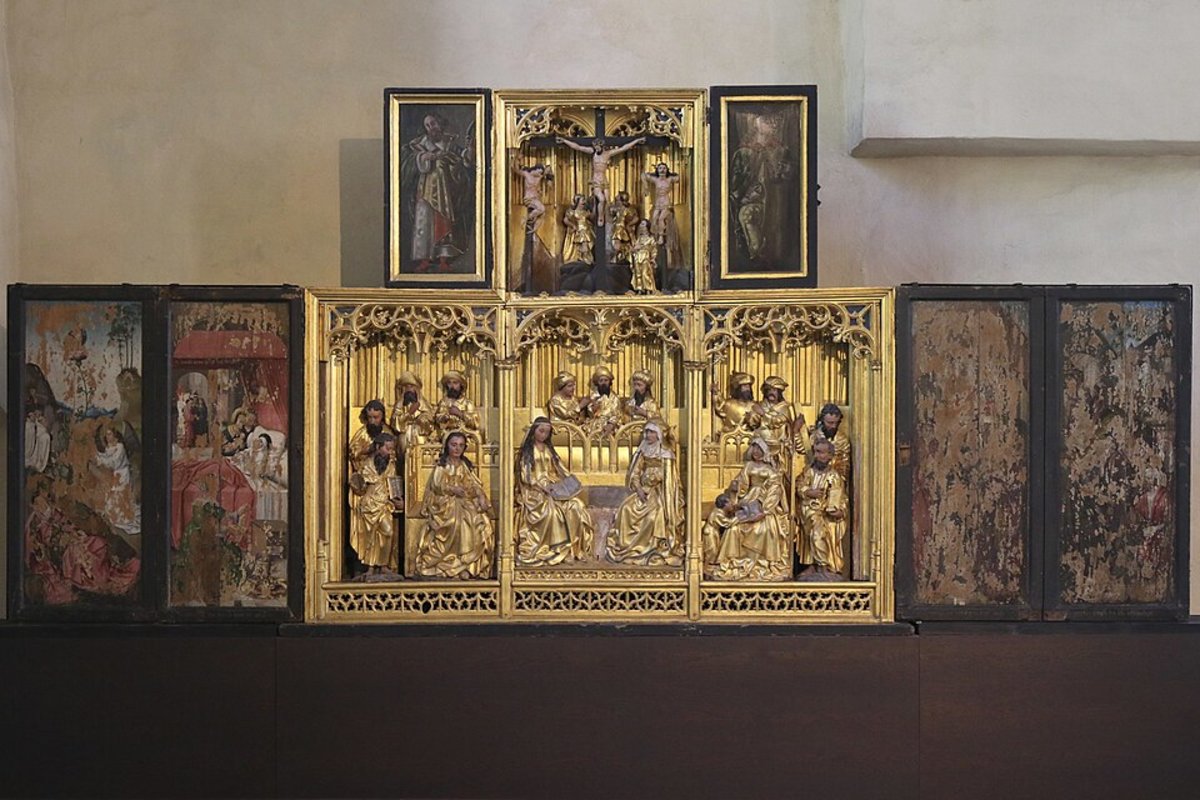
The Holy Kinship Altarpiece
Holy Kinship Altarpiece — Massys, c.1509
Quentin Massys, Public domain, via Wikimedia Commons
Quentin Massys's Holy Kinship Altarpiece (St Anne Triptych) in Brussels is the masterpiece of Flemish painting in the early 16th century — a large triptych (central panel approximately 225 by 219 cm) depicting the extended family of Christ (the Holy Kinship: the Virgin Mary's mother St Anne, her sisters, their husbands and children) in a unified architectural setting, with the donors (Jean de Sedano and his wife) in the side panels. The central panel shows St Anne enthroned at the centre with the Virgin and Child on her lap, surrounded by her daughters and their families — a meditative image of maternal devotion across three generations.
The quality of the painting — the specific portraiture of the faces, the elaborate landscape background, the precision of the textile rendering — represents Massys at his finest. The altarpiece was made for the Chapel of St Anne in the church of St Peter in Louvain.
Quentin Massys (c.1465/66-1530) was the leading painter in Antwerp in the early 16th century — the artist who bridged the late medieval Flemish tradition of van Eyck, Memling, and van der Weyden with the new Renaissance sensibility imported from Italy. His work shows the influence of Leonardo (he probably knew Leonardo's drawings through connections with the Milanese court) in its psychological subtlety and atmospheric landscape. The Holy Kinship Altarpiece was made just before Massys's engagement with humanist circles — Erasmus was his friend, and the satirical tradition of his later career (the famous Moneylender and his Wife) grows from this period.
The landscape in the central panel background is one of the finest in Flemish painting of the period: a panoramic view of a river valley with cliffs, bridges, and a distant city — rendered in the atmospheric blue recession inherited from van Eyck but with a scale and depth that anticipates Patinir's later Flemish landscape tradition. The faces of the women in the Holy Kinship group are specific portrait types — each is an individual, not a type.
When standing before this work, look carefully: Holy Kinship Altarpiece — Massys, c.1509. Give it time — what seems decorative often carries the central meaning.
When standing before this work, look carefully: St Anne with the Virgin and Child — central panel. Give it time — what seems decorative often carries the central meaning.
When standing before this work, look carefully: The panoramic landscape background. Give it time — what seems decorative often carries the central meaning.
When standing before this work, look carefully: The donor portraits — Jean de Sedano and wife. Give it time — what seems decorative often carries the central meaning.
Royal Museums of Fine Arts of Belgium, Rue de la Régence 3, Brussels. Open Tuesday-Sunday; admission fee. One of the most important art museums in Europe.