
Masaccio, Public domain, via Wikimedia Commons
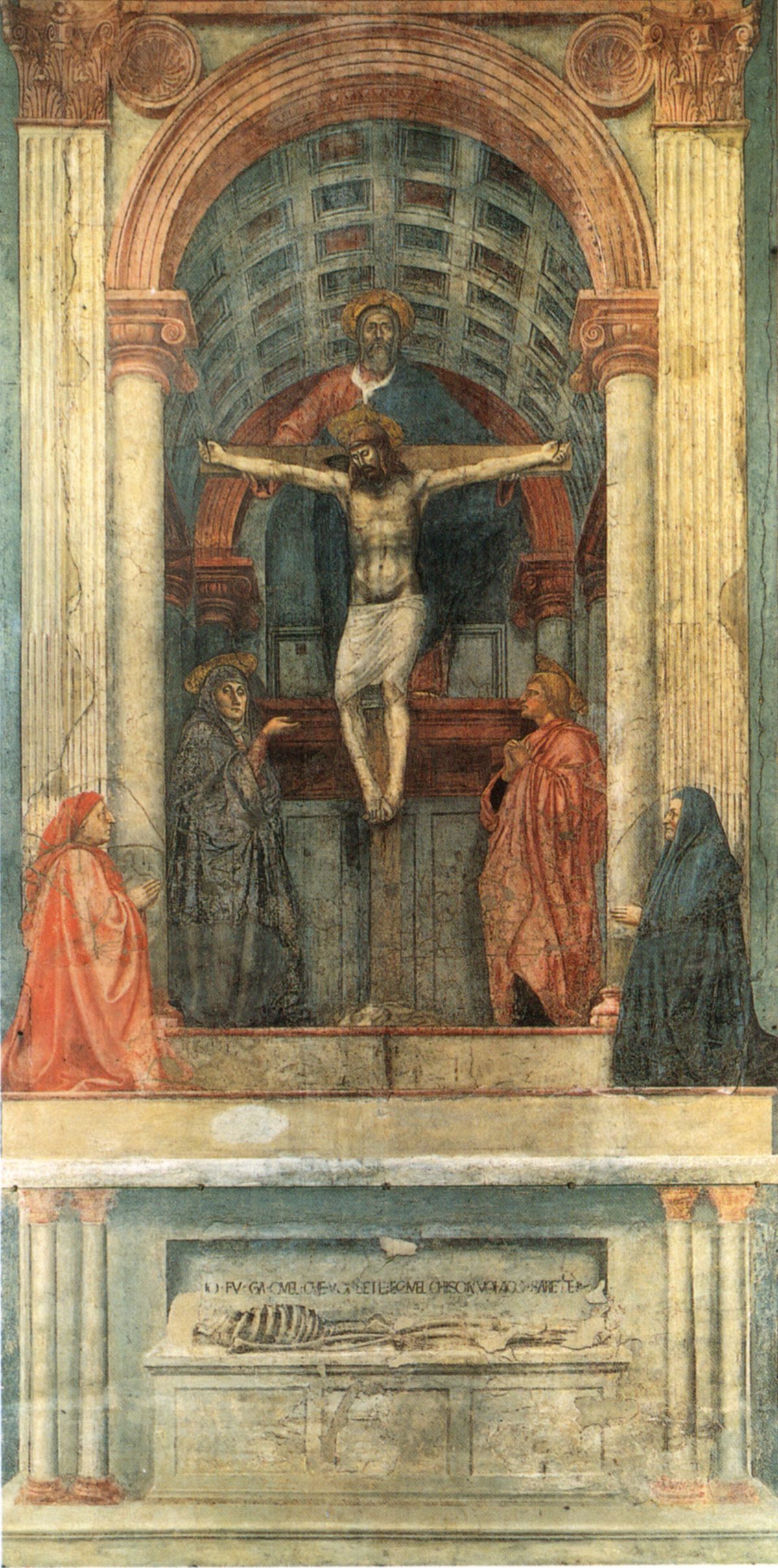
Masaccio's Trinity in Santa Maria Novella is one of the most important paintings in the history of art — the first known use of rigorous linear perspective in a large-scale painting, and the work that founded the Renaissance approach to pictorial space. The fresco shows the Trinity (God the Father holding the cross with the crucified Christ, the dove of the Holy Spirit between them) in a coffered barrel-vaulted chamber of Albertian architecture — the painted space is so convincingly three-dimensional that contemporaries reported it appeared to be a real chapel cut into the wall. Kneeling outside the architectural frame are two donors; below them, in a predella, a skeleton on a tomb bears the inscription: 'I was once what you are, and what I am you shall also be.'
Masaccio (1401–1428) died at 26 or 27, having transformed European painting in approximately six years of mature work. The Trinity fresco was probably commissioned around 1425 by the Lenzi family and completed before his death.
Filippo Brunelleschi, who had recently codified the mathematical system of one-point perspective, was Masaccio's associate and likely advised on the architectural construction. The illusionistic barrel vault in the painting is precisely calculated from a single vanishing point at the viewer's eye level — a fact that can be verified by extending the architectural lines to their convergence. The architecture depicted appears to be in the new Florentine style of Brunelleschi — classical pilasters, Ionic capitals, coffered vault — applied to a religious subject for the first time.
Stand at the painting and look at the vanishing point — at approximately eye level, in the centre of the lower section, just above the donor figures. From that point, all the lines of the architecture converge correctly.
The illusion of depth in the vault is so convincing that the painting was whitewashed in the 16th century (possibly during Vasari's renovation of the church) and lost for centuries until rediscovered in 1861. The skeleton inscription below is a momento mori that contrasts with the eternal life promised by the Trinitarian composition above — the donors kneel between mortal reminder and divine promise. God the Father above is depicted as an elderly man standing on a ledge behind Christ — one of the earliest dignified depictions of God the Father in Western art.
When standing before this work, look carefully: The Holy Trinity — Masaccio, c.1425-1428. Give it time — what seems decorative often carries the central meaning.
When standing before this work, look carefully: The barrel vault — Renaissance perspective in action. Give it time — what seems decorative often carries the central meaning.
When standing before this work, look carefully: The skeleton predella — 'I was what you are'. Give it time — what seems decorative often carries the central meaning.
When standing before this work, look carefully: Santa Maria Novella — the church exterior. Give it time — what seems decorative often carries the central meaning.
Santa Maria Novella, Piazza Santa Maria Novella, Florence. The fresco is on the left wall of the nave. The church also contains important frescoes by Ghirlandaio (in the Tornabuoni Chapel) and Filippino Lippi (Strozzi Chapel).