
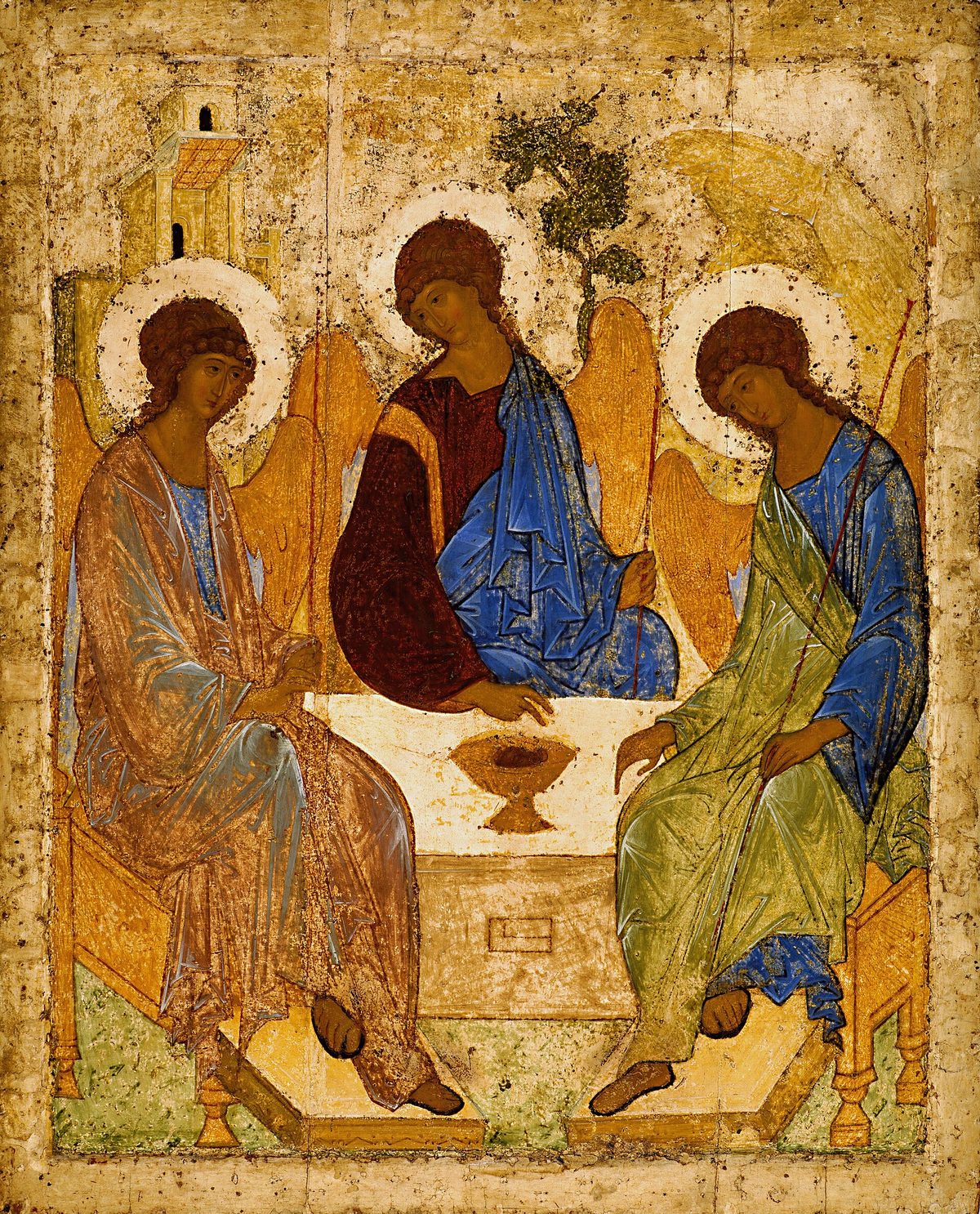
The Holy Trinity (Icon of the Trinity / Troitsa)
The Holy Trinity — Andrei Rublev, c.1411-1425
Andrei Rublev, Public domain, via Wikimedia Commons
Andrei Rublev's Trinity icon is the supreme work of Russian religious art and one of the most profound theological images in the history of Christianity. The panel (approximately 142 by 114 cm) depicts three angels seated around a table on which rests a chalice — the subject, taken from Genesis 18 (the visit of three angels to Abraham at Mamre), is understood in Orthodox theology as a pre-incarnate revelation of the Trinity.
The three figures are arranged in a circle; the composition has a perfect internal symmetry and balance achieved through the slight incline of each angel's head toward the centre. The colour scheme is unprecedented in Russian icon painting: the central angel (Christ, the Second Person) wears a blue garment and a gold himation; the left angel (the Father) wears pale iridescent colours; the right angel (the Spirit) wears green and blue. The chalice on the table is the Eucharistic cup — the whole icon is a meditation on the Trinity as love, hospitality, and sacrifice.
Andrei Rublev (c.1360-1430) was a monk of the Trinity-St Sergius Monastery (Troitse-Sergieva Lavra) near Moscow and the greatest Russian icon painter. The Trinity was made for the Trinity Cathedral of the monastery as a memorial to St Sergius of Radonezh (who had a particular devotion to the Trinity).
In 1551, the Council of the Hundred Chapters (Stoglav Sobor) declared the Rublev Trinity the canonical model for all subsequent Trinity icons — a theological and artistic ruling of extraordinary consequence. The icon suffered damage over centuries and was restored in 1904-1905; subsequent scientific examination has confirmed the 15th-century date.
The theological key to the icon is the circle: the three figures form a perfect circle, expressing the mutual indwelling of the Three Persons (perichoresis). The chalice at the centre of the table is the Eucharistic cup — the angels are blessing it, and the viewer is invited into their circular movement of self-giving love.
Notice that the three figures have identical faces — three expressions of the same divine being. The open space at the front of the table (between the viewer and the angels) is traditionally read as a place reserved for the viewer: you are invited to enter the circle. The blue of the central angel's robe is the colour of heaven and eternity — the specific shade of blue (lapis-lazuli) used by Rublev is one of the most beautiful in all medieval painting.
When standing before this work, look carefully: The Holy Trinity — Andrei Rublev, c.1411-1425. Give it time — what seems decorative often carries the central meaning.
When standing before this work, look carefully: The chalice — the Eucharistic cup at the centre. Give it time — what seems decorative often carries the central meaning.
When standing before this work, look carefully: The circular composition — the three angels as one movement. Give it time — what seems decorative often carries the central meaning.
When standing before this work, look carefully: The central angel (Christ) — blue robe and gold himation. Give it time — what seems decorative often carries the central meaning.
State Tretyakov Gallery, Lavrushinsky Lane 10, Moscow. The Trinity icon is housed in a specially designed case with controlled humidity and lighting in Room 60 of the main gallery building.