
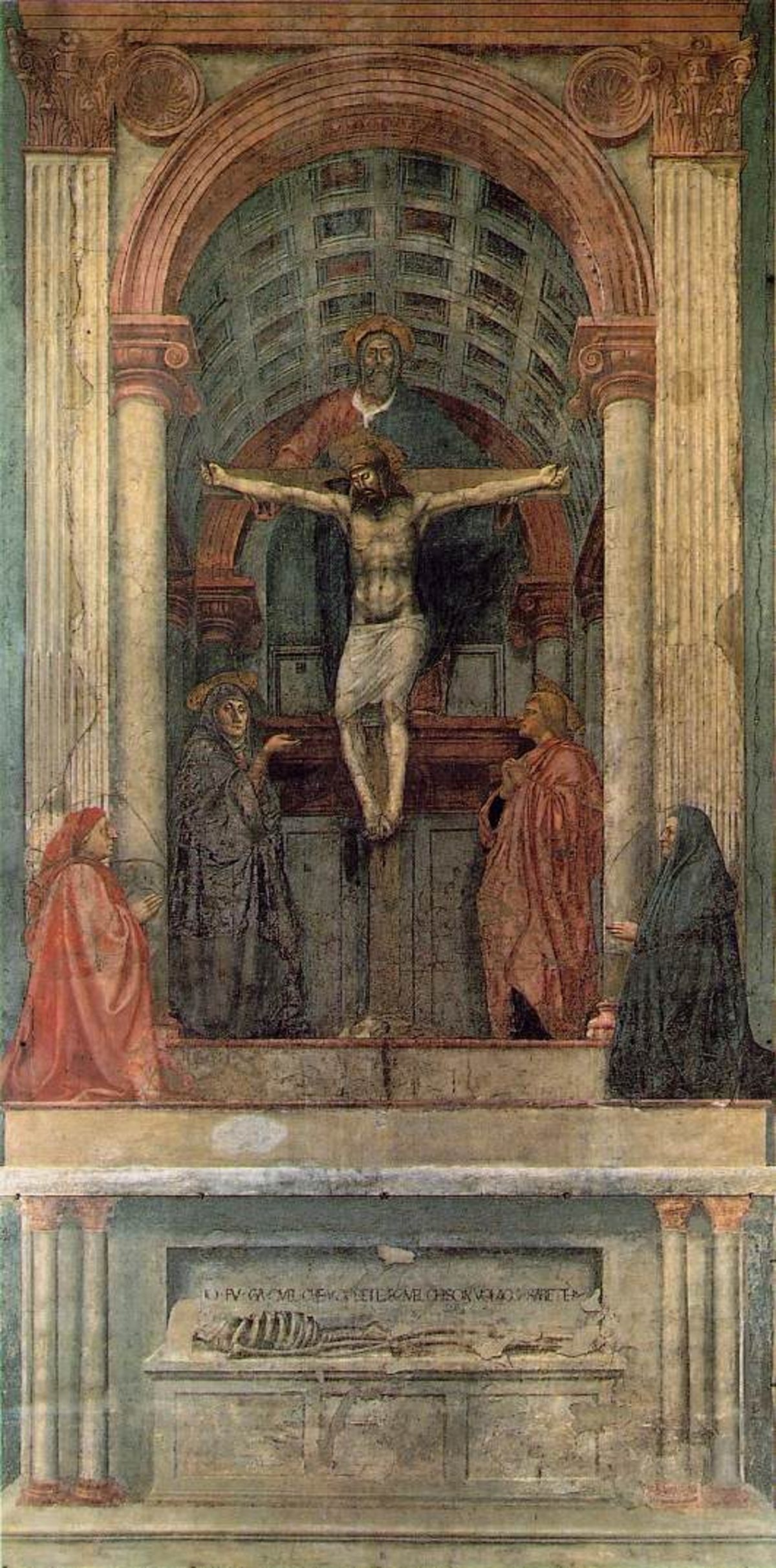
The Holy Trinity with the Virgin, St John, and Donors
Holy Trinity — Masaccio, c.1427, Santa Maria Novella
Masaccio, Public domain, via Wikimedia Commons
Masaccio's Holy Trinity fresco in Santa Maria Novella is one of the most important works in the history of Western art — the first painting in history to apply single-point perspective systematically to a monumental composition. The fresco shows the Trinity (God the Father standing behind and above the cross, the Holy Spirit as a dove between Father and Son, Christ crucified) in a barrel-vaulted architectural niche of perfect mathematical perspectival construction.
Below the niche, the Virgin and St John stand as witnesses; kneeling outside the niche on either side are the two donors. Below the entire scene, a painted sepulchre shows a skeleton and the inscription: 'I was what you are, and what I am you will be.' The architectural niche is so convincingly constructed that 15th-century viewers reportedly approached it to verify that it was a real opening in the wall.
Masaccio (1401-1428) died aged approximately 27, having in seven or eight years of activity transformed Italian painting. His major surviving works are the Brancacci Chapel frescoes (with Masolino, c.1424-1428, Santa Maria del Carmine, Florence) and this Holy Trinity fresco.
Both demonstrate the same revolutionary synthesis: the spatial logic of Brunelleschi's perspective, the physical mass and psychological weight of Donatello's sculpture, and an emotional gravity that has no precedent in painting. The Holy Trinity's architectural setting was constructed using Brunelleschi's mathematical method — Masaccio may have worked with Brunelleschi directly on the perspectival scheme.
Stand in front of the fresco and allow the perspective to work: the barrel-vaulted niche appears to recede into the wall behind the painted surface, creating an illusion of real depth. The vanishing point is at eye level — Masaccio calculated the height of the viewer and placed the vanishing point accordingly, so that the perspective works correctly from the standing viewer's position. Below the niche, the sepulchre with the skeleton is a memento mori — the viewer is positioned between the promise of the Trinity above and the certainty of death below.
When standing before this work, look carefully: Holy Trinity — Masaccio, c.1427, Santa Maria Novella. Give it time — what seems decorative often carries the central meaning.
When standing before this work, look carefully: Perspectival construction — Brunelleschi's method applied. Give it time — what seems decorative often carries the central meaning.
When standing before this work, look carefully: Skeleton and inscription — memento mori below the Trinity. Give it time — what seems decorative often carries the central meaning.
When standing before this work, look carefully: Donor figures — kneeling outside the painted niche. Give it time — what seems decorative often carries the central meaning.
Santa Maria Novella, Piazza di Santa Maria Novella, Florence. The fresco is on the left (north) wall of the nave, approximately two-thirds of the way toward the altar. Museum admission required.