
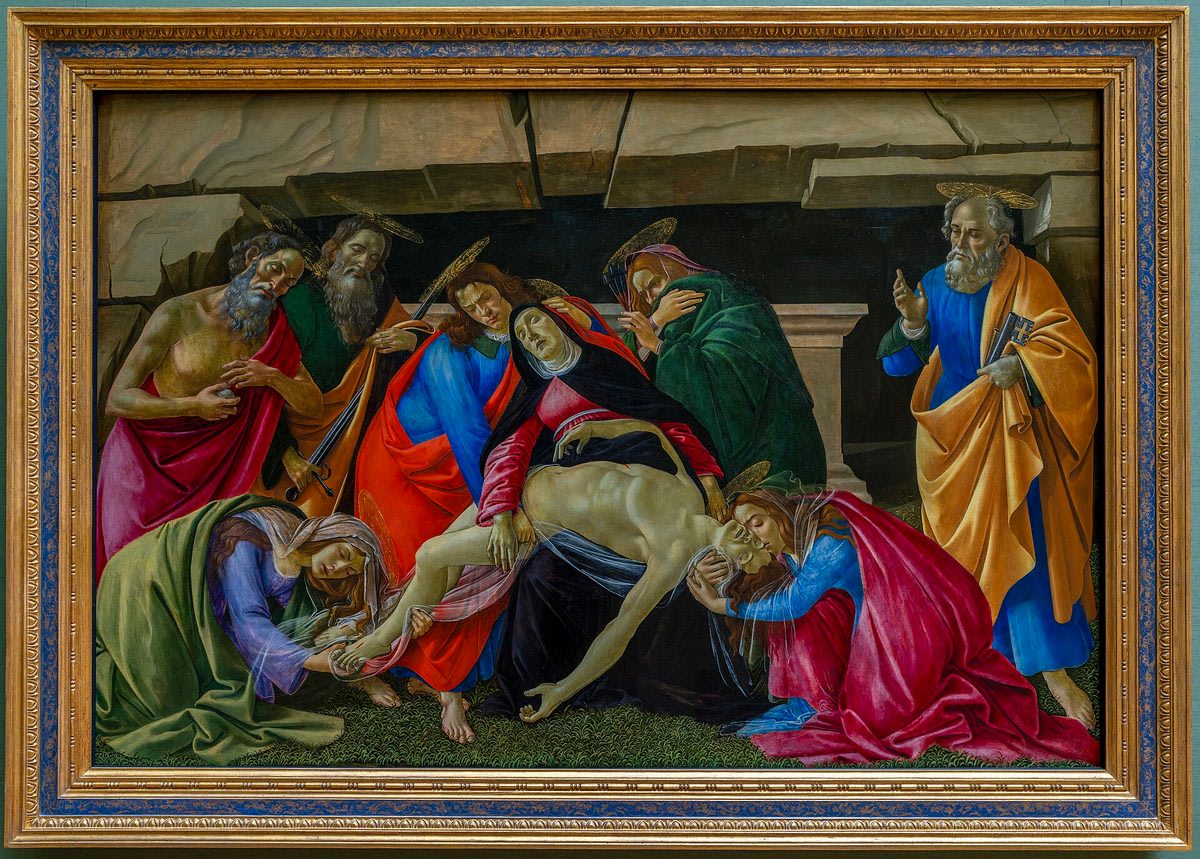
The Lamentation of Christ
Lamentation of Christ — Botticelli, c.1490-1495
Sandro Botticelli, Public domain, via Wikimedia Commons
Botticelli's Lamentation of Christ in Munich is a large altarpiece (approximately 107 by 71 cm) from the early 1490s — the period of the artist's conversion to the intense religious programme of Savonarola in Florence. The composition shows the dead Christ laid across the lap of the Virgin, with the Magdalene to the right clasping his feet, St John the Evangelist to the left supporting his upper body, and Joseph of Arimathea and Nicodemus in the background.
The figures are arranged in a shallow frieze across the foreground; the gold mosaic background (a deliberate archaism, returning to the medieval tradition) reinforces the devotional intensity. The composition is strongly influenced by the German and Flemish tradition of the Lamentation (the Vesper image or Pietà) — unusual for a Florentine painter of Botticelli's generation and probably reflects the influence of northern devotional prints that were circulating in Florence.
Sandro Botticelli (1444/45-1510) underwent a profound personal and artistic transformation in the 1490s under the influence of the Dominican friar Girolamo Savonarola (1452-1498) — who preached against the worldliness of Florentine art and society and whose burning of vanities (the 'Bonfire of the Vanities', 1497) reportedly included some of Botticelli's secular paintings. The late Botticelli is a different painter from the early Botticelli: the mythological grace of the Venus and the Spring gives way to a religious intensity and a formal archaism (the gold ground, the devotional compression) that reflects his Savonarolan conversion.
The use of a gold background in a late 15th-century Florentine altarpiece is a deliberate anachronism — by 1490, the landscape or architectural background was the norm. Botticelli's return to gold is a theological statement: the timeless, eternal light of the gold ground is more appropriate to the subject (the dead Christ, the beginning of the Redemption) than a naturalistic earthly landscape. Compare this altarpiece with the earlier Primavera and Venus — the same sinuous Botticelli line is present, but in service of grief rather than beauty.
When standing before this work, look carefully: Lamentation of Christ — Botticelli, c.1490-1495. Give it time — what seems decorative often carries the central meaning.
When standing before this work, look carefully: The Virgin holding Christ — the Pietà group. Give it time — what seems decorative often carries the central meaning.
When standing before this work, look carefully: The gold mosaic background — deliberate archaism. Give it time — what seems decorative often carries the central meaning.
When standing before this work, look carefully: Mary Magdalene clasping Christ's feet. Give it time — what seems decorative often carries the central meaning.
Alte Pinakothek, Barer Strasse 27, Munich. Open Tuesday-Sunday; admission fee. One of the greatest collections of early European painting in the world.