
The Last Supper
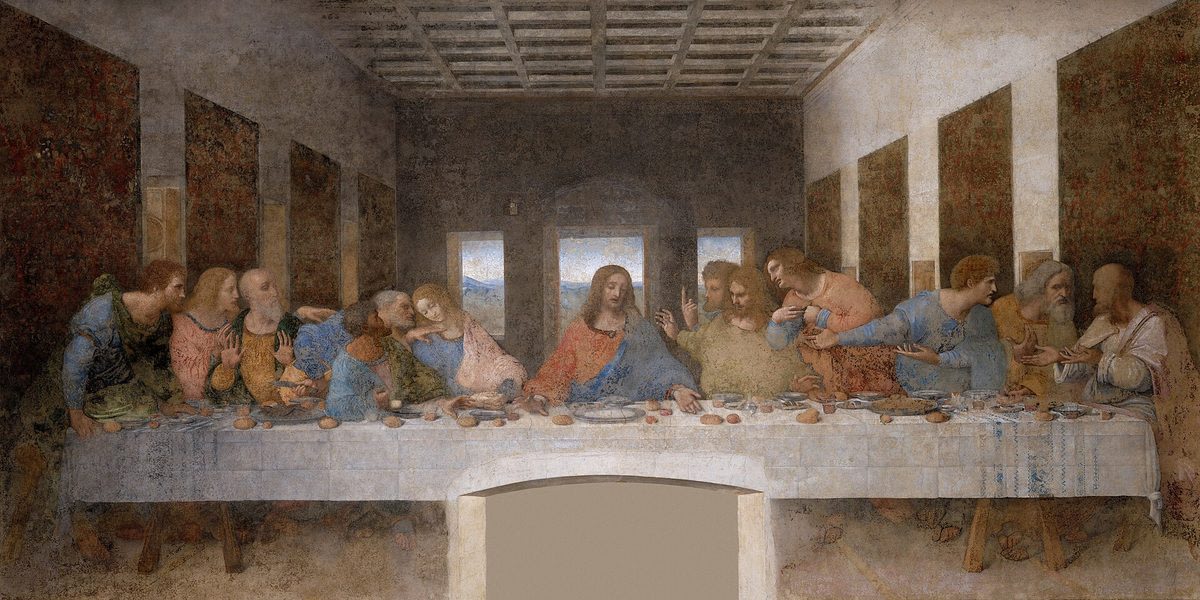
The Last Supper — full composition (high resolution)
Leonardo da Vinci, Public domain, via Wikimedia Commons
Leonardo's Last Supper is the most studied single painting in the world — a monumental mural (460 cm × 880 cm) painted on the end wall of the refectory of Santa Maria delle Grazie in Milan, depicting the moment Christ announces that one of the twelve apostles will betray him. The painting is remarkable for its psychological complexity: each apostle reacts to the announcement with a distinct gesture and expression, arranged in four groups of three on either side of the solitary, serene Christ at the centre.
The painting has been analysed, debated, and copied obsessively for five centuries. It is also one of the most damaged major works in existence — Leonardo's experimental technique (tempera and oil on dry plaster rather than true fresco) began deteriorating almost immediately after completion.
Leonardo da Vinci (1452–1519) accepted the commission from Ludovico Sforza, Duke of Milan, around 1494-95. His unconventional technique — painting on dry plaster to achieve the finish of a panel painting rather than the speed of fresco — proved disastrous: within twenty years the work was already flaking.
Over the centuries it has survived two floods, a doorway cut through the lower centre (which destroyed the feet of several apostles), and a World War II bombing that destroyed the refectory roof while the wall miraculously survived. Restoration campaigns in the 17th, 18th, 19th, and 20th centuries added and removed layers of repainting. The most recent restoration (1978-1999) removed all later additions to reveal what remains of Leonardo's original work — considerably less than most reproductions suggest.
The compositional genius lies in the arrangement of the apostles: twelve men whose simultaneous reactions to a single announcement are individually differentiated while creating a coherent visual flow from right to left toward Christ. Read from left to right: Bartholomew, James the Less, Andrew (three old men, astonished); Judas (reaching across the table, in shadow, clutching a bag), Peter (leaning toward Christ with a knife), and John (the youngest, inclining away from Peter); Christ himself at the exact centre; Thomas (finger raised), James the Greater (arms wide), Philip (hand to chest); Matthew, Thaddaeus, and Simon arguing at the right. The window behind Christ frames his head against the sky — he is both illuminated from within and silhouetted against light.
When standing before this work, look carefully: The Last Supper — full composition (high resolution). Give it time — what seems decorative often carries the central meaning.
When standing before this work, look carefully: Christ at the centre — the serene announcement. Give it time — what seems decorative often carries the central meaning.
When standing before this work, look carefully: Judas in shadow, clutching the bag. Give it time — what seems decorative often carries the central meaning.
When standing before this work, look carefully: The refectory of Santa Maria delle Grazie, Milan. Give it time — what seems decorative often carries the central meaning.
Santa Maria delle Grazie is a UNESCO World Heritage site. Visits to the refectory are strictly limited to 15 minutes, with groups of 30 persons entering at intervals; tickets must be booked well in advance (often months ahead for peak season) at cenacolovinciano.vivaticket.it.
The lighting in the refectory is carefully controlled. The painting is best viewed from the centre of the room; the perspective is designed for a viewer standing at a specific point approximately 15 metres from the wall. It is frequently fully booked; check months ahead.