
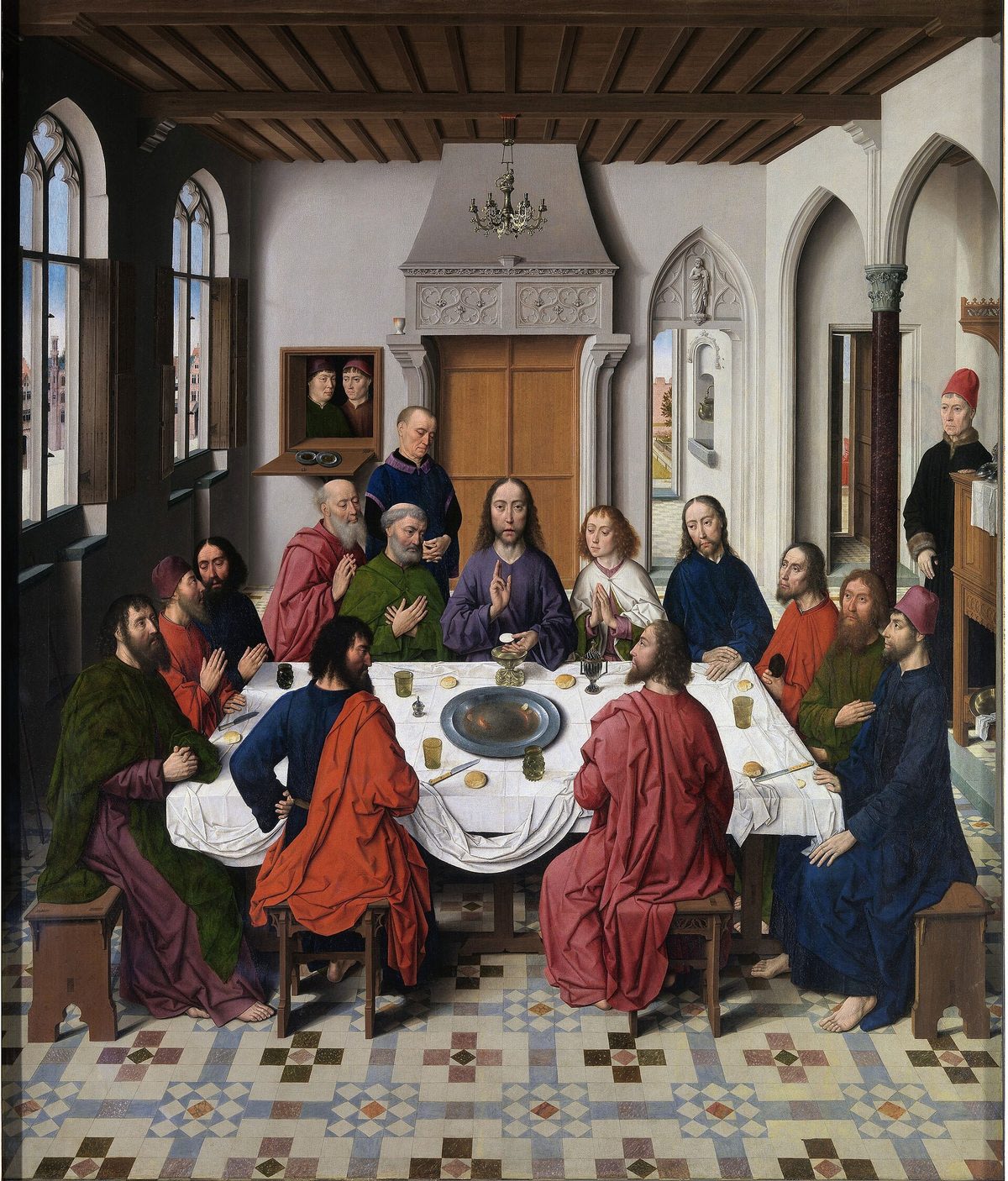
The Last Supper (Central Panel)
Last Supper — Dieric Bouts, 1464-1468, central panel
Dieric Bouts, Public domain, via Wikimedia Commons
Dieric Bouts's Last Supper is the first monumental depiction of the Last Supper in Northern European panel painting to focus entirely on the institution of the Eucharist (the moment of the blessing and breaking of bread) rather than the identification of Judas. Bouts depicted Christ at the centre of the table, blessing the bread, while the twelve apostles attend in quiet concentration — no betrayal gesture, no dramatic confrontation with Judas, but a solemn celebration of the Eucharistic rite.
The scene is set in a contemporary Flemish interior of great spatial precision (a tile floor, a view through a window to a typical Flemish town outside, a serving table at the rear with a servant). The triptych wings depict Old Testament prefigurations of the Eucharist: the Passover Meal, Elijah Refreshed by an Angel, and the Gathering of Manna.
Dieric Bouts (c.1415-1475) was a Flemish master whose contribution to the development of single-point perspective and spatial interior painting was equalled only by van Eyck. The Last Supper was commissioned by the Confraternity of the Holy Sacrament of St Peter's Church in Leuven and painted between 1464 and 1468 under the theological supervision of two theologians from the University of Leuven (the theological programme for each scene was determined by the commission). The spatial construction of the central room is among the most precisely rendered interiors in 15th-century European painting: the tile floor, the beamed ceiling, the window views, and the positioning of all figures follow a rigorous single-point perspective system.
The spatial illusion of the room is the painting's formal triumph: stand in front of it and look at the tile floor — the receding diagonal of the tiles converges on a single vanishing point, creating a room of convincing depth that extends behind the picture plane. The twelve apostles are arranged around three sides of the table (the side facing the viewer is empty, inviting the viewer's participation in the Eucharist).
Christ's blessing gesture is calm and formal — a liturgical act, not a dramatic moment. Judas is present but not identified; all twelve faces are equally attentive. The four Old Testament wings place the Eucharist in the typological framework of salvation history: each wing scene is a prefiguration of the central Eucharistic event.
When standing before this work, look carefully: Last Supper — Dieric Bouts, 1464-1468, central panel. Give it time — what seems decorative often carries the central meaning.
When standing before this work, look carefully: The tile floor — single-point perspective precision. Give it time — what seems decorative often carries the central meaning.
When standing before this work, look carefully: Christ blessing the bread — the Eucharistic rite. Give it time — what seems decorative often carries the central meaning.
When standing before this work, look carefully: The Gathering of Manna — Old Testament wing. Give it time — what seems decorative often carries the central meaning.
St Peter's Church (Sint-Pieterskerk), Grote Markt, Leuven. The Last Supper is displayed in the church in an area that requires a separate admission ticket. Leuven is approximately 25 km from Brussels; easily reached by train.