
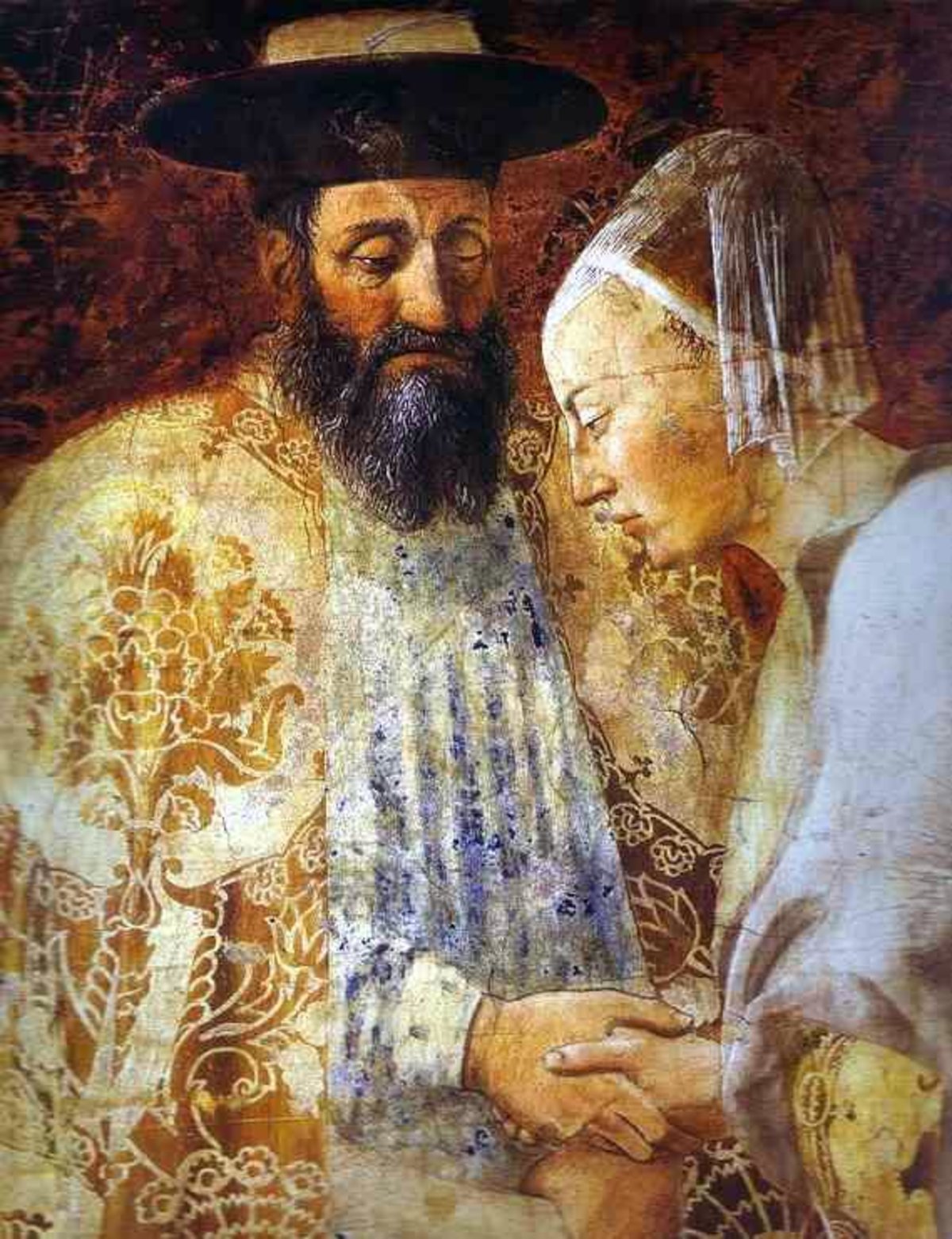
The Legend of the True Cross
Legend of the True Cross — Piero, Bacci Chapel, Arezzo
Piero della Francesca, Public domain, via Wikimedia Commons
Piero della Francesca's Legend of the True Cross in the Bacci Chapel of San Francesco in Arezzo is the greatest fresco cycle of the Italian Renaissance outside of Florence — ten large frescoes and two smaller lunettes depicting the legendary history of the wood of the Cross, from the Tree of Life planted at Adam's death through the Emperor Constantine's victory at the Battle of Milvian Bridge (where he saw the vision of the Cross) and the Emperor Heraclius's restoration of the True Cross to Jerusalem. The cycle is extraordinarily complex in its narrative, extraordinarily refined in its composition, and extraordinarily innovative in its treatment of light: Piero uses a single consistent light source (from the right) across all the frescoes, creating a unified atmospheric effect across the entire chapel that is unprecedented in fresco painting before this date. The Queen of Sheba's visit to Solomon (east wall, upper register) and the Battle of Milvian Bridge (east wall, lower register) are generally considered the finest individual compositions.
The Legend of the True Cross (the Golden Legend narrative by Jacobus de Voragine) was the primary source; Piero's interpretation is characteristically intellectual and geometric: the human figures have the quality of Euclidean solids, the landscapes have the quality of mathematical diagrams, and the light is not atmospheric but geometric — consistent, controlled, and exact. The Arezzo cycle was Piero's largest commission and the work that most clearly demonstrates his programme of uniting Christian devotion with humanist intellectual rigour.
Timed entry tickets are required for the Bacci Chapel. Begin with the cycle from the upper left (east wall, top: Adoration of the Sacred Wood and the Queen of Sheba) and work around the chapel clockwise.
The light in the frescoes — morning light from the right — creates long shadows and specific colour saturations that reward slow study. The Battle of Milvian Bridge (east wall lower register) is among the most remarkable depictions of military action in Renaissance painting: the calm geometry of the composition (horses and soldiers arranged like chess pieces) contrasts with the violence of the narrative.
When standing before this work, look carefully: Legend of the True Cross — Piero, Bacci Chapel, Arezzo. Give it time — what seems decorative often carries the central meaning.
When standing before this work, look carefully: Queen of Sheba visiting Solomon — east wall, upper register. Give it time — what seems decorative often carries the central meaning.
When standing before this work, look carefully: Battle of Milvian Bridge — Constantine's victory. Give it time — what seems decorative often carries the central meaning.
When standing before this work, look carefully: The Annunciation — north wall, upper register. Give it time — what seems decorative often carries the central meaning.
Basilica di San Francesco, Piazza San Francesco, Arezzo. The Bacci Chapel requires a timed ticket with advance reservation (essential).
Open Monday-Friday and Saturday morning; closed Sundays (open for Mass). Arezzo is approximately 1 hour from Florence by train.