
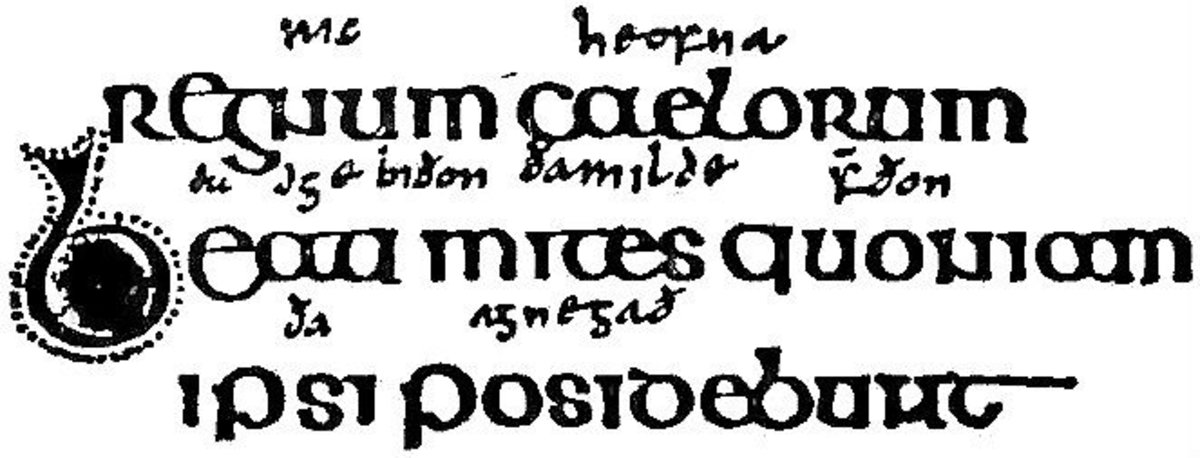
The Lindisfarne Gospels
Lindisfarne Gospels — St John carpet page
Public domain, via Wikimedia Commons
The Lindisfarne Gospels are the greatest single work of Insular illuminated manuscript art — a complete Gospel book written and decorated by Eadfrith, Bishop of Lindisfarne (died 721), on the island of Lindisfarne (Holy Island) off the coast of Northumbria between approximately 715 and 721 AD. The manuscript contains 259 vellum folios with five full-page 'carpet' pages (purely abstract ornamental compositions), five portrait pages of the Evangelists, five opening incipit pages with major decorated initials, and small decorated initials throughout.
The carpet pages — pure abstract interlace — are the most complex abstract ornament produced in the history of Western art: the St John carpet page, for example, contains no figurative element, only intertwined ribbons, spirals, and zoomorphic forms arranged with a mathematical precision that defies the eye to find its way in or out. The Lindisfarne Gospels were probably made in honour of St Cuthbert (d.687), the most revered saint of Northumbria.
Eadfrith is identified as the scribe and artist by an inscription added in the 10th century by the priest Aldred, who also added an interlinear Old English gloss — the oldest surviving translation of any portion of the Gospels into English. The manuscript was made in approximately 715-721; it was housed at Lindisfarne until the Viking raids of the 9th century, when the monks fled carrying the body of St Cuthbert and the Gospels. The manuscript eventually reached Chester-le-Street and then Durham Cathedral, where it remained until the dissolution of the monasteries; it entered the British Museum (now British Library) in 1753.
The British Library displays the Lindisfarne Gospels in its Treasures Gallery alongside the Magna Carta and the Gutenberg Bible. The display shows two pages of the manuscript open in a specially controlled case.
The facsimile (available in the British Library shop) allows close study of the complete manuscript. Compare the carpet pages of the Lindisfarne Gospels with those of the Book of Kells: they are contemporary works in the same tradition, but distinct in their approaches — Lindisfarne slightly more austere and geometric, Kells slightly more exuberant and figurative.
When standing before this work, look carefully: Lindisfarne Gospels — St John carpet page. Give it time — what seems decorative often carries the central meaning.
When standing before this work, look carefully: St Matthew portrait — Evangelist portrait page. Give it time — what seems decorative often carries the central meaning.
When standing before this work, look carefully: Chi-rho opening page — Lindisfarne style. Give it time — what seems decorative often carries the central meaning.
When standing before this work, look carefully: British Library Treasures Gallery. Give it time — what seems decorative often carries the central meaning.
British Library, 96 Euston Road, London. The Treasures Gallery is free to enter. Open Monday-Saturday and on Sunday afternoons.