
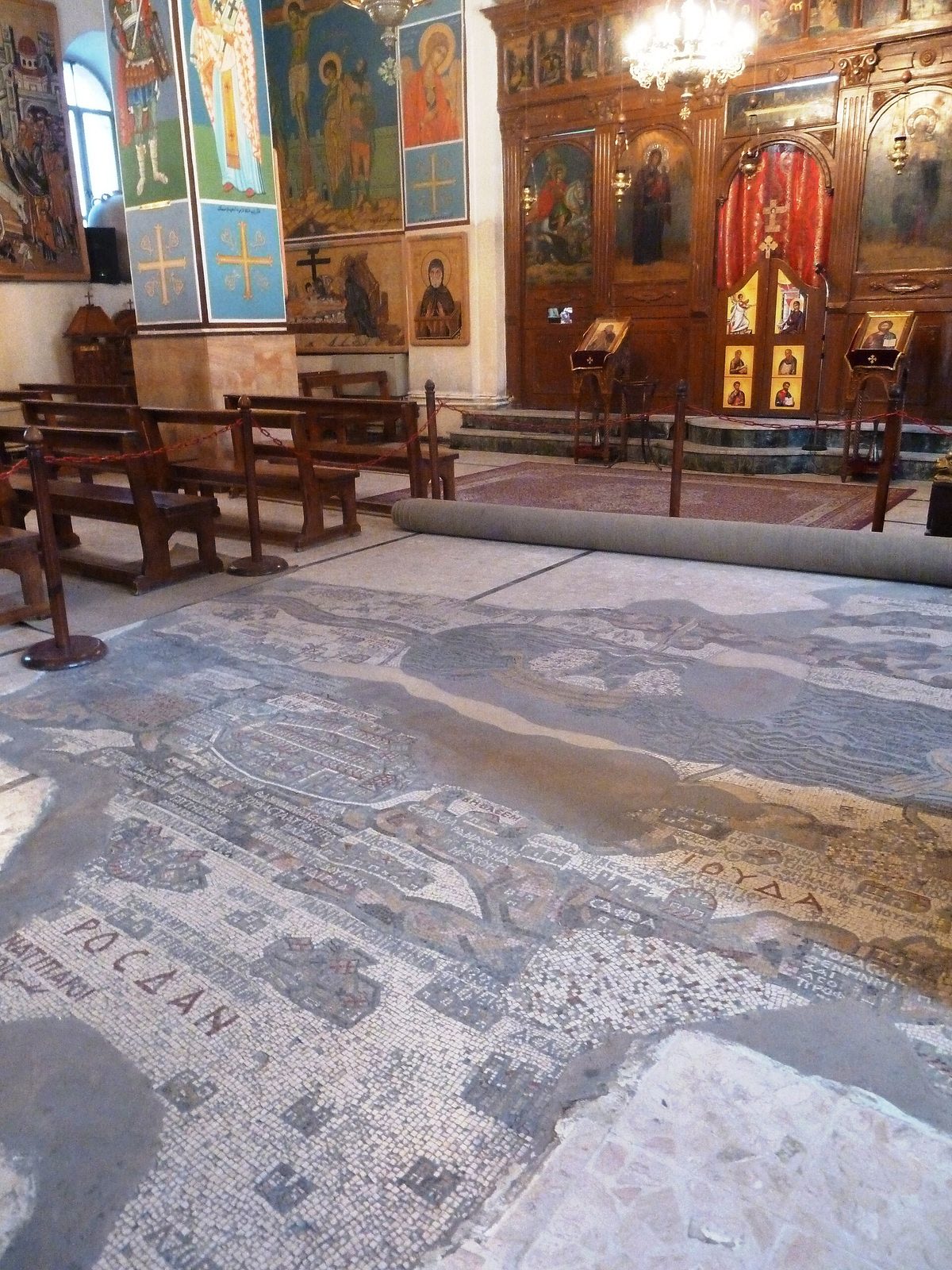
The Madaba Mosaic Map
The Madaba Mosaic Map — overview, c.560 AD
Public domain, via Wikimedia Commons
The Madaba Mosaic Map is the oldest surviving cartographic representation of the Holy Land — a floor mosaic made around 560 AD in the Byzantine city of Madaba (in present-day Jordan), depicting the Middle East from Lebanon in the north to the Nile Delta in the south, centred on Jerusalem. The mosaic originally covered approximately 94 square metres; the surviving portion (approximately 25 square metres, heavily damaged) is preserved in the nave of St George's Greek Orthodox Church in Madaba.
The Jerusalem section is the most detailed and significant: it shows the city's streets, gates, and major buildings in a bird's-eye view, including the Cardo Maximus (the colonnaded main street), the Church of the Holy Sepulchre, the Damascus Gate, and the Nea Ekklesia (the New Church, built by Justinian in 543 AD). The map uses Greek inscriptions to identify over 150 places, 156 of which are still legible.
The mosaic was made for the pavement of a Byzantine church in Madaba — probably the church that preceded the current St George's Church on the same site. It was discovered in 1884 during the construction of the current church, when part of the mosaic was destroyed by the building work.
The map is not a geographical survey in the modern sense but a pilgrimage map: the most important Christian sacred sites are depicted at larger scale than their true geographic proportions, and the routes between them are highlighted. The Dead Sea in the mosaic is populated with swimming fish (and fish swimming away from the salt water back toward the fresh-water Jordan) — a vivid combination of geographic observation and symbolic thinking.
The Jerusalem panel is the centrepiece of the map and the most detailed section. With a guidebook or the church's explanatory panels, identify: the Cardo (the wide central street with columns visible as rows of dots on both sides), the Church of the Holy Sepulchre (a large basilica visible as a distinctive red-roofed building in the centre-west of the city), the Damascus Gate (the north gate, clearly shown), and the sheep gate (Lion's Gate area). The fish swimming in the Dead Sea are charming and specific: the tesserae rendering of the fish is of high quality.
When standing before this work, look carefully: The Madaba Mosaic Map — overview, c.560 AD. Give it time — what seems decorative often carries the central meaning.
When standing before this work, look carefully: Jerusalem panel — Cardo and Church of the Holy Sepulchre. Give it time — what seems decorative often carries the central meaning.
When standing before this work, look carefully: Dead Sea detail — fish swimming in the mosaic. Give it time — what seems decorative often carries the central meaning.
When standing before this work, look carefully: St George's Church, Madaba. Give it time — what seems decorative often carries the central meaning.
St George's Church, Madaba, Jordan. Madaba is approximately 30 km south-west of Amman.
The church is open to visitors; a small admission fee is charged. The mosaic is in the nave floor, protected by a walkway.