
The Madonna of Chancellor Rolin
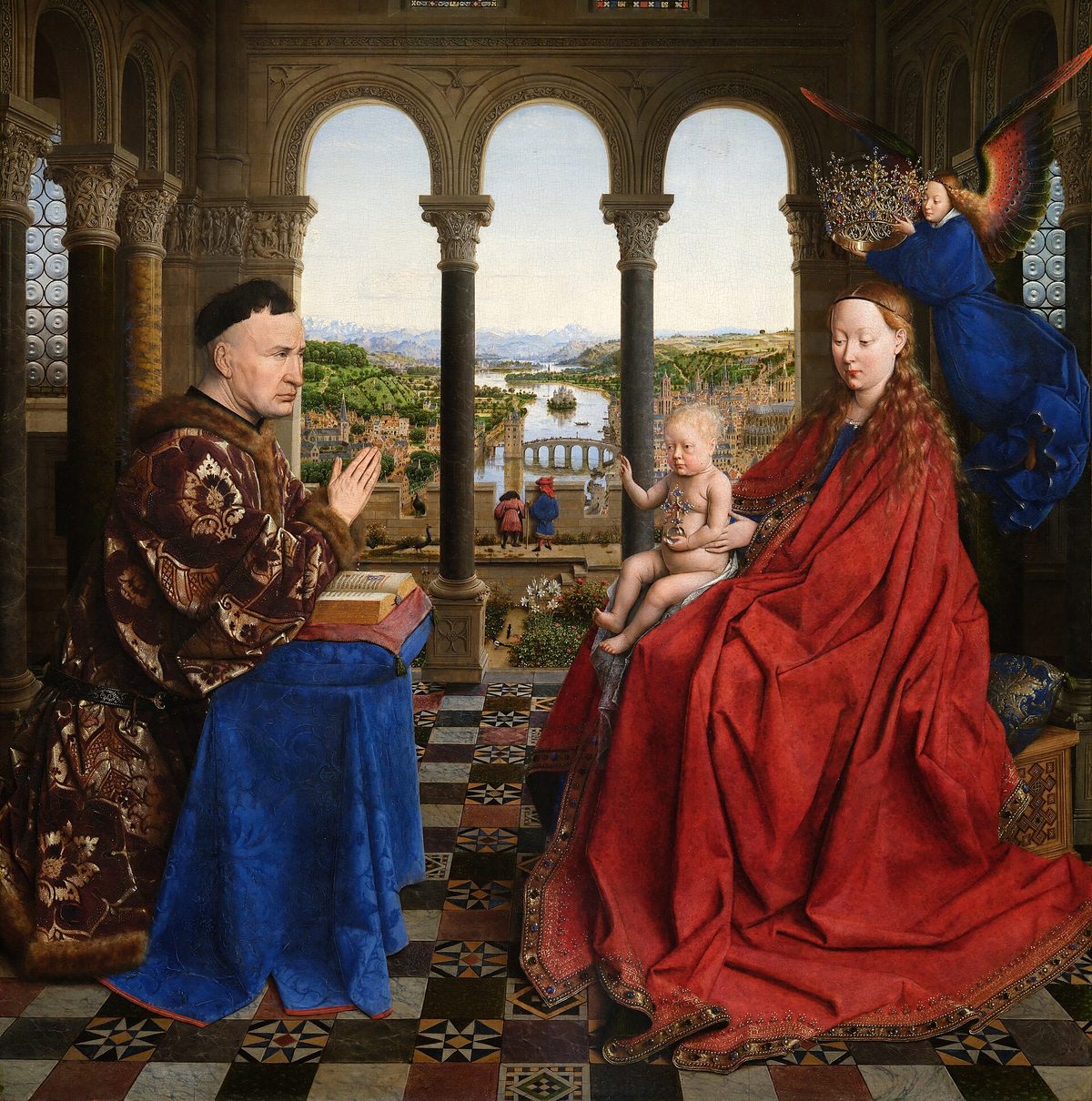
Madonna of Chancellor Rolin — Jan van Eyck, c.1434-1435
Jan van Eyck, Public domain, via Wikimedia Commons
Jan van Eyck's Madonna of Chancellor Rolin is one of the founding masterpieces of Flemish painting — a panel in which the Virgin and Child appear in an elaborate Flemish interior facing Chancellor Nicolas Rolin, the most powerful minister of Philip the Good of Burgundy, who commissioned the painting for his private devotion. An angel hovers between the two figures, placing a crown on the Virgin's head.
Behind them, a balcony with two figures looking over a river cityscape — a landscape of extraordinary depth and precision (identified as a composite of Liège and Maastricht, or possibly a fictive Burgundian city) recedes into an atmospheric haze of hills and sky. The entire painting is a demonstration of van Eyck's technique at its most extraordinary: every tile in the floor, every gem in the crown, every thread in Rolin's brocade, every leaf in the riverbank trees is depicted with the precision of a jeweller.
Jan van Eyck (c.1390-1441) received the commission from Nicolas Rolin, who was a controversial figure: enormously powerful, enormously wealthy, and reportedly not scrupulous in his exercise of power. The painting places him in the presence of the Virgin and Child with a directness that implies either great personal piety or great presumption — the two figures face each other as equals in the painting's spatial logic.
The carpet of lily-of-the-valley (a Marian flower) covers the floor between them; the three arches behind open to the cityscape. Van Eyck's technical virtuosity is the subject of the painting as much as its devotional programme: the painting is a demonstration that Flemish oil technique can render any surface, any texture, any depth.
Stand close to the panel and look at the surfaces: the brocade of Rolin's robe (individual threads of gold on a red field, each thread reflecting the light differently), the gems of the crown (each one a specific coloured stone with its own internal light), the floor tiles (reflective marble, each one slightly different), the distant landscape (aerial perspective — the trees are specific species close up, dissolving to a blue haze at the horizon). Then look at Rolin's face: specific, confident, the face of a man accustomed to power, not a devotional face. The confrontation between this face and the serene Virgin is the painting's psychological drama.
When standing before this work, look carefully: Madonna of Chancellor Rolin — Jan van Eyck, c.1434-1435. Give it time — what seems decorative often carries the central meaning.
When standing before this work, look carefully: Rolin's brocade robe — van Eyck's surface precision. Give it time — what seems decorative often carries the central meaning.
When standing before this work, look carefully: The river cityscape — atmospheric perspective. Give it time — what seems decorative often carries the central meaning.
When standing before this work, look carefully: The crown — individual gems in van Eyck's light. Give it time — what seems decorative often carries the central meaning.
Musée du Louvre, Room 4, Denon Wing. One of the principal works in the Flemish collection.