
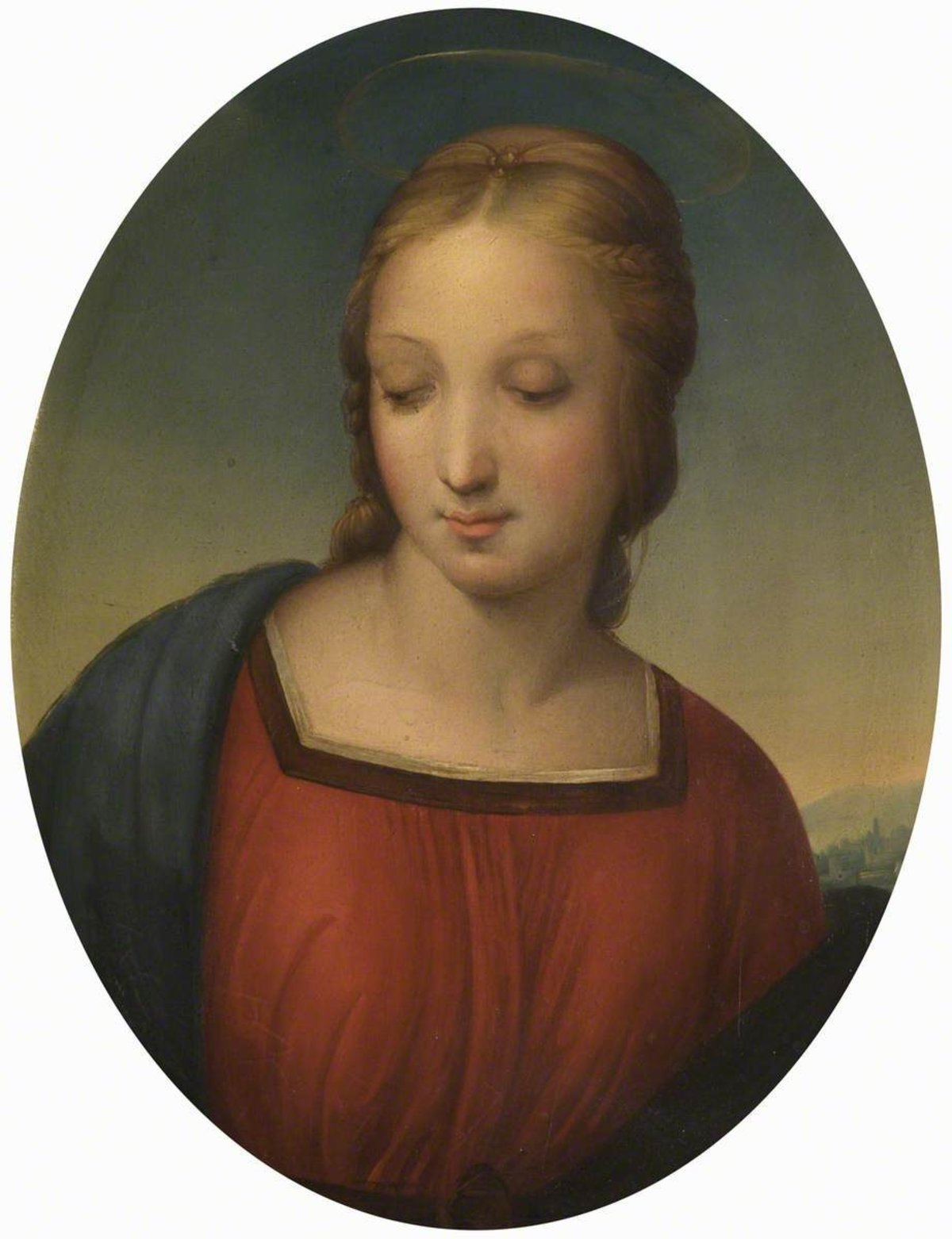
The Madonna of the Meadow
Madonna of the Meadow — Raphael, 1506
Raphael, Public domain, via Wikimedia Commons
Raphael's Madonna of the Meadow is one of the defining works of the Florentine period (1504-1508) and the fullest realisation of the triangular Madonna composition he developed under the influence of Leonardo's Virgin and Child with St Anne (entry 50). The Virgin sits in an open Umbrian meadow, her red dress and blue mantle brilliant against the green landscape; the infant Christ reaches from her lap toward the cross held by the young John the Baptist, who kneels before him.
The three figures form a perfect equilateral triangle — the compositional unit that Raphael explored in multiple works during these years. The landscape is an Umbrian panorama of sky, water, and distant hills. The painting combines Raphael's characteristic formal grace with a quality of gentle melancholy: the Virgin's expression is absorbed in awareness of what the cross the children handle will become.
Raphael arrived in Florence in late 1504, having completed the Sposalizio in Perugia. In Florence he encountered Leonardo and Michelangelo and absorbed their approaches: Leonardo's sfumato, his pyramidal Madonna compositions, and his atmospheric landscapes; Michelangelo's dynamic figure vocabulary.
The Madonna of the Meadow (1506) is the product of this encounter — a composition that owes its pyramidal structure and the quality of the landscape to Leonardo but whose execution is entirely Raphaelesque in its clarity, balance, and formal harmony. Several other triangular Madonna compositions follow in the same period: the Belle Jardinière (Louvre), the Madonna of the Goldfinch (Uffizi).
The triangular figure group is so perfectly balanced that it appears effortless — the secret of Raphael's greatness. Each figure occupies its position with complete spatial conviction, and the three figures' axes create a stable triangle from the Virgin's head to the two children's feet.
The Christ child reaching for the cross while John offers it — with the Virgin's expression of tender melancholy registering the exchange — is the theological heart of the composition: the children play with the instrument of the Passion, unaware of its meaning; the mother is aware. Look at the quality of the Umbrian landscape behind them — the pale hills, the water, the atmospheric sky — which is Leonardo's atmospheric perspective applied with Raphaelesque clarity.
When standing before this work, look carefully: Madonna of the Meadow — Raphael, 1506. Give it time — what seems decorative often carries the central meaning.
When standing before this work, look carefully: The triangular composition — perfect balance. Give it time — what seems decorative often carries the central meaning.
When standing before this work, look carefully: The Virgin's expression — tender melancholy. Give it time — what seems decorative often carries the central meaning.
When standing before this work, look carefully: The Umbrian landscape — Leonardo's aerial perspective. Give it time — what seems decorative often carries the central meaning.
Kunsthistorisches Museum (KHM), Maria-Theresien-Platz, Vienna. Room X (Raphael). The KHM contains one of the world's great collections of Renaissance and Baroque painting; the Raphael Madonna del Prato is its most celebrated Italian painting.