
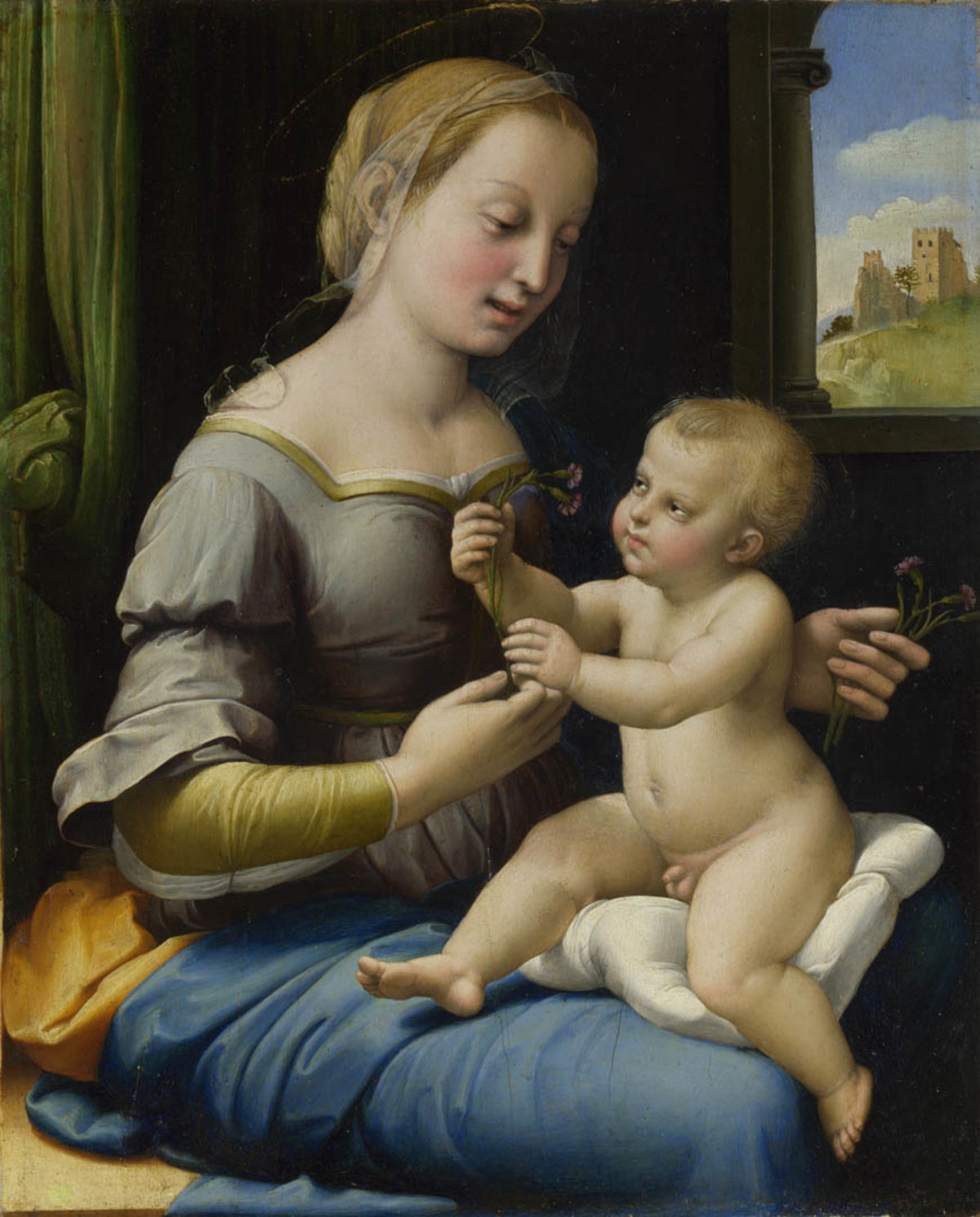
The Madonna of the Pinks (Madonna dei Garofani)
Madonna of the Pinks — Raphael, c.1506-1507
Raphael, Public domain, via Wikimedia Commons
The Madonna of the Pinks is a small intimate panel painting (approximately 27.9 by 22.4 cm) by Raphael from the period of his Florentine years (1504-1508) — one of his finest small-format Madonna and Child compositions. The Virgin holds a spray of pink carnations (garofani) with which the Christ Child plays, their faces close together, their expressions absorbed in the moment of play.
The composition is a domestic moment of maternal intimacy, set before a window opening onto a landscape. The painting was attributed to Raphael from an early period but doubted in the 19th and 20th centuries (it was catalogued as 'after Raphael' for decades); in 1991, it was reattributed to Raphael by Nicholas Penny of the National Gallery, and the attribution was confirmed by technical examination. It was purchased by the National Gallery in 2004 for £22 million (with an export deferral from the Duke of Northumberland's collection).
The pink carnation (garofano) held by the Christ Child is a symbol of the Passion: the word 'garofano' was associated in Italian with the word for 'nail' (chiodo), and the pink, with its nail-shaped petals, was a Passion symbol. The Christ Child playing with a flower that foretells his crucifixion is a motif that runs through many Raphael Madonna compositions. The quality of the painting — the sfumato modelling of the faces, the specific quality of the light from the window, the landscape visible behind them — is fully consistent with Raphael's best Florentine work.
The painting is small enough to hold in your hands — viewing at the National Gallery requires standing close. The quality of the faces (the Virgin's gaze downward at the Child, the Child's absorbed attention to the flowers) is of the same quality as the larger Alba Madonna and Small Cowper Madonna. The landscape background — a Florentine river valley, possibly the Arno — is rendered with sfumato atmospheric recession.
When standing before this work, look carefully: Madonna of the Pinks — Raphael, c.1506-1507. Give it time — what seems decorative often carries the central meaning.
When standing before this work, look carefully: The Virgin and Child — maternal intimacy. Give it time — what seems decorative often carries the central meaning.
When standing before this work, look carefully: The pink carnations — Passion symbol. Give it time — what seems decorative often carries the central meaning.
When standing before this work, look carefully: The landscape background — Florentine sfumato. Give it time — what seems decorative often carries the central meaning.
National Gallery, Room 60 (Raphael), London.