
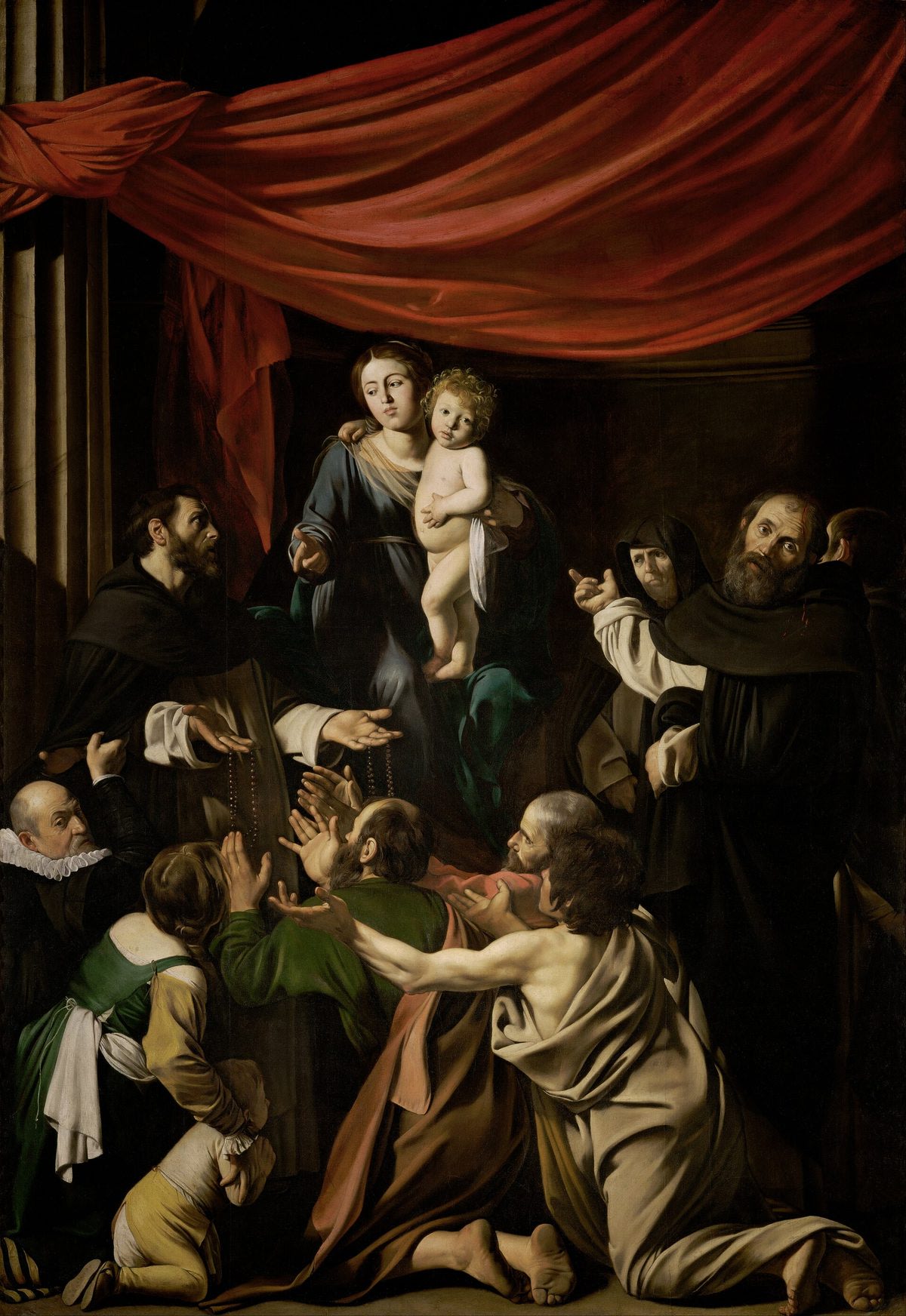
The Madonna of the Rosary
Madonna of the Rosary — Caravaggio, 1606-1607
Caravaggio, Public domain, via Wikimedia Commons
The Madonna of the Rosary is Caravaggio's largest altarpiece (3.78 by 2.49 metres) and one of his most complex and socially engaged religious images — painted in Naples in 1606-1607, immediately after his flight from Rome following the murder charge. The composition shows the Virgin and Child enthroned in glory, St Dominic (patron of the Rosary) distributing rosaries to a crowd of kneeling petitioners, and St Peter Martyr (another Dominican) witnessing from the right.
The lower third of the painting is filled with the hands of the petitioners — dirty, calloused working-class hands reaching upward for the rosaries — the most socially specific representation of the Marian faithful in any major altarpiece. Caravaggio's use of light (the divine light falling on the Virgin and Child from above, the rest of the composition in shadow) makes the upper zone radiant and the lower zone dramatically dark.
The Madonna of the Rosary was painted for a Neapolitan noble family and intended for the church of San Domenico Maggiore in Naples. The painting was acquired by a group of Flemish artists (including Peter Paul Rubens) in 1607 and sold to the Duke of Mantua, from whose collection it passed to the Emperor of Austria.
The work's history of commercial transaction reflects the prestige of Caravaggio's name even in the period of his exile and disgrace. The Kunsthistorisches Museum has owned it since 1781 and it remains one of the highlights of their extraordinary collection.
The hands in the lower third of the painting are the emotional and theological centre: Caravaggio depicts the Marian faithful not as courtiers or elegant patricians but as the working poor, their hands specific records of labour. Above them, the Dominicans mediate between the poor and the Virgin. Above the Dominicans, the Virgin and Child are depicted in a more idealised, courtly manner — a deliberate contrast of social register that reflects Caravaggio's theological vision of the Incarnation as God's entering into the lowest social stratum.
When standing before this work, look carefully: Madonna of the Rosary — Caravaggio, 1606-1607. Give it time — what seems decorative often carries the central meaning.
When standing before this work, look carefully: The petitioners' hands — working-class Neapolitan faithful. Give it time — what seems decorative often carries the central meaning.
When standing before this work, look carefully: St Dominic distributing rosaries. Give it time — what seems decorative often carries the central meaning.
When standing before this work, look carefully: The Virgin and Child in divine light. Give it time — what seems decorative often carries the central meaning.
Kunsthistorisches Museum, Maria-Theresien-Platz, Vienna. Open Tuesday-Sunday; admission fee. One of the great encyclopaedic art museums of Europe.