
The Magdalene Reading (Mary Magdalene Reading)
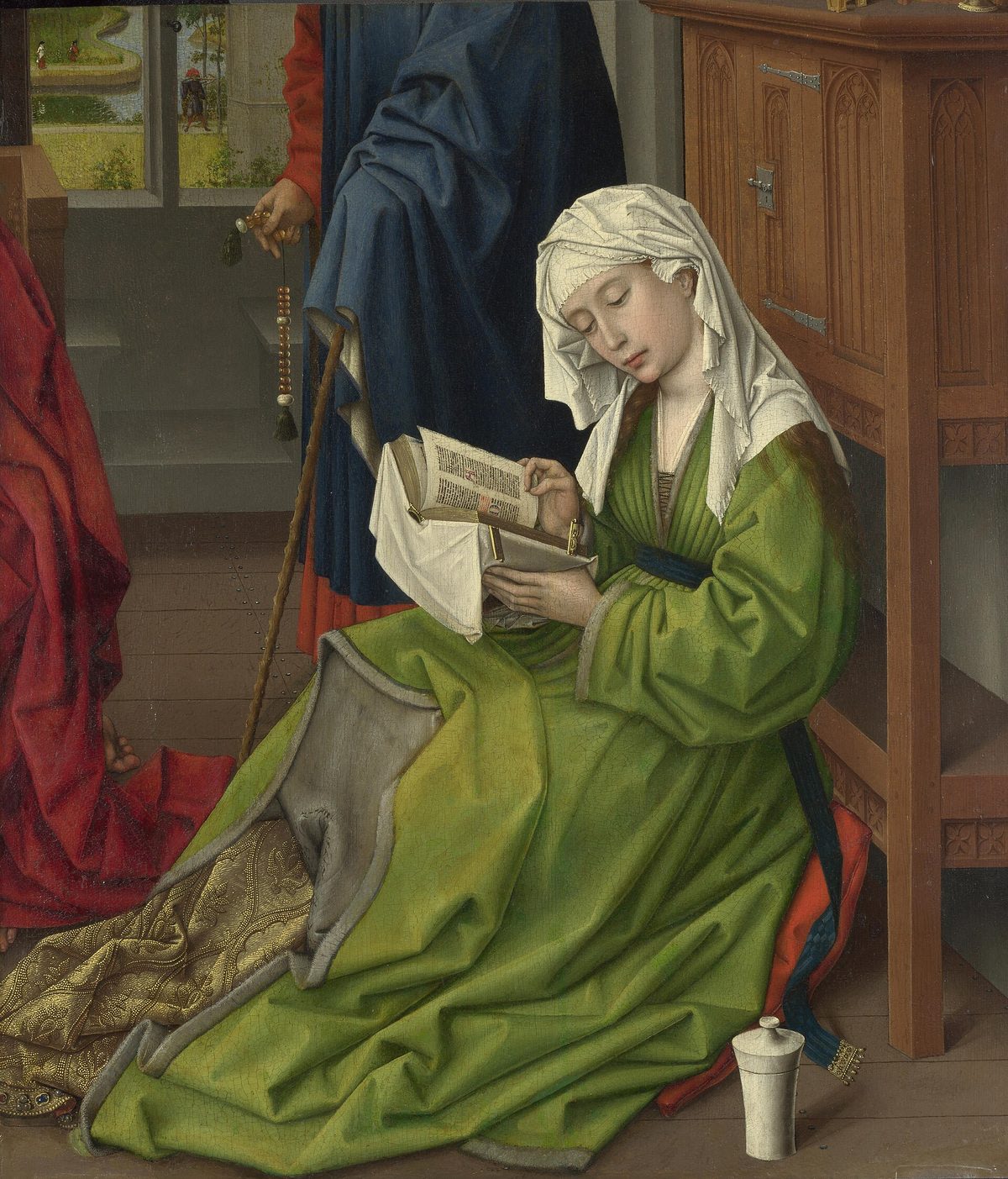
Magdalene Reading — Rogier van der Weyden, c.1435-1438
Rogier van der Weyden, Public domain, via Wikimedia Commons
The Magdalene Reading in the National Gallery London is a fragment of a larger altarpiece — a panel that shows the Magdalene seated in the foreground, absorbed in a small book, while behind her (in the full original composition) the Virgin and Child with other figures were visible. As a surviving fragment, it is one of the great studies of meditative absorption in Northern Renaissance painting: the Magdalene reads, her face slightly averted from the viewer, her elaborate headdress and rich fur-trimmed robe establishing her as a wealthy woman (the Magdalene is traditionally associated with luxury and repentance). Rogier's ability to convey a psychological state through posture and expression — the quality of genuine reading, of inward attention — makes this one of his most modern-feeling works.
Rogier van der Weyden (c.1399/1400-1464) was the most influential Flemish painter of the mid-15th century — the natural successor to Jan van Eyck as the dominant master of the tradition. Where van Eyck was interested in surface detail and optical precision, Rogier was primarily interested in emotional and psychological expression — the faces in his altarpieces communicate intense interior states (grief, devotion, joy) with a directness unmatched in the period. His influence spread throughout Europe through the export of his works and the training of his workshop pupils.
The detail of the book and the Magdalene's hands is extraordinary: the binding, the pages, the way the fingers hold the text — all rendered with Rogier's characteristic precision. The headdress (a fashionable Flemish wimple of the 1430s) demonstrates that the Magdalene's wealth and fashionability are part of the image's meaning — this is a woman of the world who has chosen devotion. The ointment jar (her traditional attribute) would have been visible in the original full composition.
When standing before this work, look carefully: Magdalene Reading — Rogier van der Weyden, c.1435-1438. Give it time — what seems decorative often carries the central meaning.
When standing before this work, look carefully: The Magdalene's face — meditative absorption. Give it time — what seems decorative often carries the central meaning.
When standing before this work, look carefully: Hands and book — precision and devotion. Give it time — what seems decorative often carries the central meaning.
When standing before this work, look carefully: The fashionable headdress — wealth and repentance. Give it time — what seems decorative often carries the central meaning.
National Gallery, Trafalgar Square, London WC2N 5DN. Free admission. Open daily 10:00-18:00.