
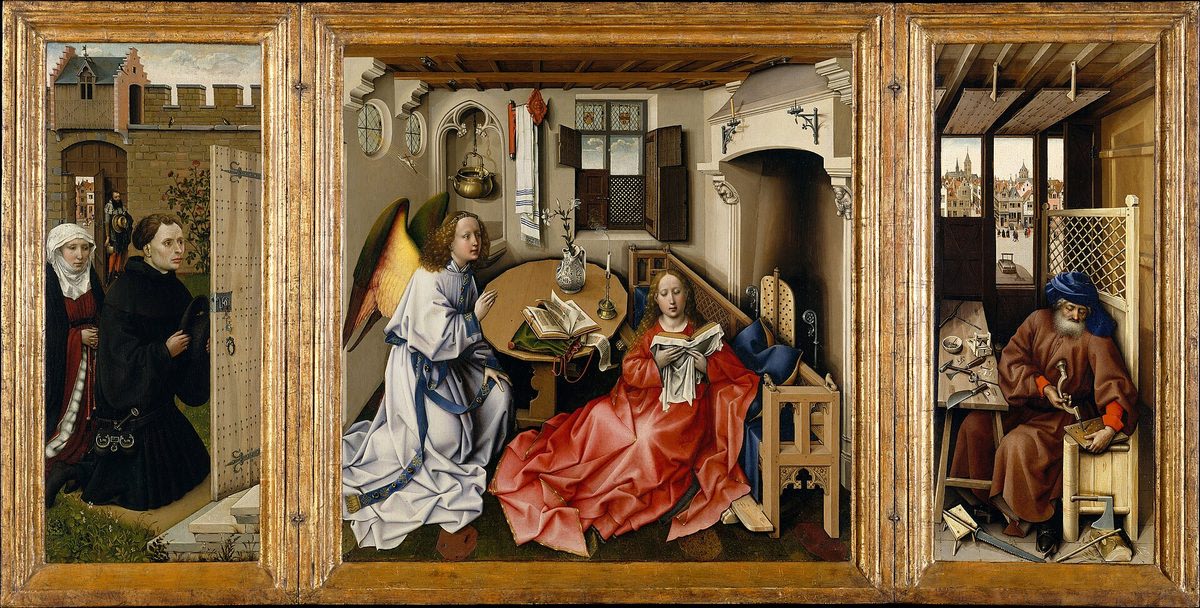
The Merode Altarpiece (Annunciation Triptych)
Merode Altarpiece — Robert Campin, c.1425-1428
Robert Campin, Public domain, via Wikimedia Commons
The Merode Altarpiece is the defining work of Early Netherlandish painting in America — a small triptych (the central panel approximately 64 by 63 cm) depicting the Annunciation set in a contemporary Flemish middle-class domestic interior, with the donor and his wife kneeling in the left panel and St Joseph at his workbench making a mousetrap in the right panel. Robert Campin's innovation was to set the Annunciation not in a formal architectural space or a golden sacred field but in an absolutely real Flemish domestic room: a fireplace, a table, a bench, a towel on a rack, a brass candlestick, a lily in a majolica vase.
Gabriel and the Virgin are in this room as if they have just entered it. The Christ child rides a beam of light through a closed window (a symbol of the Virgin Birth — light passing through glass without breaking it). The domestic realism of the setting is a theological statement: the Incarnation enters ordinary life.
Robert Campin (c.1378/79-1444) — identified with the 'Master of Flémalle' by most scholars — was the teacher of Rogier van der Weyden and one of the founders of Netherlandish oil painting. The Merode Altarpiece represents the early phase of this tradition — oil paint applied with a precision that makes every object in the room a specific described thing.
The mousetrap that Joseph is making in the right panel has been interpreted as a symbol: St Augustine described the Incarnation as a mousetrap in which the devil would be caught by the bait of Christ's human nature. Whether intentional symbolism or Campin's characteristic domestic observation, the mousetrap is one of the most discussed objects in medieval Flemish painting.
The central panel rewards extremely slow reading. Start with the fireplace — the fire screen, the fireside bench, the fire itself — then move to the table: the manuscript open to a psalter text, the brass candlestick (whose candle has just been snuffed, the smoke still rising), the majolica vase with the lily.
Gabriel enters from the left with his message; the Virgin, absorbed in her reading, has not yet looked up. The Christ child (invisible in scale) rides a golden beam through the window to the right, a roundel angel at the window visible to the exterior viewer. Every object is a symbol: the lily (purity), the candle (the life of the old dispensation, extinguished by the new light), the towel (the Virgin's purity), the fire (divine warmth).
When standing before this work, look carefully: Merode Altarpiece — Robert Campin, c.1425-1428. Give it time — what seems decorative often carries the central meaning.
When standing before this work, look carefully: The Annunciation in the domestic interior. Give it time — what seems decorative often carries the central meaning.
When standing before this work, look carefully: Joseph making a mousetrap — right panel. Give it time — what seems decorative often carries the central meaning.
When standing before this work, look carefully: The Christ child riding a golden beam through the window. Give it time — what seems decorative often carries the central meaning.
The Met Cloisters, Fort Tryon Park, Washington Heights, New York. The Cloisters is a branch of the Metropolitan Museum of Art dedicated to medieval art; it incorporates architectural elements from five medieval French cloisters. Reached by subway (A train to 190th Street) or taxi.