
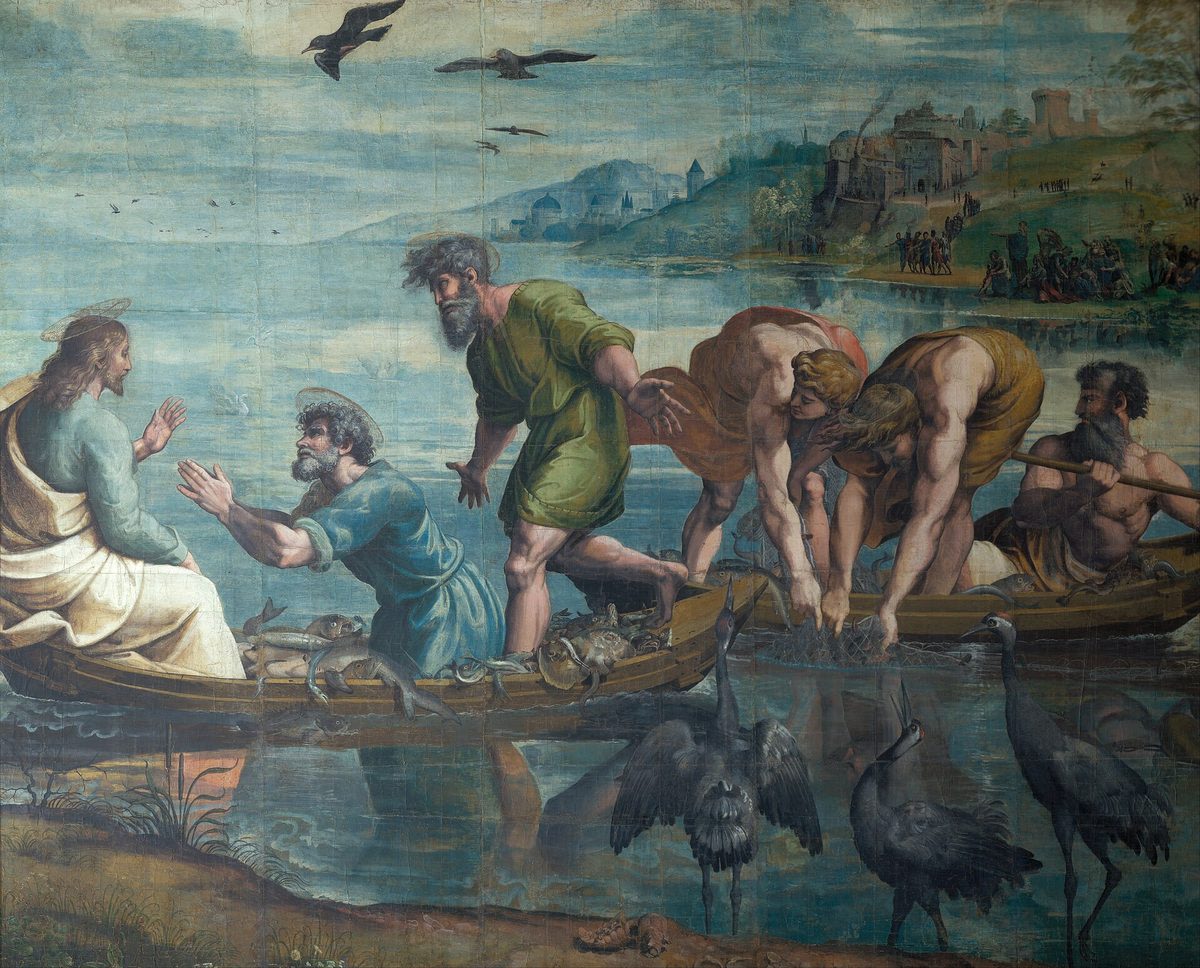
The Miraculous Draught of Fishes
Miraculous Draught of Fishes — the Vatican tapestry
Raphael (cartoon), Public domain, via Wikimedia Commons
Raphael's Tapestry Cartoons are among his greatest works — ten large-scale designs (approximately 3.5 by 5 metres each) made for tapestries to hang in the Sistine Chapel beneath Michelangelo's ceiling. Seven of the original ten cartoons survive, in the Victoria and Albert Museum in London (see entry 128).
The tapestries woven from them — finished around 1521 — were first displayed in the Sistine Chapel for a papal ceremony and are now in the Vatican Museums. The subjects are scenes from the Acts of the Apostles: the Miraculous Draught of Fishes, the Healing of the Lame Man at the Temple, the Death of Ananias, the Stoning of St Stephen, the Conversion of the Proconsul, Paul and Barnabas at Lystra, and Paul Preaching in Athens — a programme celebrating the mission of the early Church.
The tapestries were commissioned by Pope Leo X (the Medici pope) and woven in Brussels by Pieter van Aelst. Brussels tapestry-weaving was the most technically sophisticated in Europe; the weavers used silver-gilt and silk thread to achieve colour and tonal effects impossible in wool alone.
Raphael's cartoons were drawn in reverse (as mirror images) so that the weavers, working from the back of the tapestry, would produce the correct orientation. The cartoons were kept in Brussels and used to make additional sets of tapestries; they were eventually acquired by Charles I of England and are now on permanent loan to the V&A. The Vatican tapestries, woven from these cartoons, are among the most precious objects in the Vatican Museums.
The Miraculous Draught of Fishes depicts Peter, James, and John hauling a net full of fish from the Sea of Galilee while Christ sits in a second boat. The composition is simple and powerful — the physical labour of the fishermen, the weight of the net and fish, the quality of the water and sky — and demonstrates Raphael's ability to translate High Renaissance painting into the linear, flat language of tapestry design without loss of quality. The herons standing in the foreground water are a famous detail — simultaneously naturalistic observation and symbolic weight (the heron symbolising prayer and perseverance).
When standing before this work, look carefully: Miraculous Draught of Fishes — the Vatican tapestry. Give it time — what seems decorative often carries the central meaning.
When standing before this work, look carefully: The original cartoon — Victoria and Albert Museum. Give it time — what seems decorative often carries the central meaning.
When standing before this work, look carefully: The tapestries in the Vatican Museums. Give it time — what seems decorative often carries the central meaning.
When standing before this work, look carefully: Healing of the Lame Man — another tapestry in the series. Give it time — what seems decorative often carries the central meaning.
Vatican Museums, Pinacoteca, Room VIII. The tapestries are displayed in the same room as Raphael's Transfiguration and the Caravaggio Entombment — one of the great rooms in the history of painting.