
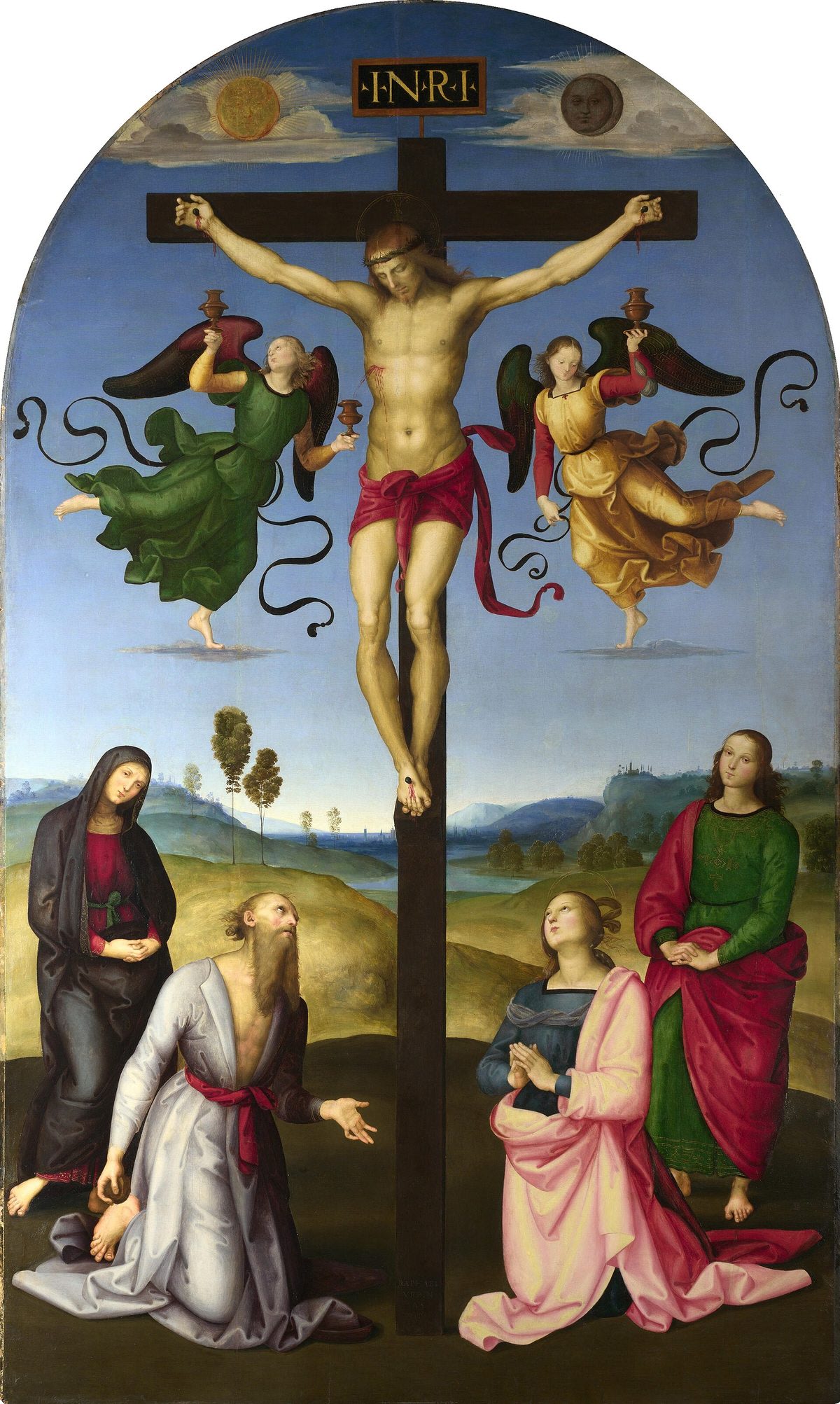
The Mond Crucifixion
The Mond Crucifixion — Raphael, c.1502-1503
Raphael, Public domain, via Wikimedia Commons
The Mond Crucifixion is Raphael's earliest major surviving altarpiece — painted around 1502-1503 for the Gavari family chapel in San Domenico, Città di Castello, when Raphael was approximately 19 years old and still working under the influence of Perugino. The altarpiece shows Christ on the cross against a luminous pale-blue sky, his expression serene and undistorted by suffering; at the foot of the cross, two angels collect his blood in golden chalices; to the left, the Virgin and St John the Evangelist; to the right, St Jerome and Mary Magdalene.
Above the cross, two more angels hold symbols of the Passion. The quality of the painting — particularly the landscape (an Umbrian valley in early morning light) and the serene, idealised faces — already demonstrates Raphael's mastery of the Perugino tradition; the composition is clearly indebted to Perugino's own Crucifixion in Santa Maria Maddalena dei Pazzi (Florence).
The Mond Crucifixion takes its name from the collection of Ludwig Mond, the German-born British industrialist who bequeathed it to the National Gallery in 1909. At the time of Raphael's death in 1520, the Città di Castello altarpiece was already considered an important early work; by the 19th century, when it was acquired by Mond, it was recognised as one of the finest surviving examples of Raphael's early period. The comparison of this work with his later paintings (the Vatican Stanze, the Sistine Madonna) shows the trajectory of his development across a 15-year career.
The serenity of Christ's face in the Mond Crucifixion was deliberate theological statement: this is not the suffering Christ of Matthias Grünewald or the anguished Christ of the late medieval tradition, but the triumphant Christ whose death is simultaneously a victory. The landscape of the Umbrian valley — the same landscape visible in the Baptism of Christ (Piero della Francesca) and the Perugino altarpieces — is one of Raphael's finest early achievements: pale hills dissolving into a mist of blue and green, a quality of absolute morning calm.
When standing before this work, look carefully: The Mond Crucifixion — Raphael, c.1502-1503. Give it time — what seems decorative often carries the central meaning.
When standing before this work, look carefully: Christ's serene face — triumphant not suffering. Give it time — what seems decorative often carries the central meaning.
When standing before this work, look carefully: Angels collecting the blood of Christ. Give it time — what seems decorative often carries the central meaning.
When standing before this work, look carefully: The Umbrian landscape — morning light and mist. Give it time — what seems decorative often carries the central meaning.
National Gallery, Room 60 (Raphael and his circle), London. Free admission.