
The Mystic Nativity
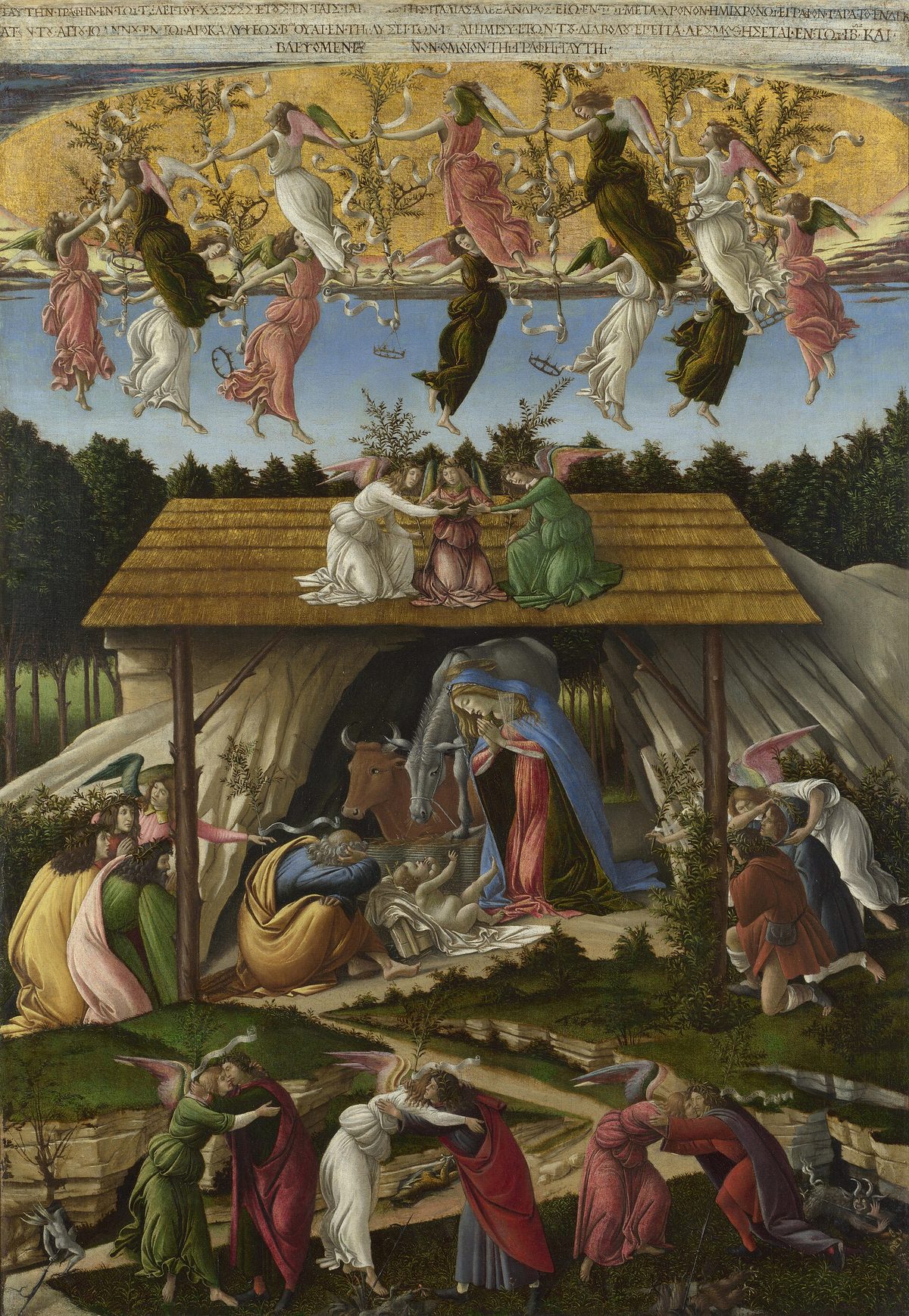
Mystic Nativity — Botticelli, 1500-1501
Sandro Botticelli, Public domain, via Wikimedia Commons
Botticelli's Mystic Nativity is the only signed and dated work by the artist — an inscription in Greek at the top of the canvas identifies it as painted at the 'troubles of Italy' (1500-1501, at the turn of the millennium) and connects it to the prophecies of the Book of Revelation and Savonarola's prophetic preaching. The composition is an extraordinary departure from the naturalistic tradition of Italian painting: the figures are arranged in hierarchical scale (the angels are larger than the human figures; the Virgin is larger than all the human participants; the Nativity shelter is depicted at approximately half the scale it would require to shelter the figures inside it), the gold ground and the cosmic register (twelve dancing angels carrying olive branches at the top, three devils retreating into holes at the bottom) create a medieval-style vertical cosmological structure. This is Botticelli's most personal and most theologically explicit work — a response to the crisis of his time, made in the period of his most intense Savonarolan devotion.
The inscription at the top of the Mystic Nativity reads: 'I Sandro painted this picture at the end of the year 1500 in the troubles of Italy in the half-time after the time according to the 11th chapter of St John in the second woe of the Apocalypse during the release of the devil for three and a half years then he will be chained in the 12th chapter and we shall see him trodden down as in this picture'. The reference to Revelation 11 and 12 places the painting in the context of Savonarolan millenarianism — the belief that the 15th and early 16th centuries were the prophesied time of tribulation before the final coming of Christ.
The hierarchical scaling of the composition — the large angels, the large Virgin, the small human figures — is deliberately archaic, returning to the medieval convention of size-indicating-importance (hieratic scale) that the Florentine Renaissance had abandoned. The three couples embracing at the bottom (angels embracing human figures, implying reconciliation of heaven and earth) are among the most joyful images in Botticelli's career — the embrace of salvation, the end of tribulation. The three cowering devils retreating into holes are simultaneously comic (small and absurd) and ominous (not yet entirely defeated).
When standing before this work, look carefully: Mystic Nativity — Botticelli, 1500-1501. Give it time — what seems decorative often carries the central meaning.
When standing before this work, look carefully: The twelve dancing angels — cosmic upper register. Give it time — what seems decorative often carries the central meaning.
When standing before this work, look carefully: Angels and humans embracing — reconciliation of heaven and earth. Give it time — what seems decorative often carries the central meaning.
When standing before this work, look carefully: The three retreating devils — temporal tribulation overcome. Give it time — what seems decorative often carries the central meaning.
National Gallery, Room 58 (Botticelli and his contemporaries), London.