
The Ognissanti Crucifix
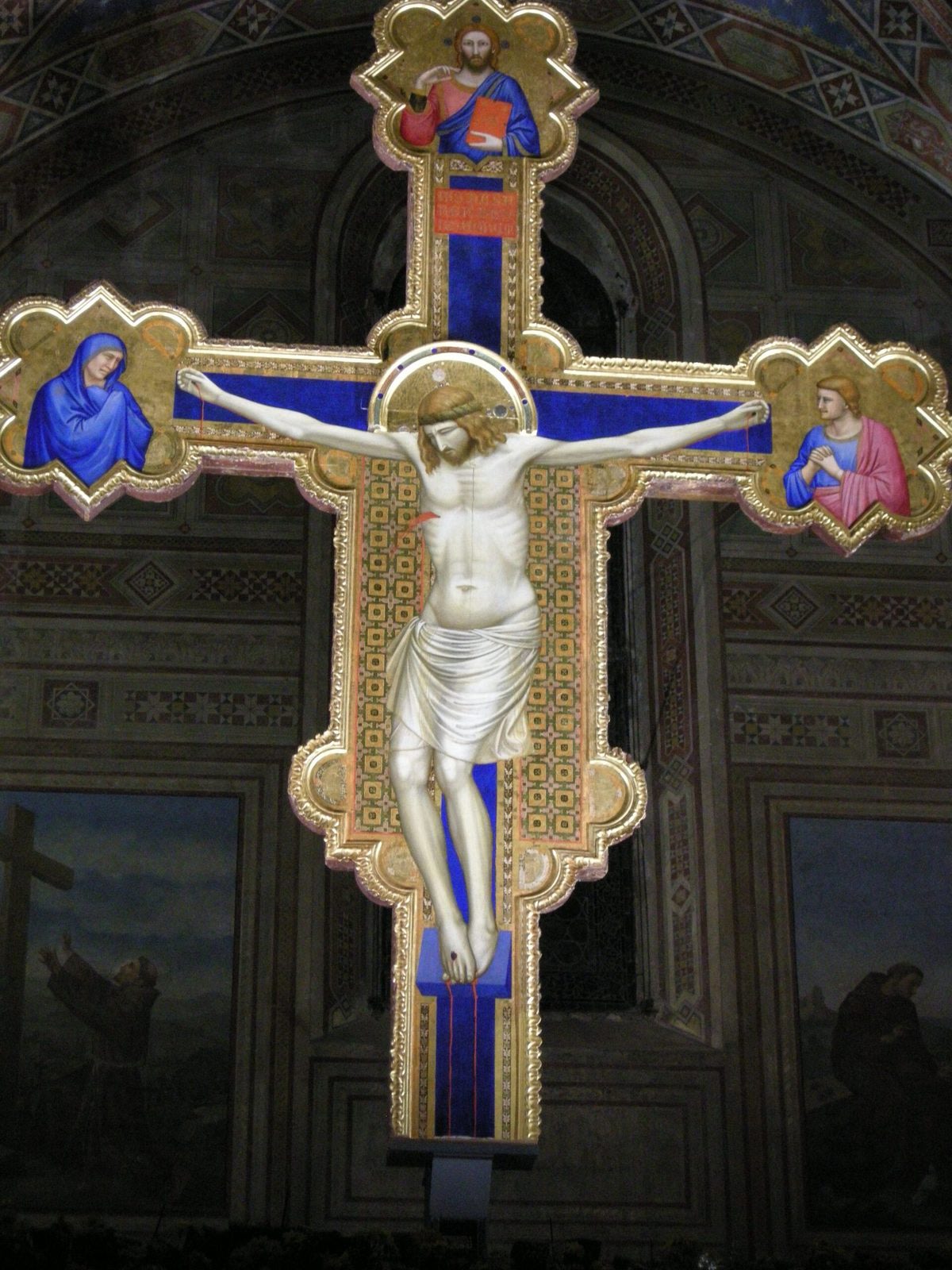
Ognissanti Crucifix — Giotto, c.1310-1315, Bargello Florence
Giotto di Bondone, Public domain, via Wikimedia Commons
The Ognissanti Crucifix (now in the Bargello, Florence) is one of the most important works associated with Giotto di Bondone — a large painted crucifix (approximately 578 by 406 cm) showing the dead Christ on the cross with mourning figures at the terminals. Painted crosses (Crocifissi) were a central form of Italian devotional painting from the 12th century onward; Giotto transformed the type by giving Christ's body a genuine physical weight — the body sags naturally, the head falls to one side, the anatomy is rendered with a new conviction.
Compared to the formal, hieratic Crocifissi of Cimabue and the Byzantine tradition, Giotto's Christ is a real human body in the process of death, observed with unprecedented compassion. The Ognissanti Crucifix, originally in the church of Ognissanti in Florence, was the altarpiece of Giotto's own parish church.
Giotto di Bondone (c.1267-1337) is the first name in the history of Western painting — the painter who, according to Dante, Boccaccio, and Petrarch, surpassed his master Cimabue and established a new tradition of realism. His major works are the Arena Chapel frescoes in Padua (c.1304-1306) and the Ognissanti Madonna (Uffizi) — but the Ognissanti Crucifix is equally important for understanding the revolution Giotto brought to the painted cross tradition. The body of Christ is no longer an icon but a physical presence.
The comparison with earlier Crocifissi is the most illuminating way to encounter this work: look at Cimabue's Crucifix in Santa Croce (severely damaged in the 1966 flood) or the Byzantine examples in Italian museums, then look at Giotto's. The difference is immediately apparent: where the earlier tradition shows a formal, symbolic representation of Christ on the cross, Giotto shows a human body under the force of gravity. This is the revolution.
When standing before this work, look carefully: Ognissanti Crucifix — Giotto, c.1310-1315, Bargello Florence. Give it time — what seems decorative often carries the central meaning.
When standing before this work, look carefully: Christ's body — physical weight and gravity. Give it time — what seems decorative often carries the central meaning.
When standing before this work, look carefully: Head of Christ — falling to the side in death. Give it time — what seems decorative often carries the central meaning.
When standing before this work, look carefully: Mourning figures at the terminals. Give it time — what seems decorative often carries the central meaning.
Museo Nazionale del Bargello, Via del Proconsolo 4, Florence. Open daily (closed some Mondays).
Admission fee applies. The Crucifix is in the Giotto room.