
The Pilgrims of Emmaus (Supper at Emmaus)
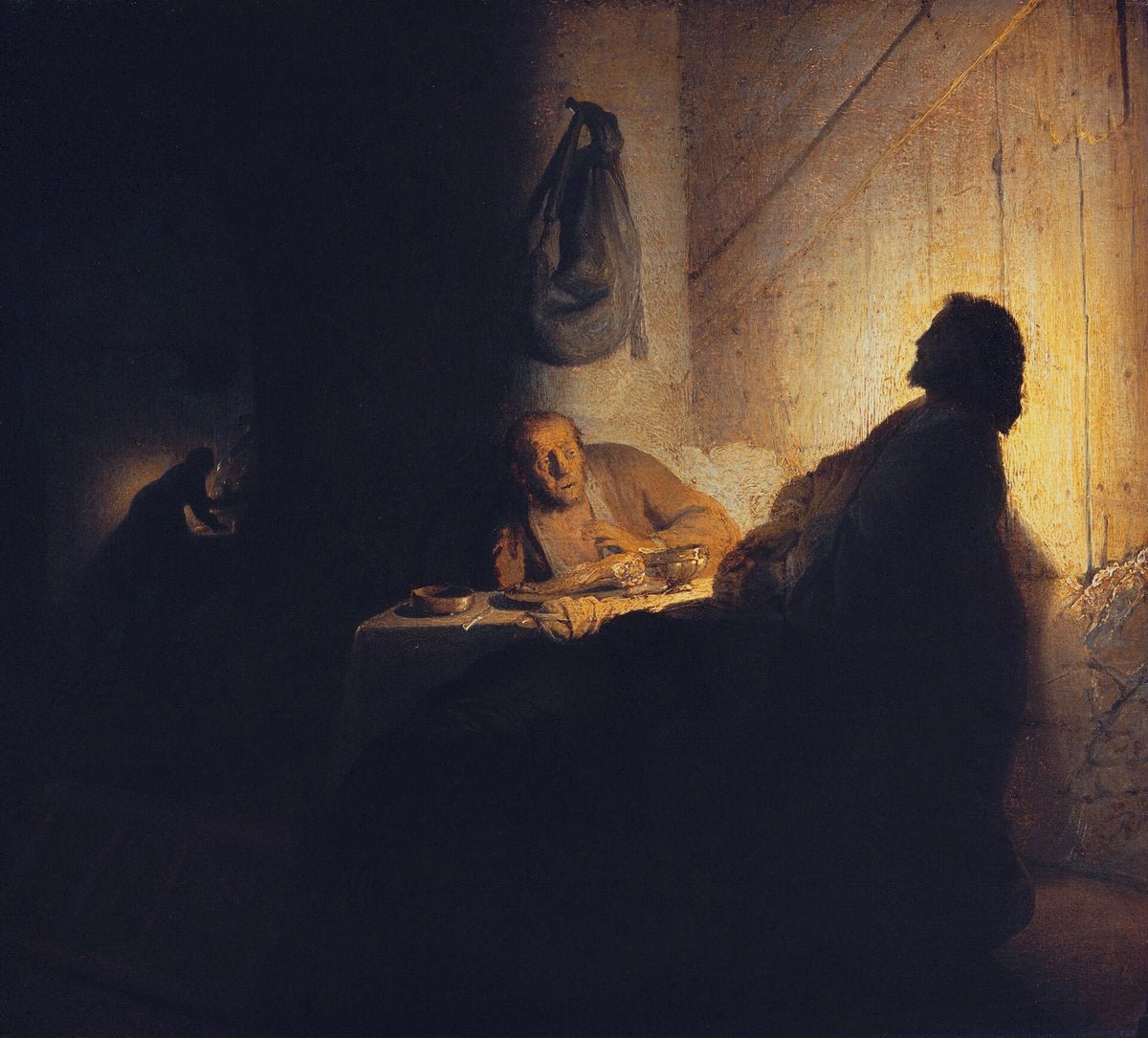
Supper at Emmaus — Rembrandt, 1648, Louvre
Rembrandt van Rijn, Public domain, via Wikimedia Commons
Rembrandt painted the Supper at Emmaus (Luke 24:13-35) multiple times across his career; the 1648 Louvre panel is the most theologically concentrated of them. The moment depicted is the breaking of the bread: the risen Christ, who has been unrecognised by the two disciples on the road to Emmaus, takes the bread and breaks it, and in this action 'their eyes were opened, and they recognised him.' Rembrandt shows the precise instant of recognition — the moment between not-knowing and knowing.
Christ's face is illuminated from within; the two disciples respond in different ways — one draws back in awe, one leans forward. In the background, a serving boy is unaware of what is happening. The composition is set within a shallow architectural space that echoes an apse.
Rembrandt (1606-1669) was the greatest painter of Protestant Amsterdam, but his subject matter throughout his career was overwhelmingly drawn from the Hebrew Bible and the New Testament. The Supper at Emmaus was a subject he returned to repeatedly because it offered what he was most interested in: a moment of spiritual recognition — the moment at which the eternal breaks through into the ordinary. The 1648 version has a quality of stillness and contained emotion that distinguishes it from the more dramatic 1629 version in the Musée Jacquemart-André, Paris.
The Christ figure is the spiritual centre of the composition: his face is illuminated (from no visible external light source — the light is internal), and his hands break the bread with the gesture that is simultaneously the Passover gesture and the Eucharistic gesture. The two disciples' contrasting reactions embody the range of human responses to the sacred: awe and withdrawal on the one hand, eager recognition and leaning-in on the other. The serving boy in the background — unaware, ordinary — emphasises the miracle by contrast.
When standing before this work, look carefully: Supper at Emmaus — Rembrandt, 1648, Louvre. Give it time — what seems decorative often carries the central meaning.
When standing before this work, look carefully: Christ breaking bread — internal illumination. Give it time — what seems decorative often carries the central meaning.
When standing before this work, look carefully: The two disciples — contrasting reactions. Give it time — what seems decorative often carries the central meaning.
When standing before this work, look carefully: The unaware serving boy — ordinary against miraculous. Give it time — what seems decorative often carries the central meaning.
Musée du Louvre, Richelieu Wing, Room 844 (Rembrandt). Open Wednesday-Monday 9:00-18:00. Admission fee applies.