
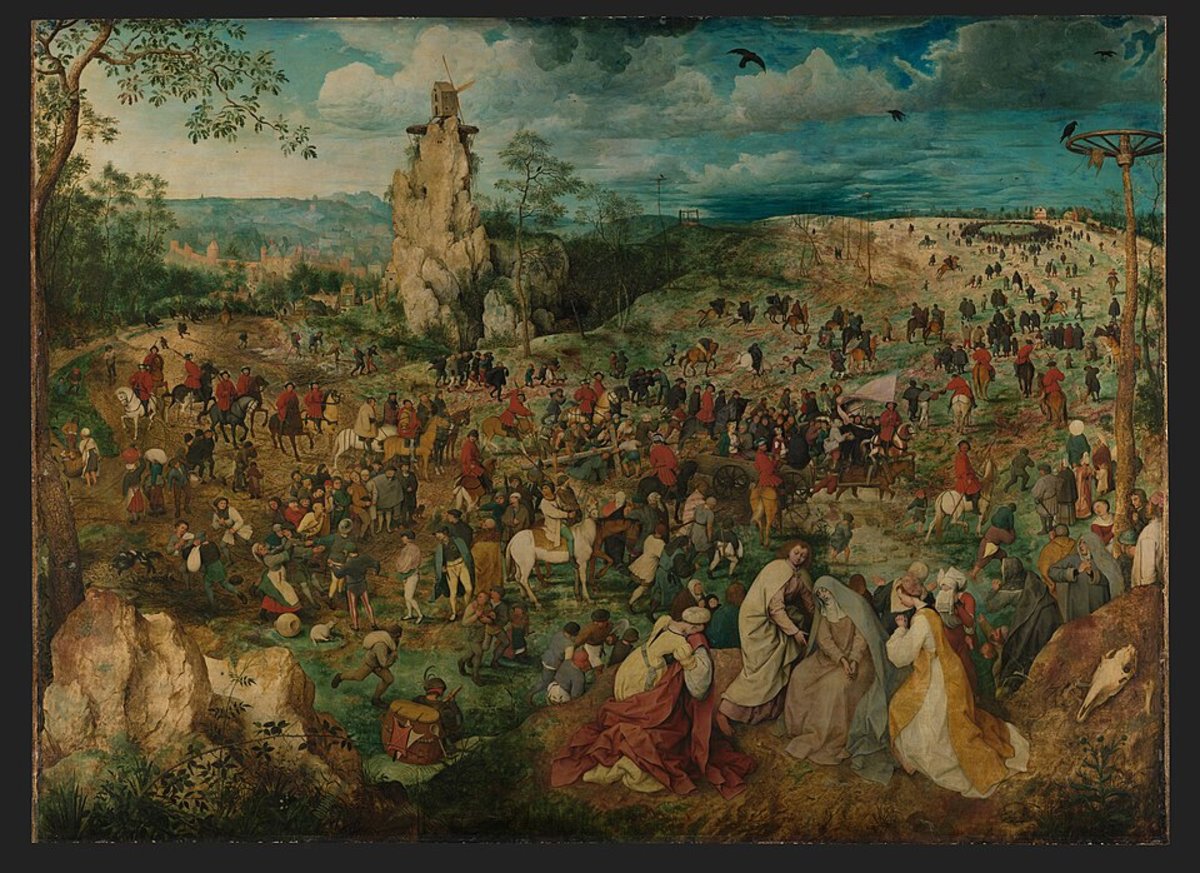
The Procession to Calvary
Procession to Calvary — Bruegel, 1564
Pieter Bruegel the Elder, Public domain, via Wikimedia Commons
Pieter Bruegel the Elder's Procession to Calvary is his largest painting and the fullest expression of his approach to Christian narrative: setting the sacred event within the observed world of 16th-century Flemish life, as if the Passion of Christ is occurring now, in a landscape populated by the ordinary inhabitants of a contemporary Dutch or Flemish province. The painting is approximately 124 by 170 cm — a wall-sized panel crowded with hundreds of figures in a panoramic Brabant landscape of brown earth, grey sky, and windmill.
Christ is one small figure among hundreds — carrying his cross, fallen, the procession continuing around him — while in the foreground, conspicuously isolated from the crowd in the conventional devotional mode, the Virgin swoons supported by St John and the holy women. The contrast between the foreground (where the sacred figures are depicted in the traditional devotional convention) and the middle distance (where Christ is almost invisible in the crowd) is Bruegel's theological statement.
The painting was commissioned by Nicolas Jonghelinck of Antwerp in 1564, the same year as the Hunters in the Snow and the other famous landscape series. It represents Bruegel's synthesis of the late medieval tradition of the 'crowd Calvary' (exemplified by Pieter Aertsen and others) with his own documentary approach to Flemish peasant life.
The Flemish landscape in which the Passion unfolds has been specifically identified: the rocky formations at the right are the same formations that appear in other Bruegel landscapes as a generic 'world-landscape' backdrop, but the rest is Brabant: the windmill, the agricultural land, the dress of the crowd. The Passion happens here, now, among people who are largely unaware of its significance.
Stand back from the painting and locate Christ: he is in the middle distance, a small figure wearing a white robe (the only white garment in the crowd) fallen under the cross, surrounded by soldiers. Find him, and then observe the crowd around him: many figures are simply going about their business, observing the procession with curiosity or going elsewhere entirely.
The foreground holy women are conspicuously different in style from the crowd — painted in a more formal, conventional mode that marks them as belonging to a different visual register. The windmill on the hill at upper right is one of Bruegel's characteristic details: it turns above the scene of the Passion, indifferent and mechanical, the wheel of ordinary life.
When standing before this work, look carefully: Procession to Calvary — Bruegel, 1564. Give it time — what seems decorative often carries the central meaning.
When standing before this work, look carefully: Christ fallen — small, white, in the crowd. Give it time — what seems decorative often carries the central meaning.
When standing before this work, look carefully: The holy women in the foreground — conventional devotional mode. Give it time — what seems decorative often carries the central meaning.
When standing before this work, look carefully: The windmill above — indifferent to the Passion. Give it time — what seems decorative often carries the central meaning.
Kunsthistorisches Museum, Vienna. Room IX (Bruegel). The KHM holds the largest and finest collection of Pieter Bruegel the Elder's paintings in the world — twelve paintings in one room, including the Hunters in the Snow, the Tower of Babel, and the Peasant Wedding.