
The Raphael Cartoons
Miraculous Draught of Fishes — the V&A cartoon
Raphael, Public domain, via Wikimedia Commons
Raphael's Tapestry Cartoons are seven surviving large-scale preparatory drawings for the Acts of the Apostles tapestry series — made in 1515-1516 for Pope Leo X to be woven by Pieter van Aelst's Brussels workshop and hung in the Sistine Chapel. The cartoons (each approximately 3.5 by 5 metres) are painted in distemper (a water-based paint) on sheets of paper glued together, in the reversed orientation required for weaving.
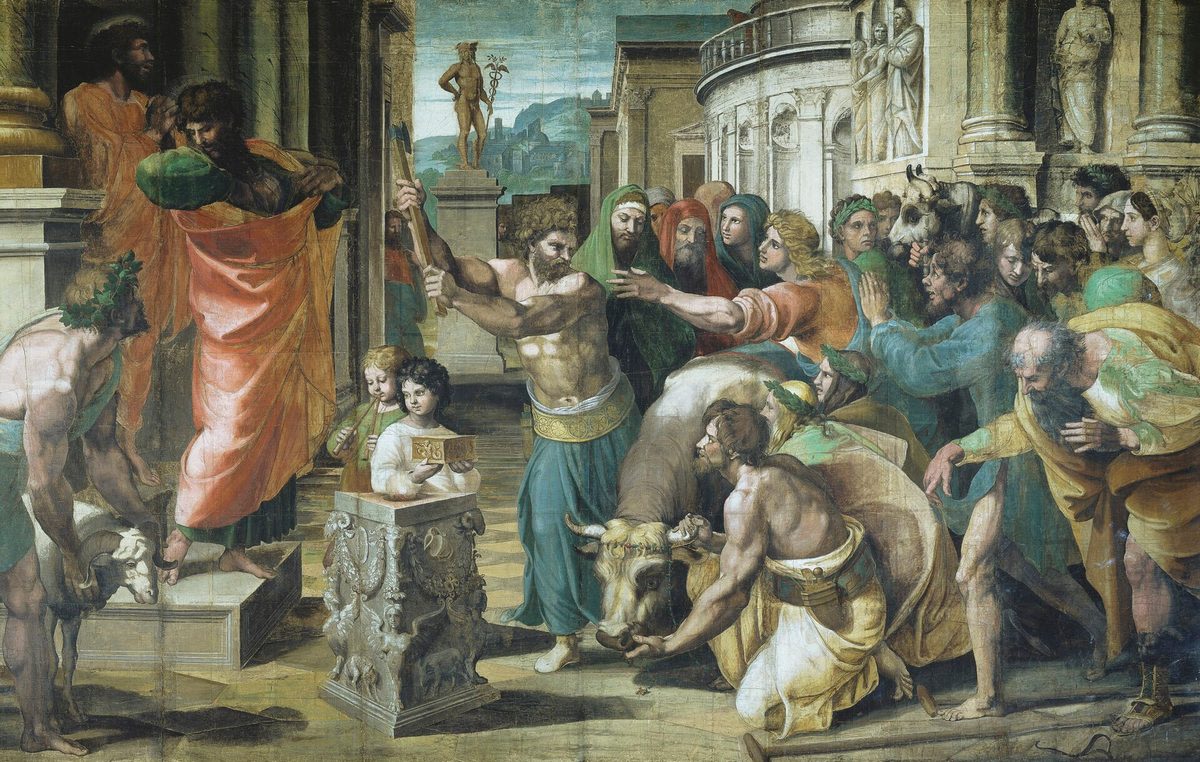
They depict seven scenes: the Miraculous Draught of Fishes, the Healing of the Lame Man, the Death of Ananias, the Blinding of Elymas, the Sacrifice at Lystra, Paul Preaching at Athens, and Paul and Barnabas at Lystra. After being used in Brussels for weaving, they were purchased by Charles I of England in 1623 and have been in British Royal Collection ownership since then, on loan to the V&A since 1865.
The cartoons represent Raphael at the peak of his maturity — made between the completion of the Stanza d'Eliodoro in the Vatican and the beginning of work on the Villa Farnesina in Rome. The compositions are among the most powerful he ever devised: the Blinding of Elymas is a composition of concentrated theatrical force; the Death of Ananias (where a man struck dead for withholding his property from the Christian community falls at the feet of Peter and John) is an extraordinary group of reactions to sudden death; the Paul Preaching at Athens is a meditation on rhetorical persuasion. The scale — each cartoon is approximately 5 metres wide — requires Raphael's compositional genius to operate at the scale of history painting, not easel picture.
The V&A display allows viewing at close range and at the same height as the figures — an experience not possible with the woven tapestries. Standing before the Miraculous Draught of Fishes at approximately the scale at which it was drawn: the herons in the water are specific species (one is a grey heron, one a cormorant — both identified by ornithologists); Peter falls to his knees in the boat; Christ sits calmly in the distant boat. The quality of the drawing — in chalk and distemper, with figures revised and reworked — allows you to see Raphael thinking through his compositions on the sheet itself.
When standing before this work, look carefully: Miraculous Draught of Fishes — the V&A cartoon. Give it time — what seems decorative often carries the central meaning.
When standing before this work, look carefully: Death of Ananias — reactions to sudden death. Give it time — what seems decorative often carries the central meaning.
When standing before this work, look carefully: Paul Preaching at Athens — rhetorical composition. Give it time — what seems decorative often carries the central meaning.
When standing before this work, look carefully: The Raphael Cartoon room at the V&A. Give it time — what seems decorative often carries the central meaning.
Victoria and Albert Museum, Cromwell Road, South Kensington, London. The Raphael Cartoons are in a purpose-built room in the Cast Courts section of the museum. Free admission.