
The Resurrection of Christ
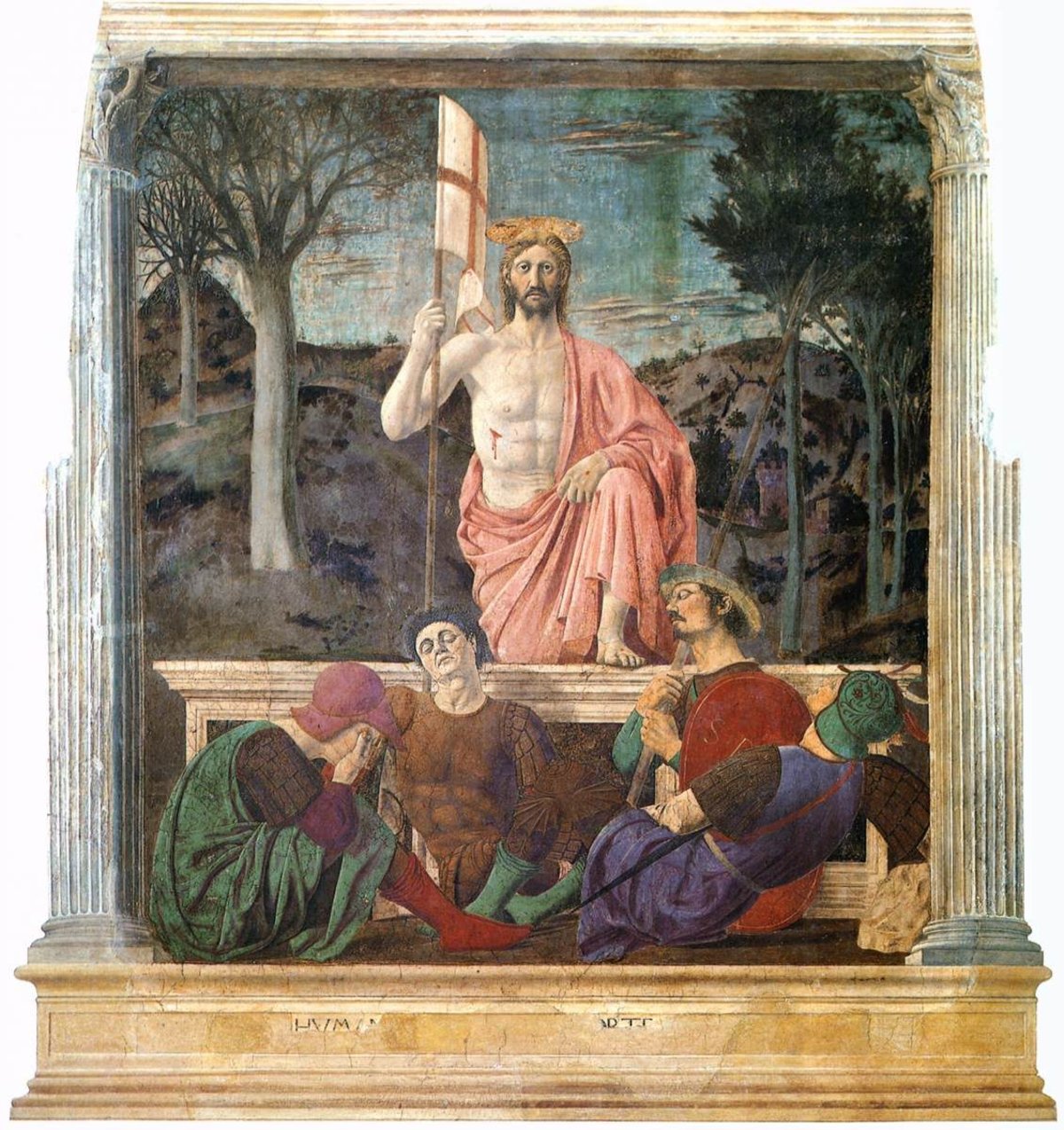
Resurrection of Christ — Piero della Francesca, c.1463-1465
Piero della Francesca, Public domain, via Wikimedia Commons
Piero della Francesca's Resurrection in Sansepolcro is the painting Aldous Huxley called 'the greatest painting in the world' — a fresco (approximately 225 by 200 cm) in the Council Chamber of Sansepolcro's Palazzo Comunale, now the city's museum. The composition shows Christ rising from the tomb at dawn, one foot already raised to step forward out of the stone sarcophagus, holding the banner of the Resurrection, his eyes open and fixed on the viewer with an expression of absolute authority and disturbing directness.
Below him, four sleeping soldiers (among them, traditionally, a self-portrait of Piero in the figure at the lower left) slump against the tomb in various postures of sleep. Behind Christ, the landscape changes from winter (bare trees, frost on the left) to spring (new leaves, green on the right) — the Resurrection is depicted as the hinge point between death and new life in the natural world.
The painting was made for Sansepolcro (Piero's hometown) and has remained there. During World War II, British artillery was positioned to shell Sansepolcro; an officer who had read Huxley's essay on the painting (written in 1925) ordered the guns to halt long enough to confirm that the town's citizens had evacuated.
The town was captured intact — the painting preserved. This story, whether entirely accurate or embellished, captures the work's reputation for overwhelming human significance.
The four soldiers asleep around the tomb are among Piero's finest figure compositions: each is in a different posture of sleep (slumped forward, leaning back, resting on the tomb's edge, tilted sideways), and each represents a different human type. The soldier traditionally identified as Piero himself (lower left, leaning back with eyes closed) has a specific face distinct from the others. The contrast between the sleeping soldiers and the awake, staring Christ is the theological heart of the painting: human unconsciousness (moral sleep, spiritual torpor) in the presence of divine awakening.
When standing before this work, look carefully: Resurrection of Christ — Piero della Francesca, c.1463-1465. Give it time — what seems decorative often carries the central meaning.
When standing before this work, look carefully: Christ's direct gaze — absolute authority. Give it time — what seems decorative often carries the central meaning.
When standing before this work, look carefully: The four sleeping soldiers around the tomb. Give it time — what seems decorative often carries the central meaning.
When standing before this work, look carefully: Winter to spring landscape — the Resurrection in nature. Give it time — what seems decorative often carries the central meaning.
Museo Civico di Sansepolcro, Via Aggiunti 65, Sansepolcro, Tuscany. Open daily (hours vary).
Admission fee. Sansepolcro is approximately 40 km from Arezzo.