
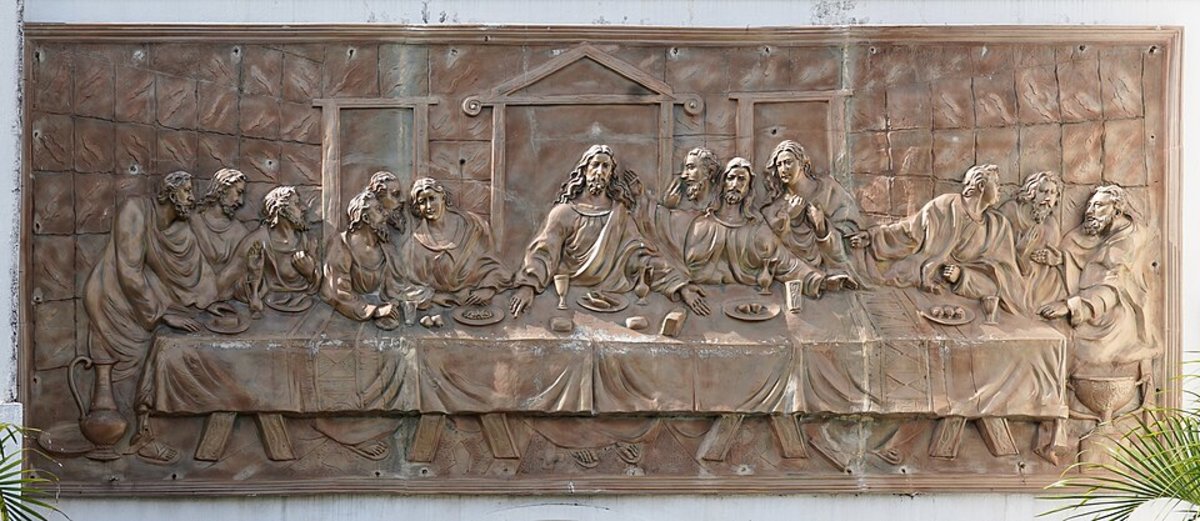
The Sacrament of the Last Supper
The Sacrament of the Last Supper — Dalí, 1955
Salvador Dalí / DACS, Public domain in the US, via Wikimedia Commons
Dalí's Sacrament of the Last Supper is one of the most widely reproduced religious paintings of the 20th century — a large canvas (approximately 167 by 268 cm) showing the Last Supper in a transparent dodecahedral (twelve-faced) architectural space, with Christ at the centre of the table addressing eleven disciples (Judas is absent), the landscape of Port Lligat visible through the transparent walls. The dodecahedron — one of the five Platonic solids, associated by Plato with the cosmos — symbolises the divine order of the universe; the transparency of the architectural space suggests the interpenetration of the sacred and the natural.
Christ's torso is translucent, revealing the landscape behind him — a visual metaphor for the Incarnation (God dwelling in the world, the divine body made of the same substance as the world). A gigantic Christ figure (from whose body the scene is viewed) is implied by a pair of hands and forearms in the upper portion of the composition.
Painted in 1955 during Dalí's 'Nuclear Mysticism' period, the Last Supper combines his religious programme with his engagement with modern physics. The dodecahedral frame references the Platonic tradition of geometric cosmology; the translucent figures reference the atomic theory of matter (all physical objects are primarily empty space). The painting was purchased by Chester Dale for the National Gallery of Art in 1959 and has been one of the most visited works in the collection ever since — its combination of spectacular visual effect and recognisable Christian subject matter makes it accessible to the broadest possible audience.
The painting's central paradox is visual: Christ is both specific (a figure seated at the table) and universal (the enormous implied Christ above, whose body contains the scene). The eleven disciples are depicted with individual expressions and postures but without the specific individuation of Leonardo's version — they are types rather than portraits. The landscape of Port Lligat visible through the transparent walls connects the sacred event to a specific real place — as if the Last Supper happened there, in Dalí's own landscape.
When standing before this work, look carefully: The Sacrament of the Last Supper — Dalí, 1955. Give it time — what seems decorative often carries the central meaning.
When standing before this work, look carefully: The dodecahedral architectural space — cosmic order. Give it time — what seems decorative often carries the central meaning.
When standing before this work, look carefully: The translucent Christ — divinity and matter. Give it time — what seems decorative often carries the central meaning.
When standing before this work, look carefully: Port Lligat landscape through the transparent walls. Give it time — what seems decorative often carries the central meaning.
National Gallery of Art, West Building, Washington DC. Free admission.